

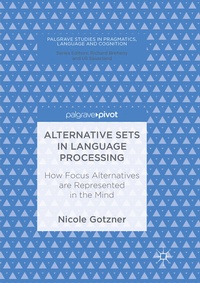
Alternative Sets in Language Processing
How Focus Alternatives are Represented in the Mind
Published on 13. July 2018
Book
Paperback/Softback
XIV, 162 pages
978-3-319-84979-9 (ISBN)
Description
This book presents a novel experimental approach to investigating the mental representation of linguistic alternatives. Combining theoretical and psycholinguistic questions concerning the nature of alternative sets, it sheds new light on the theory of focus and the cognitive mechanisms underlying the processing of alternatives. In a series of language comprehension experiments, the author shows that intonational focus and focus particles such as 'only' shape the representation of alternatives in a listener's mind in a fundamental way. This book is relevant to researchers interested in semantics, pragmatics, language processing and memory.
More details
Series
Edition
Softcover reprint of the original 1st ed. 2017
Language
English
Place of publication
Cham
Switzerland
Publishing group
Springer International Publishing
Target group
Professional and scholarly
Illustrations
3 s/w Abbildungen, 12 farbige Abbildungen
XIV, 162 p. 15 illus., 12 illus. in color.
Dimensions
Height: 210 mm
Width: 148 mm
Thickness: 10 mm
Weight
236 gr
ISBN-13
978-3-319-84979-9 (9783319849799)
DOI
10.1007/978-3-319-52761-1
Schweitzer Classification
Other editions
Additional editions
Nicole Gotzner
Alternative Sets in Language Processing
How Focus Alternatives are Represented in the Mind
Book
02/2017
Palgrave Macmillan
€58.84
Shipment within 10-15 days
Person
Nicole Gotzner is a postdoctoral researcher at the Centre for General Linguistics (ZAS) in Berlin, Germany. She is affiliated with the DFG Priority Programme Xprag.de "New Pragmatic Theories Based on Experimental Evidence". Her research combines semantic and pragmatic theory with language processing and child language acquisition.
Content
Chapter 1. Introduction.- Chapter 2. Theoretical and empirical background.- Chapter 3. Long-term representation of the entire alternative set.- Chapter 4. The mechanisms of activation and competitive inhibition.- Chapter 5. What's included in the set of alternatives?.- Chapter 6. Contrastive pitch accents and focus particles.- Chapter 7. Conclusions.