

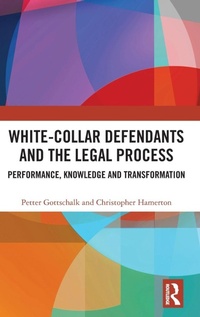
White-Collar Defendants and the Legal Process
Performance, Knowledge and Transformation
1st Edition
Will be published approx. on 18. June 2026
Book
Hardback
222 pages
978-1-032-91332-2 (ISBN)
Description
This book provides a detailed socio-legal examination of the experiences, perceptions, and responses of individual white-collar defendants following the criminal trial process.
White-collar crime is defined both in an offense-based perspective and an offender-based perspective. The offense-based perspective focuses on non-violent acts for financial gain, while the offender-based perspective focuses on members of the elite in society who abuse their professional positions for financial gain. Applying both of these definitions, this book pursues a close comparative analysis of a number of key international white-collar crime case studies. Examining the formal ritual of the criminal legal process, the book considers the experience of defendants within the performative context of the other legal actors in the trial: advocates, judges, and public participants. In doing so, the book offers a nuanced and compelling socio-legal analysis of the process of white-collar trial and punishment, whilst critically exploring the perceptions and experiences of elite defendants within this under-researched area of the public sphere.
This book will appeal to scholars and students of socio-legal studies, corporate law, and criminal justice.
White-collar crime is defined both in an offense-based perspective and an offender-based perspective. The offense-based perspective focuses on non-violent acts for financial gain, while the offender-based perspective focuses on members of the elite in society who abuse their professional positions for financial gain. Applying both of these definitions, this book pursues a close comparative analysis of a number of key international white-collar crime case studies. Examining the formal ritual of the criminal legal process, the book considers the experience of defendants within the performative context of the other legal actors in the trial: advocates, judges, and public participants. In doing so, the book offers a nuanced and compelling socio-legal analysis of the process of white-collar trial and punishment, whilst critically exploring the perceptions and experiences of elite defendants within this under-researched area of the public sphere.
This book will appeal to scholars and students of socio-legal studies, corporate law, and criminal justice.
More details
Language
English
Place of publication
London
United Kingdom
Publishing group
Taylor & Francis Ltd
Target group
College/higher education
Professional and scholarly
Postgraduate
Illustrations
4 s/w Tabellen, 10 s/w Abbildungen, 10 s/w Zeichnungen
4 Tables, black and white; 10 Line drawings, black and white; 10 Illustrations, black and white
Dimensions
Height: 234 mm
Width: 156 mm
Weight
453 gr
ISBN-13
978-1-032-91332-2 (9781032913322)
Copyright in bibliographic data and cover images is held by Nielsen Book Services Limited or by the publishers or by their respective licensors: all rights reserved.
Schweitzer Classification
Other editions
Additional editions
Petter Gottschalk | Christopher Hamerton
White-Collar Defendants and the Legal Process
Performance, Knowledge and Transformation
E-Book
approx. 06/2026
1st Edition
Routledge
€56.49
Available for download
Petter Gottschalk | Christopher Hamerton
White-Collar Defendants and the Legal Process
Performance, Knowledge and Transformation
E-Book
approx. 06/2026
1st Edition
Routledge
€56.49
Available for download
Persons
Petter Gottschalk is Professor in the Department of Leadership and Organizational Behavior at BI Norwegian Business School in Oslo, Norway. After completing his education at Technische Universitaet Berlin, Dartmouth College, MIT, and Henley Management College, he took on executive positions in technology enterprises for 20 years before joining academia. Dr. Gottschalk has published extensively on knowledge management, intelligence strategy, police investigations, white-collar crime, and fraud examinations.
Christopher Hamerton is Programme Director in Criminology and Law at City St George's, University of London, United Kingdom. Educated at the universities of Oxford and Southampton, he holds degrees in law, criminal justice, and history. In addition, he is a Barrister of the Middle Temple and an elected Fellow of both the Royal Anthropological Institute and the Linnean Society of London. Dr. Hamerton is an interdisciplinary and comparative scholar whose research and writing primarily focuses on socio-legal and criminological perspectives on organizational deviance and crime.
Christopher Hamerton is Programme Director in Criminology and Law at City St George's, University of London, United Kingdom. Educated at the universities of Oxford and Southampton, he holds degrees in law, criminal justice, and history. In addition, he is a Barrister of the Middle Temple and an elected Fellow of both the Royal Anthropological Institute and the Linnean Society of London. Dr. Hamerton is an interdisciplinary and comparative scholar whose research and writing primarily focuses on socio-legal and criminological perspectives on organizational deviance and crime.
Content
1. Introduction
2. Public Performance and the Integral Inconvenience of Legal Process
3. Lawyer Knowledge, Professional Advantage, and Performance
4. Guilt, Seriousness and Deferral of Scrutiny
5. Direct Public Participation in White-Collar Censure
6. Legal Process and Reflection: Redemptive Autobiography and White-Collar Offenders
7. Evaluating Defendant Perception: Reactions to Loss of Trust
8 . Organizational Deviance and an Enduring Example of Trial by Media
9. Deconstructing Denial: The Complexities of Executive Misconduct
10.Conclusion
2. Public Performance and the Integral Inconvenience of Legal Process
3. Lawyer Knowledge, Professional Advantage, and Performance
4. Guilt, Seriousness and Deferral of Scrutiny
5. Direct Public Participation in White-Collar Censure
6. Legal Process and Reflection: Redemptive Autobiography and White-Collar Offenders
7. Evaluating Defendant Perception: Reactions to Loss of Trust
8 . Organizational Deviance and an Enduring Example of Trial by Media
9. Deconstructing Denial: The Complexities of Executive Misconduct
10.Conclusion