

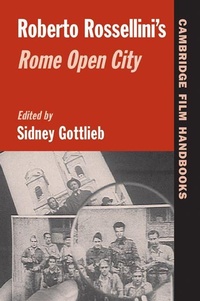
Roberto Rossellini's Rome Open City
Published on 14. June 2004
Book
Paperback/Softback
206 pages
978-0-521-54519-8 (ISBN)
Description
Roberto Rossellini's Rome Open City instantly, markedly, and permanently changed the landscape of film history. Made at the end of World War II, it has been credited with initiating a revolution in and reinvention of modern cinema, bold claims that are substantiated when its impact on how films are conceptualized, made, structured, theorized, circulated, and viewed is examined. This 2004 volume offers a fresh look at the production history of Rome Open City; some of its key images, and particularly its representation of the city and various types of women; its cinematic influences and affinities; the complexity of its political dimensions, including the film's vision of political struggle and the political uses to which the film was put; and the legacy of the film in public consciousness. It serves as a well illustrated, up to date, and accessible introduction to one of the major achievements of filmmaking.
More details
Series
Language
English
Place of publication
Cambridge
United Kingdom
Target group
Professional and scholarly
Product notice
Paperback (trade)
Illustrations
23 Halftones, unspecified
Dimensions
Height: 229 mm
Width: 152 mm
Thickness: 13 mm
Weight
343 gr
ISBN-13
978-0-521-54519-8 (9780521545198)
Copyright in bibliographic data and cover images is held by Nielsen Book Services Limited or by the publishers or by their respective licensors: all rights reserved.
Schweitzer Classification
Person
Sidney Gottlieb is Professor of English and Media Studies at Sacred Heart University in Fairfield, Connecticut. He has edited Hitchcock on Hitchcock: Selected Writings and Interviews and Framing Hitchcock: Essays from the Hitchcock Annual, and serves as Co-Editor of the Hitchcock Annual.
Content
Introduction: Open City: reappropriating the old, making the new Sidney Gottlieb; 1. Rossellini, Open City, and neorealism Sidney Gottlieb; 2. The making of Roma citta aperta: the legacy of fascism and the birth of neorealism Peter Bondanella; 3. Celluloide and the palimpsest of cinematic memory: Carlo Lizzani's film of the story behind Open City Millicent Marcus; 4. Diverting cliches: femininity, masculinity, melodrama, and neorealism in Open City Marcia Landy; 5. Space, rhetoric, and the divided city in Roma citta aperta David Forgacs; 6. Mourning, melancholia, and the popular front: Roberto Rossellini's beautiful revolution Michael P. Rogin; Reviews of Open City; Filmography.