

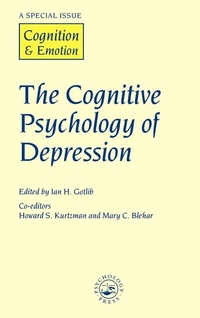
The Cognitive Psychology of Depression
A Special Issue of Cognition and Emotion
Will be published approx. on 27. November 1997
Book
Hardback
186 pages
978-0-86377-973-2 (ISBN)
Description
Of all the psychiatric disorders, depression is by far the most common, affecting between 8 and 18 percent of the general population at some point in their lives. Although the heterogeneity of the affective disorders makes it unlikely that a single set of factors can adequately explain the full range of phenomena associated with depression, there has been a swell of research over the past two decades designed to examine cognitive factors in the etiology, maintenance, and treatment of this disorder.
Whereas early work in this area tended to examine responses of depressed persons to questionnaires assessing cognitions, more recent research has drawn both theoretically and methodologically from experimental cognitive psychology, including work in information processing, social cognition, and cognitive neuropsychology.
In an effort to examine the current state of research and theory in this area, the National Institute of Mental Health held a workshop on "The Cognitive Psychology of Depression" - this special issue is a result of that workshop. The papers represent a wide range of approaches to examining the relation between cognition and depression, and include studies assessing attention, memory, and schematic processing of both self-referential and neutral information, as well as examinations of transient mood effects and underlying brain activity. Moreover, the papers cover a diverse set of samples (including children and young and middle-aged adults, and unipolar depressed, bipolar depressed, and formerly depressed individuals) and encompass a range of severity of depressive symptoms.
Finally, a closing commentary identifies and discusses issues raised by this group of papers, and offers suggestions concerning fruitful directions for future research in the study of cognition and depression.
Whereas early work in this area tended to examine responses of depressed persons to questionnaires assessing cognitions, more recent research has drawn both theoretically and methodologically from experimental cognitive psychology, including work in information processing, social cognition, and cognitive neuropsychology.
In an effort to examine the current state of research and theory in this area, the National Institute of Mental Health held a workshop on "The Cognitive Psychology of Depression" - this special issue is a result of that workshop. The papers represent a wide range of approaches to examining the relation between cognition and depression, and include studies assessing attention, memory, and schematic processing of both self-referential and neutral information, as well as examinations of transient mood effects and underlying brain activity. Moreover, the papers cover a diverse set of samples (including children and young and middle-aged adults, and unipolar depressed, bipolar depressed, and formerly depressed individuals) and encompass a range of severity of depressive symptoms.
Finally, a closing commentary identifies and discusses issues raised by this group of papers, and offers suggestions concerning fruitful directions for future research in the study of cognition and depression.
More details
Series
Language
English
Place of publication
Hove
United Kingdom
Publishing group
Taylor & Francis Ltd
Target group
College/higher education
Dimensions
Height: 235 mm
Width: 157 mm
Thickness: 15 mm
Weight
431 gr
ISBN-13
978-0-86377-973-2 (9780863779732)
Copyright in bibliographic data and cover images is held by Nielsen Book Services Limited or by the publishers or by their respective licensors: all rights reserved.
Schweitzer Classification
Other editions
Additional editions
Book
01/2019
1st Edition
Psychology Press Ltd
€47.70
Shipment within 10-20 days
Person
I.H. Gottlib
Content
I.H. Gotlib, H.S. Kurtzman, M.C. Blehar, The Cognitive Psychology of Depression: Introduction to the Special Issue. Z.V. Segal, M. Gemar, Changes in Cognitive Organisation for Negative Self-referent Material Following Cognitive Behaviour Therapy for Depression: A Primed Stroop Study. E. Gilboa, I.H. Gotlib, Cognitive Biases and Affect Persistence in Previously Dysphoric and Never-dysphoric Individuals. L.B. Alloy, L.Y. Abramson, L.A. Murray, W.G. Whitehouse, M.E. Hogan, Self-referent Information-processing in Individuals at High and Low Cognitive Risk for Depression. P.T. Hertel, On the Contributions of Deficient Cognitive Control to Memory Impairments in Depression. J. Miranda, J.I. Gross, Cognitive Vulnerability, Depression, and the Mood-state Dependent Hypothesis: Is Out of Sight Out of Mind? E. Eich, D. Macaulay, R.W. Lam, Mania, Depression, and Mood Dependent Memory. J. Garber, N.S. Robinson, Cognitive Vulnerability in Children at Risk for Depression. W. Heller, J.B. Nitschke, Regional Brain Activity in Emotion: A Framework for Understanding Cognition in Depression. I.H. Gotlib, H.S. Kurtzman, M.C. Blehar, Cognition and Depression: Issues and Future Directions.