

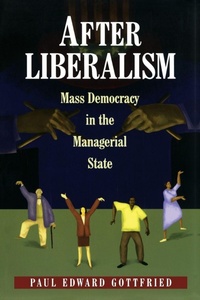
After Liberalism
Mass Democracy in the Managerial State
Published on 22. July 2001
Book
Paperback/Softback
200 pages
978-0-691-08982-9 (ISBN)
Description
In this trenchant challenge to social engineering, Paul Gottfried analyzes a patricide: the slaying of nineteenth-century liberalism by the managerial state. Many people, of course, realize that liberalism no longer connotes distributed powers and bourgeois moral standards, the need to protect civil society from an encroaching state, or the virtues of vigorous self-government. Many also know that today's "liberals" have far different goals from those of their predecessors, aiming as they do largely to combat prejudice, to provide social services and welfare benefits, and to defend expressive and "lifestyle" freedoms. Paul Gottfried does more than analyze these historical facts, however. He builds on them to show why it matters that the managerial state has replaced traditional liberalism: the new regimes of social engineers, he maintains, are elitists, and their rule is consensual only in the sense that it is unopposed by any widespread organized opposition. Throughout the western world, increasingly uprooted populations unthinkingly accept centralized controls in exchange for a variety of entitlements.
In their frightening passivity, Gottfried locates the quandary for traditionalist and populist adversaries of the welfare state. How can opponents of administrative elites show the public that those who provide, however ineptly, for their material needs are the enemies of democratic self-rule and of independent decision making in family life? If we do not wake up, Gottfried warns, the political debate may soon be over, despite sporadic and ideologically confused populist rumblings in both Europe and the United States.
In their frightening passivity, Gottfried locates the quandary for traditionalist and populist adversaries of the welfare state. How can opponents of administrative elites show the public that those who provide, however ineptly, for their material needs are the enemies of democratic self-rule and of independent decision making in family life? If we do not wake up, Gottfried warns, the political debate may soon be over, despite sporadic and ideologically confused populist rumblings in both Europe and the United States.
Reviews / Votes
"After Liberalism is no angry screed, but a dense, probing work full of insight from the author's seeming encyclopedic knowledge of Western thought."--World "The central fact of the nineteenth century was the emergence of the working class. The central fact of the twentieth century is the emergence of a managerial "New Class" elite, reshaping all modern democracies in its own interest. Gottfried's is a gold-standard analysis of this extraordinary phenomenon, heavily encrusted with sparkling jewels of intellectual history."--Peter Brimelow, Senior Editor, Forbes Magazine "Well-written, very learned, and informative."--Paul Seaton, SocietyMore details
Series
Language
English
Place of publication
New Jersey
United States
Target group
Professional and scholarly
College/higher education
Product notice
Paperback (trade)
Dimensions
Height: 234 mm
Width: 156 mm
Thickness: 13 mm
Weight
353 gr
ISBN-13
978-0-691-08982-9 (9780691089829)
Copyright in bibliographic data and cover images is held by Nielsen Book Services Limited or by the publishers or by their respective licensors: all rights reserved.
Schweitzer Classification
Other editions
Additional editions
E-Book
07/2001
1st Edition
Princeton University Press
from
€137.95
Available for download
Person
Paul Edward Gottfried is Professor of Humanities at Elizabethtown College and author of, among other books, Carl Schmitt: Politics and Theory, The Search for Historical Meaning; and The Conservative Movement. Editor in chief of This World, he is also a senior editor of Telos and a contributing editor to Chronicles and Humanitas.
Content
Introduction vii CHAPTER ONE In Search of a Liberal Essence 3 CHAPTER TWO Liberalism vs. Democracy 30 CHAPTER THREE Public Administration and Liberal Democracy 49 CHAPTER FOUR Pluralism and Liberal Democracy 72 CHAPTER FIVE Mass Democracy and the Populist Alternative 110 CONCLUSION 135 Notes 143 Index 177