

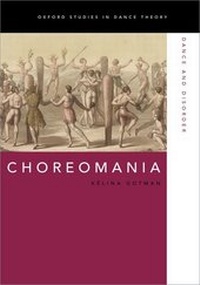
Choreomania
Dance and Disorder
Published on 22. February 2018
Book
Paperback/Softback
384 pages
978-0-19-084042-6 (ISBN)
Description
When political protest is read as epidemic madness, religious ecstasy as nervous disease, and angular dance moves as dark and uncouth, the disorder being described is choreomania. At once a catchall term to denote spontaneous gestures and the unruly movements of crowds, choreomania emerged in the nineteenth century at a time of heightened class conflict, nationalist policy, and colonial rule. In this book, author Kelina Gotman examines these choreographies of unrest, rethinking the modern formation of the choreomania concept as it moved across scientific and social scientific disciplines. Reading archives describing dramatic misformationsof bodies and body politicsshe shows how prejudices against expressivity unravel, in turn revealing widespread anxieties about demonstrative agitation. This history of the fitful body complements stories of nineteenth-century discipline and regimentation. As she notes, constraints on movement imply constraints on political power and agency. In each chapter, Gotman confronts the many ways choreomania works as an extension of discourses shaping colonialist orientalism, which alternately depict riotous bodies as dangerously infected others, and as curious bacchanalian remains. Through her research, Gotman also shows how beneath the radar of this colonial discourse, men and women gathered together to repossess on their terms the gestures of social revolt.
Reviews / Votes
[...] what Gotman accomplishes in the process is a daring negotiation with the history of 'movement', one that persuades her readers to imagine the possibilities inherent in the sight of bodies dancing beyond the rigid confines of the ordinary - outside, perhaps, the onward march of late capitalism - and into states of dissent, disruption, and ecstatic disorder. * Megan Girdwood, The Cambridge Quarterly * choreomania encourages broader notions of how discourse on dance is produced and reproduced in order to better understand dance's political and social potential. * Tessa Nun, Comparative Literature Studies * Choreomania is as progressive in its historical methodologies as it is in its provocative analyses of heretofore undertheorized modes of movement, dance and gesture. I have no doubt that it will deeply impact dance and performance studies as a pathbreaking analysis of social bodies in motion as well as an inspiring example of how the durable roots of rigorous critical and historical methodologies strengthen scholarship that stretches so far across geography and time. * Rebecca Chaleff, Theatre Research International * [Choreomania] is a significant contribution to theatre and performance studies methodologies, advancing a historiographical method that attends to movement, motility, kinetics, dynamics, efforts, push, and pull...It is exciting to imagine what new research Choreomania will make possible. * Broderick D. V. Chow, Royal Central School of Speech & Drama, Contemporary Theatre Review * Choreomania is consistently enlightening and Provocative. * Megan Girdwood, Cambridge Quarterly *More details
Series
Language
English
Place of publication
New York
United States
Target group
Professional and scholarly
Illustrations
23 halftones
Dimensions
Height: 178 mm
Width: 251 mm
Thickness: 25 mm
Weight
672 gr
ISBN-13
978-0-19-084042-6 (9780190840426)
Copyright in bibliographic data and cover images is held by Nielsen Book Services Limited or by the publishers or by their respective licensors: all rights reserved.
Schweitzer Classification
Other editions
Additional editions

Book
02/2018
Oxford University Press Inc
€193.90
Shipment within 15-20 days
E-Book
12/2017
1st Edition
OUP eBook
€40.49
Available for download
E-Book
12/2017
1st Edition
OUP eBook
€40.49
Available for download
Person
Kelina Gotman is Lecturer in Theatre and Performance Studies at King's College London. She is translator among others of Felix Guattari's The Anti-Oedipus Papers (2006) and collaborates widely on dance and theatre productions in Europe and North America.
Content
CONTENTS
List of illustrations
Foreword
Preface
Acknowledgments
Introduction: Choreomania, Another Orientalism
Part I: Excavating Dance in the Archives
1. Obscuritas Antiquitatis: Institutions, Affiliations, Marginalia
2. Madness after Foucault: Medieval Bacchanals
3. Translatio: St. Vitus's Dance, Demonism and the Early Modern
4. The Convulsionaries: Antics on the French Revolutionary Stage
5. Mobiles, Mobs and Monads: Nineteenth-Century Crowd Forms
6. Medecine Retrospective: Hysteria's Archival Drag
Part II: Colonial and Postcolonial Stages: Scenes of Ferment in the Field
7. "Sicily Implies Asia and Africa": Tarantellas and Comparative Method
8. Ecstasy-belonging in Madagascar and Brazil
9. Ghost Dancing: Excess, Waste and the American West
10. "The Gift of Seeing Resemblances": Cargo Cults in the Antipodes
11. Monstrous Grace: Blackness and the New Dance "Crazes"
12. Coda: Moving Fields, Modernity and the Bacchic Chorus
Bibliography
List of illustrations
Foreword
Preface
Acknowledgments
Introduction: Choreomania, Another Orientalism
Part I: Excavating Dance in the Archives
1. Obscuritas Antiquitatis: Institutions, Affiliations, Marginalia
2. Madness after Foucault: Medieval Bacchanals
3. Translatio: St. Vitus's Dance, Demonism and the Early Modern
4. The Convulsionaries: Antics on the French Revolutionary Stage
5. Mobiles, Mobs and Monads: Nineteenth-Century Crowd Forms
6. Medecine Retrospective: Hysteria's Archival Drag
Part II: Colonial and Postcolonial Stages: Scenes of Ferment in the Field
7. "Sicily Implies Asia and Africa": Tarantellas and Comparative Method
8. Ecstasy-belonging in Madagascar and Brazil
9. Ghost Dancing: Excess, Waste and the American West
10. "The Gift of Seeing Resemblances": Cargo Cults in the Antipodes
11. Monstrous Grace: Blackness and the New Dance "Crazes"
12. Coda: Moving Fields, Modernity and the Bacchic Chorus
Bibliography