

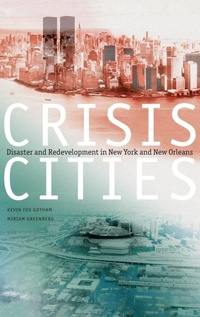
Crisis Cities
Disaster and Redevelopment in New York and New Orleans
Published on 17. April 2014
Book
Hardback
352 pages
978-0-19-975222-5 (ISBN)
Description
Crisis Cities blends critical theoretical insight with a historically grounded comparative study to examine the form, trajectory, and contradictions of redevelopment efforts following the 9/11 and Hurricane Katrina disasters. Based on years of research in the two cities, Gotham and Greenberg contend that New York and New Orleans have emerged as paradigmatic crisis cities, representing a free-market approach to post-disaster redevelopment that is increasingly dominant for crisis-stricken cities around the world. This approach, which Gotham and Greenberg term crisis driven urbanization, emphasizes the privatization of disaster aid and resources, the devolution of disaster recovery responsibilities to the local state, and the use of generous tax incentives to bolster revitalization. Crisis driven urbanization also involves global branding campaigns and public media events to repair a city's image for business and tourism, as well as internally-focused political campaigns and events that associate post-crisis political leaders and public-private partnerships with this revitalized urban image.
By focusing on past and present conditions in New York and New Orleans, Gotham and Greenberg show how crises expose long-neglected injustices, underlying power structures, and social inequalities. In doing so, they reveal the impact of specific policy reforms, public-private actions, and socio-legal regulatory strategies on the creation and reproduction of risk and vulnerability to disasters. Crisis Cities questions the widespread narrative of resilience and reveals the uneven and contradictory effects of redevelopment activities in the two cities.
By focusing on past and present conditions in New York and New Orleans, Gotham and Greenberg show how crises expose long-neglected injustices, underlying power structures, and social inequalities. In doing so, they reveal the impact of specific policy reforms, public-private actions, and socio-legal regulatory strategies on the creation and reproduction of risk and vulnerability to disasters. Crisis Cities questions the widespread narrative of resilience and reveals the uneven and contradictory effects of redevelopment activities in the two cities.
Reviews / Votes
Crisis Cities is a very valuable academic contribution to studies of post-disaster rebuilding. It encourages the reader to ask the important normative question recovery for whom?. The book builds an important bridge between critical urban and geographical theory and literature on disaster. It adds important empirical material to earlier accounts on disaster capitalism (Klein, 2007) by taking into consideration the historical development of social disadvantages. * Henrik Jacobsen, Urban Studies * Every urban crisis is also an opportunity, and in this penetrating study of post-disaster New York and New Orleans, Kevin Gotham and Miriam Greenberg show how and why the market-model of redevelopment does so little for the people and places that need it most. Crisis Cities is insightful, sophisticated, and, alas, timely. It belongs not only in the classroom, but on every mayor's desk. * Eric Klinenberg, author of Heat Wave and Going Solo * In this wide-ranging and carefully researched book, Gotham and Greenberg explore the crisis-driven strategies of urbanization that have been pursued in two major post-disaster U.S. cities and their deeply uneven, polarizing and destructive impacts upon the social and ecological fabric. A fundamental and original analysis of early twenty-first century urban transformations in the age of disaster capitalism, this book is a superb demonstration of how the methods of critical urban studies can illuminate the powerful social, political, economic and ideological forces that are reshaping cities and regions today. * Neil Brenner, Professor of Urban Theory, Harvard Graduate School of Design * Crisis Cities is a critical revelation of the political and economic forces that direct the resources offered to cities after catastrophes. The authors clearly show how the resources are not necessarily directed to the rebuilding and recovery projects that serve all segments of the communities and would provide a successful collective future. Drawing on catastrophes in two well-known American cities the dangers of this common path are clearly presented. * Shirley Laska, Professor Emerita of Sociology, University of New Orleans *More details
Language
English
Place of publication
New York
United States
Target group
College/higher education
Professional and scholarly
Illustrations
31 illustrations
Dimensions
Height: 240 mm
Width: 161 mm
Thickness: 23 mm
Weight
690 gr
ISBN-13
978-0-19-975222-5 (9780199752225)
Copyright in bibliographic data and cover images is held by Nielsen Book Services Limited or by the publishers or by their respective licensors: all rights reserved.
Schweitzer Classification
Other editions
Additional editions
Kevin Fox Gotham | Miriam Greenberg
Crisis Cities
Disaster and Redevelopment in New York and New Orleans
Book
04/2014
Oxford University Press Inc
€56.60
Shipment within 15-20 days
Kevin Fox Gotham | Miriam Greenberg
Crisis Cities
Disaster and Redevelopment in New York and New Orleans
E-Book
04/2014
1st Edition
OUP eBook
€25.49
Available for download
Persons
Kevin Fox Gotham is Professor of Sociology at Tulane University. Miriam Greenberg is Associate Professor of Sociology at the University of California, Santa Cruz.
Content
Preface ; List of Acronyms ; Chapter 1: Introduction: Comparing the Incomparable: Towards a Theory of Crisis Cities ; Chapter 2: "Tighten Your Belts and Bite the Bullet": The Legacy of Urban Crisis in New York and New Orleans ; Chapter 3: Constructing the Tabula Rasa: Framing and the Political Construction of Crisis ; Chapter 4: Crisis as Opportunity: Tracing the Contentious Spatial Politics of Redevelopment ; Chapter 5: Landscapes of Risk and Resilience: From Lower Manhattan to the Lower Ninth Ward ; Chapter 6: Re-Branding the "Big Apple" and the "Big Easy": Representations of Crisis and Crises of Representation ; Chapter 7: Conclusion: Lessons In the Wake of New York and New Orleans ; Notes ; References ; Index