

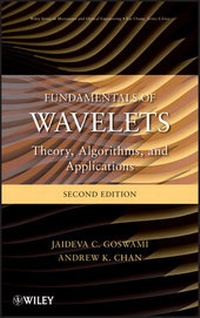
Fundamentals of Wavelets
Theory, Algorithms, and Applications
2nd Edition
Published on 21. January 2011
Book
Hardback
360 pages
978-0-470-48413-5 (ISBN)
Description
Most existing books on wavelets are either too mathematical or they focus on too narrow a specialty. This book provides a thorough treatment of the subject from an engineering point of view. It is a one-stop source of theory, algorithms, applications, and computer codes related to wavelets. This second edition has been updated by the addition of:
* a section on "Other Wavelets" that describes curvelets, ridgelets, lifting wavelets, etc
* a section on lifting algorithms
* Sections on Edge Detection and Geophysical Applications
* Section on Multiresolution Time Domain Method (MRTD) and on Inverse problems
Reviews / Votes
"This book provides a thorough treatment of wavelet theory and is very convenient for graduate students and researchers in electrical engineering, physics, and applied mathematics." (Zentralblatt MATH, 2011)More details
Series
Edition
2. Auflage
Language
English
Place of publication
New York
United States
Target group
College/higher education
Product notice
sewn/stitched
Paper over boards
Dimensions
Height: 240 mm
Width: 161 mm
Thickness: 25 mm
Weight
742 gr
ISBN-13
978-0-470-48413-5 (9780470484135)
Schweitzer Classification
Other editions
Additional editions

E-Book
03/2011
2nd Edition
Wiley
€125.99
Available for download

E-Book
11/2010
2nd Edition
Wiley
€125.99
Available for download
Previous edition
Book
02/1999
1st Edition
Wiley
€109.00
Article exhausted; check for reprint
Persons
Jaideva C. Goswami, PhD, is an Engineering Advisor at Schlumberger in Sugarland, Texas. He is also a former professor of Electronics and Communication Engineering at the Indian Institute of Technology, Kharagpur. Dr. Goswami has taught several short courses on wavelets and contributed to the Wiley Encyclopedia of Electrical and Electronics Engineering as well as Wiley Encyclopedia of RF and Microwave Engineering. He has many research papers and patents to his credit, and is a Fellow of IEEE.
Andrew K. Chan, PhD, is on the faculty of Texas A&M University and is the coauthor of Wavelets in a Box and Wavelet Toolware. He is a Life Fellow of IEEE.
Andrew K. Chan, PhD, is on the faculty of Texas A&M University and is the coauthor of Wavelets in a Box and Wavelet Toolware. He is a Life Fellow of IEEE.
Content
1.What is this book all about?
2. Mathematical Preliminary.
2.1 Linear Spaces.
2.2 Vectors and Vector Spaces.
2.3 Basis Functions, Orthogonality and Biothogonality.
2.4 Local Basis and Riesz Basis.
2.5 Discrete Linear Normed Space.
2.6 Approximation by Orthogonal Projection.
2.7 Matrix Algebra and Linear Transformation.
2.8 Digital Signals.
2.9 Exercises.
2.10 References.
3. Fourier Analysis.
3.1 Fourier Series.
3.2 Rectified Sine Wave.
3.3 Fourier Transform.
3.4 Properties of Fourier Transform.
3.5 Examples of Fourier Transform.
3.6 Poisson's Sum and Partition of ZUnity.
3.7 Sampling Theorem.
3.8 Partial Sum and Gibb's Phenomenon.
3.9 Fourier Analysis of Discrete-Time Signals.
3.10 Discrete Fourier Transform (DFT).
3.11 Exercise.
3.12 References.
4. Time-Frequency Analysis.
4.1 Window Function.
4.2 Short-Time Fourier Transform.
4.3 Discrete Short-Time Fourier Transform.
4.4 Discrete Gabor Representation.
4.5 Continuous Wavelet Transform.
4.6 Discrete Wavelet Transform.
4.7 Wavelet Series.
4.8 Interpretations of the Time-Frequency Plot.
4.9 Wigner-Ville Distribution.
4.10 Properties of Wigner-Ville Distribution.
4.11 Quadratic Superposition Principle.
4.12 Ambiguity Function.
4.13 Exercise.
4.14 Computer Programs.
4.15 References.
5. Multiresolution Anaylsis.
5.1 Multiresolution Spaces.
5.2 Orthogonal, Biothogonal, and Semiorthogonal Decomposition.
5.3 Two-Scale Relations.
5.4 Decomposition Relation.
5.5 Spline Functions and Properties.
5.6 Mapping a Function into MRA Space.
5.7 Exercise.
5.8 Computer Programs.
5.9 References.
6. Construction of Wavelets.
6.1 Necessary Ingredients for Wavelet Construction.
6.2 Construction of Semiorthogonal Spline Wavelets.
6.3 Construction of Orthonormal Wavelets.
6.4 Orthonormal Scaling Functions.
6.5 Construction of Biothogonal Wavelets.
6.6 Graphical Display of Wavelet.
6.7 Exercise.
6.8 Computer Programs.
6.9 References.
7. DWT and Filter Bank Algorithms.
7.1 Decimation and Interpolation.
7.2 Signal Representation in the Approximation Subspace.
7.3 Wavelet Decomposition Algorithm.
7.4 Reconstruction Algorithm.
7.5 Change of Bases.
7.6 Signal Reconstruction in Semiorthogonal Subspaces.
7.7 Examples.
7.8 Two-Channel Perfect Reconstruction Filter Bank.
7.9 Polyphase Representation for Filter Banks.
7.10 Comments on DWT and PR Filter Banks.
7.11 Exercise.
7.12 Computer Program.
7.13 References.
8. Special Topics in Wavelets and Algorithms.
8.1 Fast Integral Wavelet Transform.
8.2 Ridgelet Transform.
8.3 Curvelet Transform.
8.4 Complex Wavelets.
8.5 Lifting Wavelet transform.
8.6 References.
9. Digital Signal Processing Applications.
9.1 Wavelet Packet.
9.2 Wavelet-Packet Algorithms.
9.3 Thresholding.
9.4 Interference Suppression.
9.5 Faulty Bearing Signature Identification.
9.6 Two-Dimensional Wavelets and Wavelet Packets.
9.7 Edge Detection.
9.8 Image Compression.
9.9 Microcalcification Cluster Detection.