

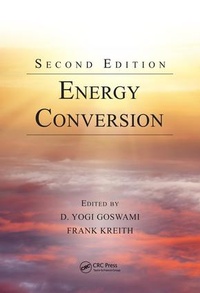
Energy Conversion
2nd Edition
Published on 22. June 2017
Book
Hardback
1193 pages
978-1-4665-8482-2 (ISBN)
Description
This handbook surveys the range of methods and fuel types used in generating energy for industry, transportation, and heating and cooling of buildings. Solar, wind, biomass, nuclear, geothermal, ocean and fossil fuels are discussed and compared, and the thermodynamics of energy conversion is explained. Appendices are provided with fully updated data. Thoroughly revised, this second edition surveys the latest advances in energy conversion from a wide variety of currently available energy sources. It describes energy sources such as fossil fuels, biomass (including refuse-derived biomass fuels), nuclear, solar radiation, wind, geothermal, and ocean, then provides the terminology and units used for each energy resource and their equivalence. It includes an overview of the steam power cycles, gas turbines, internal combustion engines, hydraulic turbines, Stirling engines, advanced fossil fuel power systems, and combined-cycle power plants. It outlines the development, current use, and future of nuclear power.
Reviews / Votes
The second edition of Energy Conversion is an excellent resource, as there is growing interest in the substitution of renewable energy sources for fossil fuels. The book is divided into two sections- "Energy Resources" and "Energy Conversion." The first section presents a good review of current energy sources such as fossil fuels, biomass, municipal solid waste, nuclear, solar, wind, and geothermal. Under each topic, the availability of the resources, production, transportation, and environmental features are discussed. The second section covers energy conversion from different technologies to power/work. Some of the topics covered in this section include gas turbines, internal combustion engines, hydraulic turbines, advanced fossil fuel power systems, nuclear fusion, energy storage technologies, solar thermal energy conversion, wind energy conversion, biomass conversion process, waste-to-energy combustion, fuel cells, and direct energy conversion. Each chapter offers a general review of the topic and relevant scientific fundamentals, followed by technology applications.-CHOICE, March 2018
More details
Series
Edition
2nd edition
Language
English
Place of publication
Bosa Roca
United States
Publishing group
Taylor & Francis Inc
Target group
Professional and scholarly
Illustrations
510 s/w Abbildungen, 171 s/w Tabellen
171 Tables, black and white; 510 Illustrations, black and white
Dimensions
Height: 254 mm
Width: 178 mm
Weight
2020 gr
ISBN-13
978-1-4665-8482-2 (9781466584822)
Copyright in bibliographic data and cover images is held by Nielsen Book Services Limited or by the publishers or by their respective licensors: all rights reserved.
Schweitzer Classification
Other editions
Additional editions
D. Yogi Goswami | Frank Kreith
Energy Conversion
E-Book
07/2017
2nd Edition
CRC Press
€337.99
Available for download
D. Yogi Goswami | Frank Kreith
Energy Conversion
E-Book
07/2017
2nd Edition
CRC Press
€337.99
Available for download
Previous edition
D. Yogi Goswami | Frank Kreith
Energy Conversion
Book
05/2007
1st Edition
CRC Press
€209.47
Article exhausted; check for reprint
Persons
D. Yogi Goswami is a distinguished university professor and director of the Clean Energy Research Center at the University of South Florida. He conducts fundamental and applied research on solar thermal power and cooling, photocatalytic detoxification and disinfection, thermodynamics, third-generation photovoltaics, and hydrogen production and storage. Professor Goswami is the editor in chief of Solar Energy and Progress in Solar Energy. He has published as an author or editor 19 books and more than 375 refereed technical papers. He also holds 17 patents, some of which have been successfully commercialized.
Frank Kreith is professor emeritus of engineering at the University of Colorado, Boulder, USA. He received his MS in engineering from the University of California, Los Angeles, and his doctorate from the University of Paris in 1964. From 1953 to 1959 he was associate professor of mechanical engineering at Lehigh University, Bethlehem, Pennsylvania, USA. In 1959, he joined the University of Colorado, where he held appointments as professor of mechanical and chemical engineering. He was senior research fellow at the Solar Energy Research Institute, and has consulted for NATO, the U.S. Agency of International Development, and the United Nations. Dr. Kreith was recently awarded the Association of Engineering Societies' 2016 John Fritz Medal for his achievements in the advancement of solar energy.
Frank Kreith is professor emeritus of engineering at the University of Colorado, Boulder, USA. He received his MS in engineering from the University of California, Los Angeles, and his doctorate from the University of Paris in 1964. From 1953 to 1959 he was associate professor of mechanical engineering at Lehigh University, Bethlehem, Pennsylvania, USA. In 1959, he joined the University of Colorado, where he held appointments as professor of mechanical and chemical engineering. He was senior research fellow at the Solar Energy Research Institute, and has consulted for NATO, the U.S. Agency of International Development, and the United Nations. Dr. Kreith was recently awarded the Association of Engineering Societies' 2016 John Fritz Medal for his achievements in the advancement of solar energy.
Content
Preface. Contributors. Global Energy Systems. Fossil Fuels. Biomass Properties and Resources. Municipal Solid Waste. Nuclear Resources. Solar Energy Resources. Wind Energy Resource. Geothermal Energy. Steam Power Plant. Gas Turbines. Internal Combustion Engines. Hydraulic Turbines. Advanced Fossil Fuel Power Systems. Stirling Engines. Nuclear Power Technologies through Year 2035. Nuclear Fusion. Energy Storage Technologies. Solar Thermal Energy Conversion. Concentrating Solar Thermal Power. Photovoltaics Fundamentals, Technology and Application. Wind Energy Conversion. Biomass Conversion Process for Energy Recovery. Geothermal Power Generation. Waste-to-Energy Combustion. Fuel Cells. Direct Energy Conversion. Appendix A: The International System of Units, Fundamental Constants, and Conversion Factors. Appendix B: Solar Radiation Data. Appendix C: Properties of Gases, Vapors, Liquids, and Solids. Appendix D: Ultimate Analysis of Biomass Fuels. Index.