

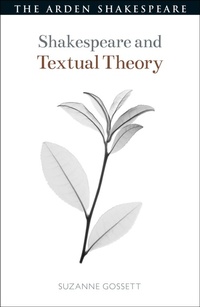
Shakespeare and Textual Theory
Published on 10. February 2022
Book
Hardback
272 pages
978-1-350-12124-9 (ISBN)
Description
There is no Shakespeare without text. Yet readers often do not realize that the words in the book they hold, like the dialogue they hear from the stage, has been revised, augmented and emended since Shakespeare's lifetime. An essential resource for the history of Shakespeare on the page, Shakespeare and Textual Theory traces the explanatory underpinnings of these changes through the centuries.
After providing an introduction to early modern printing practices, Suzanne Gossett describes the original quartos and folios as well as the first collected editions. Subsequent sections summarize the work of the 'New Bibliographers' and the radical challenge to their technical analysis posed by poststructuralist theory, which undermined the presumed stability of author and text. Shakespeare and Textual Theory presents a balanced view of the current theoretical debates, which include the nature of the surviving texts we call Shakespeare's; the relationship of the author 'Shakespeare' and of authorial intentions to any of these texts; the extent and nature of Shakespeare's collaboration with others; and the best or most desirable way to present the texts - in editions or performances. The book is illustrated throughout with examples showing how theoretical decisions affect the text of Shakespeare's plays, and case studies of Hamlet and Pericles demonstrate how different theories complicate both text and meaning, whether a play survives in one version or several. The conclusion summarizes the many ways in which beliefs about Shakespeare's texts have changed over the centuries.
After providing an introduction to early modern printing practices, Suzanne Gossett describes the original quartos and folios as well as the first collected editions. Subsequent sections summarize the work of the 'New Bibliographers' and the radical challenge to their technical analysis posed by poststructuralist theory, which undermined the presumed stability of author and text. Shakespeare and Textual Theory presents a balanced view of the current theoretical debates, which include the nature of the surviving texts we call Shakespeare's; the relationship of the author 'Shakespeare' and of authorial intentions to any of these texts; the extent and nature of Shakespeare's collaboration with others; and the best or most desirable way to present the texts - in editions or performances. The book is illustrated throughout with examples showing how theoretical decisions affect the text of Shakespeare's plays, and case studies of Hamlet and Pericles demonstrate how different theories complicate both text and meaning, whether a play survives in one version or several. The conclusion summarizes the many ways in which beliefs about Shakespeare's texts have changed over the centuries.
Reviews / Votes
[A] clearly written and useful explanation of the state of Shakespeare and Textual Theory. * The Year's Work in English Studies * Gossett's breadth of knowledge allows readers to move easily between Shakespeare's time and the last two centuries of criticism ... She treats the reader to stylistic clarity, grace in advancing herideas, and economy of exposition. * Shakespeare Quarterly * The breadth of [Gossett's] scholarly knowledge, the depth of her editorial experience, and the quality of her pedagogical aptitude are all strongly evident in the book and, combined, produce a text that serves as a useful reference for the seasoned Shakespearean as well as an invaluable tool for the neophyte textual scholar. * Textual Cultures *
More details
Series
Language
English
Place of publication
London
United Kingdom
Publishing group
Bloomsbury Publishing PLC
Target group
College/higher education
Illustrations
6 bw illus
Dimensions
Height: 209 mm
Width: 132 mm
Thickness: 18 mm
Weight
387 gr
ISBN-13
978-1-350-12124-9 (9781350121249)
Copyright in bibliographic data and cover images is held by Nielsen Book Services Limited or by the publishers or by their respective licensors: all rights reserved.
Schweitzer Classification
Persons
Suzanne Gossett is Professor Emerita of English at Loyola University Chicago, USA. Her publications include essays on theatrical collaboration, Shakespeare's late plays, and textual editing. She is a General Textual Editor of the Norton Shakespeare, 3rd edition, and a General Editor of Arden Early Modern Drama. She has edited many plays by Shakespeare and his contemporaries, including Pericles and All's Well That Ends Well for the Arden Shakespeare, Middleton's A Fair Quarrel for the Collected Middleton, and Beaumont and Fletcher's Philaster for Arden Early Modern Drama. She is a past president of the Shakespeare Association of America and, together with Dympna Callaghan, she edited Shakespeare in Our Time in honor of the 2016 anniversary year.
Content
Series Editor's Preface
Acknowledgements
Introduction
Part One: Textual Studies Before 'Theory'
1 Shakespeare's Texts From the Sixteenth to the
Nineteenth Century
The progress of an early modern play
The First Folio
Successive Folios
Early editions
Part Two: Twentieth-Century Theories
2 The New Bibliography
3 The Advent of Poststructuralism
4 Textual and Other Theories
Part Three: Current Debates
5 Authorship, Agency, and Intentionality
6 Attribution and Collaboration
External evidence
Internal evidence
Enlarging the canon
Theoretical implications
7 The (In)Stability of the Text
What if the printer went to lunch?
Why are some texts bad?
Why - and how and when - do some texts change?
8 Editing and Unediting
Editing Shakespeare
Editing collaborations
Unediting Shakespeare
Deciding on intervention
9 Book History and the Text
Shakespeare as literary dramatist
The creation of 'Shakespeare' through books
Readers, commonplacers and collectors
Women and Shakespeare books
Two material texts
10 Performance and the Text
Traces of early performance
Editing for performance
11 Textual Theories and Difficult Cases: Hamlet
and Pericles
Shakespeare's texts and early editions
Enter the New Bibliography
The challenge of post-structuralism, or authorship,
authority, and intention
Textual and other theories
Attribution and collaboration
Printing unstable texts
Editing and unediting
Book history and the text
Performance and the text
Coda: The Immaterial Text
12 Textual Studies After the Digital Turn
References
Index
Acknowledgements
Introduction
Part One: Textual Studies Before 'Theory'
1 Shakespeare's Texts From the Sixteenth to the
Nineteenth Century
The progress of an early modern play
The First Folio
Successive Folios
Early editions
Part Two: Twentieth-Century Theories
2 The New Bibliography
3 The Advent of Poststructuralism
4 Textual and Other Theories
Part Three: Current Debates
5 Authorship, Agency, and Intentionality
6 Attribution and Collaboration
External evidence
Internal evidence
Enlarging the canon
Theoretical implications
7 The (In)Stability of the Text
What if the printer went to lunch?
Why are some texts bad?
Why - and how and when - do some texts change?
8 Editing and Unediting
Editing Shakespeare
Editing collaborations
Unediting Shakespeare
Deciding on intervention
9 Book History and the Text
Shakespeare as literary dramatist
The creation of 'Shakespeare' through books
Readers, commonplacers and collectors
Women and Shakespeare books
Two material texts
10 Performance and the Text
Traces of early performance
Editing for performance
11 Textual Theories and Difficult Cases: Hamlet
and Pericles
Shakespeare's texts and early editions
Enter the New Bibliography
The challenge of post-structuralism, or authorship,
authority, and intention
Textual and other theories
Attribution and collaboration
Printing unstable texts
Editing and unediting
Book history and the text
Performance and the text
Coda: The Immaterial Text
12 Textual Studies After the Digital Turn
References
Index