

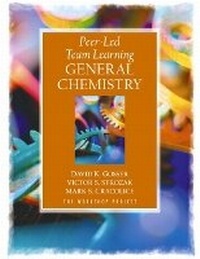
Peer-Led Team Learning
General Chemistry
Published on 24. April 2001
Book
Paperback/Softback
320 pages
978-0-13-028806-6 (ISBN)
Description
Peer-Led Team Learning is an innovative model in science education. Student-leaders (peers) guide the activities of small groups of students in weekly Workshop meetings. The students work through challenging problems that are designed to be solved cooperatively. The peer leaders are trained to ensure that the students are actively and productively engaged with the material and with each other. This methodology offers a number of educational opportunities: the supportive format encourages questions and discussions that lead to conceptual understanding; students learn to work in teams and to communicate more effectively; peer leaders learn teaching and group management skills. Designed for students, this workbook features hundreds of class-tested problems at a variety of levels. These problems cover the core areas of the typical general chemistry course and can be used as-is or adapted by instructors.
More details
Language
English
Place of publication
United States
Publishing group
Pearson Education (US)
Target group
Professional and scholarly
Dimensions
Height: 280 mm
Width: 220 mm
Thickness: 20 mm
Weight
743 gr
ISBN-13
978-0-13-028806-6 (9780130288066)
Copyright in bibliographic data and cover images is held by Nielsen Book Services Limited or by the publishers or by their respective licensors: all rights reserved.
Schweitzer Classification
Other editions
New editions
Book
04/2005
2nd Edition
Pearson
€48.27
Shipment within 15-20 days
Content
1. The Search for the Elements.
2. Atoms and Subatomic Structure.
3. Introduction to Stoichiometry.
4. Strategies for Stoichiometry.
5. Ions in Solution.
6. Gases: Nature, Laws, and Applications.
7. Thermochemistry.
8. Energy and the Hydrogen Atom.
9. Building Atoms with Quantum Leaps.
10. Covalent Bonding.
11. The Structure of Molecules.
12. Oxidation-Reduction Reactions.
13. Solutions.
14. Chemical Kinetics: Concepts and Models.
15. Rate Data and Rate Equations.
16. The Transition State and Catalysis.
17. Equilibrium Concepts.
18. Introduction to Acids and Bases.
19. The Acid-Base Concept.
20. Buffers and Titrations.
21. Solubility Equilibria.
22. Entropy Concepts.
23. Enthalpy, Entropy, and Free Energy Calculations.
24. Electrochemistry.
Appendix A: Mathematics and Measurement.
Appendix B: Unit Conversion-Dimensional Analysis.
2. Atoms and Subatomic Structure.
3. Introduction to Stoichiometry.
4. Strategies for Stoichiometry.
5. Ions in Solution.
6. Gases: Nature, Laws, and Applications.
7. Thermochemistry.
8. Energy and the Hydrogen Atom.
9. Building Atoms with Quantum Leaps.
10. Covalent Bonding.
11. The Structure of Molecules.
12. Oxidation-Reduction Reactions.
13. Solutions.
14. Chemical Kinetics: Concepts and Models.
15. Rate Data and Rate Equations.
16. The Transition State and Catalysis.
17. Equilibrium Concepts.
18. Introduction to Acids and Bases.
19. The Acid-Base Concept.
20. Buffers and Titrations.
21. Solubility Equilibria.
22. Entropy Concepts.
23. Enthalpy, Entropy, and Free Energy Calculations.
24. Electrochemistry.
Appendix A: Mathematics and Measurement.
Appendix B: Unit Conversion-Dimensional Analysis.