

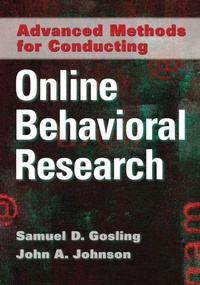
Advanced Methods for Conducting Online Behavioral Research
Published on 15. January 2010
Book
Hardback
286 pages
978-1-4338-0695-7 (ISBN)
Description
This book goes beyond the basics to teach readers advanced methods for conducting behavioral research on the Internet. Readers are shown, step by step, how to conduct online experiments, surveys, and ability testing, use advanced graphic tools, apply automatic text analysis tools, check the validity of protocols, and much more.
The Internet is revolutionizing the way psychologists conduct behavioral research. Studies conducted online are not only less error-prone and labor-intensive but also rapidly reach large numbers of diverse participants at a fraction of the cost of traditional methods. In addition to improving the efficiency and accuracy of data collection, online studies provide automatic data storage and deliver immediate personalized feedback to research participants-a major incentive that can exponentially expand participant pools. Furthermore, behavioral researchers can also track data on online behavioral phenomena, including Instant Messaging (IM), social networking, and other social media.
Readers are shown, step by step, how to conduct online experiments, surveys, and ability testing, use advanced graphic tools such as drag-and-drop objects, apply automatic text analysis tools, check the validity of protocols, automate the storage and analysis of data, record amp quot field notes amp quot on the behavior of online subjects and chatroom or blogging communities, and much more. Chapters also address critical issues such as data security, ethics, participant recruitment, and how to ensure the completion of tests or questionnaires. This volume also features supplemental resources, links, scripts, and instructions to further assist readers with their online research. See the supplemental materials tab for details.
This book is designed for researchers and advanced graduate students in the behavioral sciences seeking greater technical detail about emerging research methods. Readers will be well equipped to implement and integrate these exciting new methods into their own Internet-based behavioral research effectively, securely, and responsibly.
The Internet is revolutionizing the way psychologists conduct behavioral research. Studies conducted online are not only less error-prone and labor-intensive but also rapidly reach large numbers of diverse participants at a fraction of the cost of traditional methods. In addition to improving the efficiency and accuracy of data collection, online studies provide automatic data storage and deliver immediate personalized feedback to research participants-a major incentive that can exponentially expand participant pools. Furthermore, behavioral researchers can also track data on online behavioral phenomena, including Instant Messaging (IM), social networking, and other social media.
Readers are shown, step by step, how to conduct online experiments, surveys, and ability testing, use advanced graphic tools such as drag-and-drop objects, apply automatic text analysis tools, check the validity of protocols, automate the storage and analysis of data, record amp quot field notes amp quot on the behavior of online subjects and chatroom or blogging communities, and much more. Chapters also address critical issues such as data security, ethics, participant recruitment, and how to ensure the completion of tests or questionnaires. This volume also features supplemental resources, links, scripts, and instructions to further assist readers with their online research. See the supplemental materials tab for details.
This book is designed for researchers and advanced graduate students in the behavioral sciences seeking greater technical detail about emerging research methods. Readers will be well equipped to implement and integrate these exciting new methods into their own Internet-based behavioral research effectively, securely, and responsibly.
More details
Language
English
Place of publication
Washington DC
United States
Target group
College/higher education
Professional and scholarly
Product notice
sewn/stitched
Cloth over boards
Dimensions
Height: 264 mm
Width: 184 mm
Thickness: 29 mm
Weight
695 gr
ISBN-13
978-1-4338-0695-7 (9781433806957)
Copyright in bibliographic data and cover images is held by Nielsen Book Services Limited or by the publishers or by their respective licensors: all rights reserved.
Schweitzer Classification
Persons
Samuel D. Gosling, PhD, is a professor of psychology at the University of Texas at Austin. He has been using the Internet to collect data since the mid 99 s, when he created a questionnaire to collect personality ratings of pets by their owners. Since then, he has published numerous articles that make use of data collected on the Internet these articles focus on such diverse topics as personality change over the life span, the links between music preferences and personality, geographic variation in psychological traits, and perceptions of others based on their Web sites and their online social networking profiles (e.g., Facebook). His 2 4 American Psychologist article focused on evaluating the pros and cons of Internet methods.
Dr. Gosling's substantive research has focused on animal personality and on how human personality is manifested in everyday contexts like bedrooms, offices, clothing, Web pages, and music preferences. The latter topic was summarized in his book, Snoop: What Your Stuff Says About You (2 8).
Dr. Gosling is a recipient of an American Psychological Association Distinguished Scientific Award for Early Career Contribution.
John A. Johnson, PhD, is a professor of psychology at the Pennsylvania State University, DuBois. He also serves as the consultant for the International Personality Item Pool, a Web-based repository for psychological measures in the public domain. He entered the field of computer-assisted psychological research in 98 , when he wrote microcomputer programs for scoring and interpreting the Hogan Personality Inventory. When the World Wide Web emerged in the 99 s, he transported concepts from these programs to the Web. He has published research on assessing the validity of data collected on the Internet and on sharing data through Web-based collaboratories.
Dr. Gosling's substantive research has focused on animal personality and on how human personality is manifested in everyday contexts like bedrooms, offices, clothing, Web pages, and music preferences. The latter topic was summarized in his book, Snoop: What Your Stuff Says About You (2 8).
Dr. Gosling is a recipient of an American Psychological Association Distinguished Scientific Award for Early Career Contribution.
John A. Johnson, PhD, is a professor of psychology at the Pennsylvania State University, DuBois. He also serves as the consultant for the International Personality Item Pool, a Web-based repository for psychological measures in the public domain. He entered the field of computer-assisted psychological research in 98 , when he wrote microcomputer programs for scoring and interpreting the Hogan Personality Inventory. When the World Wide Web emerged in the 99 s, he transported concepts from these programs to the Web. He has published research on assessing the validity of data collected on the Internet and on sharing data through Web-based collaboratories.
Content
Contributors
I. Getting Started
How to Use This Book
-John A. Johnson and Samuel D. Gosling
An Overview of Major Techniques of Web-Based Research
-Michael H. Birnbaum
II. Considerations When Designing Web Pages
Design and Formatting in Internet-Based Research
-Ulf-Dietrich Reips
Using Graphics, Photographs, and Dynamic Media
-John H. Krantz and John E. Williams
Drag amp amp Drop: A Flexible Method for Moving Objects, Implementing Rankings, and a Wide Range of Other Applications
-Wolfgang Neubarth
III. Studying Internet Behavior
Collecting Data From Social Networking Web Sites and Blogs
-Elizabeth Mazur
Using Automated amp quot Field Notes amp quot to Observe the Behavior of Online Subjects
-Sonja Utz
Automatic Text Analysis
-Matthias R. Mehl and Alastair J. Gill
IV. Transporting Traditional Methodologies to the Web
Internet-Based Ability Testing
-Ulrich Schroeders, Oliver Wilhelm, and Stefan Schipolowski
Web-Based Self-Report Personality Scales
-John A. Johnson
Online Collection of Informant Reports
-Simine Vazire
Conducting Online Surveys
-Tracy L. Tuten
Conducing True Experiments on the Web
-Ulf-Dietrich Reips and John H. Krantz
V. Cross-Cutting Issues
Using Lotteries, Loyalty Points, and Other Incentives to Increase Participant Response and Completion
-Anja S. G amp ouml ritz
Security and Data Protection: Collection, Storage, and Feedback in Internet Research
-Olaf Thiele and Lars Kaczmirek
Ethical Issues in Psychological Research on the Internet
-Tom Buchanan and John E. Williams
Index
About the Editors
I. Getting Started
How to Use This Book
-John A. Johnson and Samuel D. Gosling
An Overview of Major Techniques of Web-Based Research
-Michael H. Birnbaum
II. Considerations When Designing Web Pages
Design and Formatting in Internet-Based Research
-Ulf-Dietrich Reips
Using Graphics, Photographs, and Dynamic Media
-John H. Krantz and John E. Williams
Drag amp amp Drop: A Flexible Method for Moving Objects, Implementing Rankings, and a Wide Range of Other Applications
-Wolfgang Neubarth
III. Studying Internet Behavior
Collecting Data From Social Networking Web Sites and Blogs
-Elizabeth Mazur
Using Automated amp quot Field Notes amp quot to Observe the Behavior of Online Subjects
-Sonja Utz
Automatic Text Analysis
-Matthias R. Mehl and Alastair J. Gill
IV. Transporting Traditional Methodologies to the Web
Internet-Based Ability Testing
-Ulrich Schroeders, Oliver Wilhelm, and Stefan Schipolowski
Web-Based Self-Report Personality Scales
-John A. Johnson
Online Collection of Informant Reports
-Simine Vazire
Conducting Online Surveys
-Tracy L. Tuten
Conducing True Experiments on the Web
-Ulf-Dietrich Reips and John H. Krantz
V. Cross-Cutting Issues
Using Lotteries, Loyalty Points, and Other Incentives to Increase Participant Response and Completion
-Anja S. G amp ouml ritz
Security and Data Protection: Collection, Storage, and Feedback in Internet Research
-Olaf Thiele and Lars Kaczmirek
Ethical Issues in Psychological Research on the Internet
-Tom Buchanan and John E. Williams
Index
About the Editors