

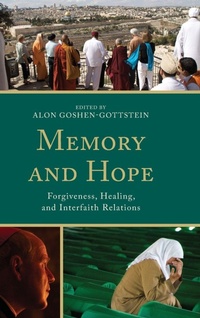
Memory and Hope
Forgiveness, Healing, and Interfaith Relations
Published on 8. October 2015
Book
Hardback
174 pages
978-1-4985-2638-8 (ISBN)
Description
This book tackles the core problem of how painful historical memories between diverse religious communities continue to impact, even poison, present day relations. Its operative notion is that of healing of memory, a notion developed by John Paul II. The different papers explore how the painful memories of yesteryear can be healed in the framework of contemporary efforts. In so doing, they seek to address some of the root causes that continue to impact present day relations, but which rarely if ever get addressed in other contexts. Strategies from six different faith traditions are brought together in what is, in some ways, a cross-religious brainstorming session that seeks to identify the kinds of tools that would allow us to improve present day relations.
At the end of the conceptual pole of this project is the notion of hope. If memory informs our past, hope sets the horizons for our future. How does the healing of memory open new horizons for the future? And what is the notion of hope in each of our traditions, so that it might be receptive to opening up to a common vision of good for all?
Between memory and hope, the project seeks to offer a vision of healing and hope that can serve as a resource in contemporary interfaith relations.
At the end of the conceptual pole of this project is the notion of hope. If memory informs our past, hope sets the horizons for our future. How does the healing of memory open new horizons for the future? And what is the notion of hope in each of our traditions, so that it might be receptive to opening up to a common vision of good for all?
Between memory and hope, the project seeks to offer a vision of healing and hope that can serve as a resource in contemporary interfaith relations.
Reviews / Votes
Ultimately, Memory and Hope represents an important contribution to ongoing academic, interfaith, and public conversations about how religious communities can engage with painful memories of the past and attempt to negotiate more hopeful futures. This book could be effectively incorporated into graduate-level courses-and possibly upper-level undergraduate seminars-in disciplines such as religious studies, peace studies, sociology, psychology, and other areas. * Reading Religion * A great and often neglected human challenge is how to manage individual and collective memories of wrongs suffered and committed. World religions face the challenge, too, as violence has marked their internal and external relations. This book, unique in many ways, contains rich resources, drawn from diverse world religions, for figuring out how to remember rightly and hope boldly in a violent world. -- Miroslav Volf, Yale University, author of The End of Memory: Remembering Rightly in a Violent WorldMore details
Series
Language
English
Place of publication
United States
Publishing group
Bloomsbury Publishing Plc
Target group
Professional and scholarly
Dimensions
Height: 235 mm
Width: 157 mm
Thickness: 14 mm
Weight
412 gr
ISBN-13
978-1-4985-2638-8 (9781498526388)
Copyright in bibliographic data and cover images is held by Nielsen Book Services Limited or by the publishers or by their respective licensors: all rights reserved.
Schweitzer Classification
Persons
Alon Goshen-Gottstein is founder and director of the Elijah Interfaith Institute. A noted scholar of Jewish studies, he has held academic posts at the Hebrew University of Jerusalem and Tel Aviv University and has served as director of the Center for the Study of Rabbinic Thought, Beit Morasha College, Jerusalem.
Content
Foreword, Alon Goshen-Gottstein
Chapter 1: Memory and Hope: Summary of Papers and Project Synthesis, Alon Goshen-Gottstein
Chapter 2: The Malleability of Collective Memory in Jewish Tradition, Meir Sendor
Chapter 3: Memory and Hope in Christianity, Flora A. Keshgegian
Chapter 4: "Hope Is Greater Than Memory" (asa vai smarad bhuyasi) Chandogya Upanishad 7.14.2: Insights From the Hindu Tradition, Anantanand Rambachan
Chapter 5: Memory as Benevolence: Toward a Sikh Ethics of Liberation, Rahuldeep Gill
Chapter 6: Memory, Hope, and Systems of Repair, Muhammad Suheyl Umar
Chapter 7: Memory in Buddhism, Michael von Brueck, with Maria Reis Habito
Afterword: Towards a Collective Case Study-Hope for Jerusalem, Alon Goshen-Gottstein
Chapter 1: Memory and Hope: Summary of Papers and Project Synthesis, Alon Goshen-Gottstein
Chapter 2: The Malleability of Collective Memory in Jewish Tradition, Meir Sendor
Chapter 3: Memory and Hope in Christianity, Flora A. Keshgegian
Chapter 4: "Hope Is Greater Than Memory" (asa vai smarad bhuyasi) Chandogya Upanishad 7.14.2: Insights From the Hindu Tradition, Anantanand Rambachan
Chapter 5: Memory as Benevolence: Toward a Sikh Ethics of Liberation, Rahuldeep Gill
Chapter 6: Memory, Hope, and Systems of Repair, Muhammad Suheyl Umar
Chapter 7: Memory in Buddhism, Michael von Brueck, with Maria Reis Habito
Afterword: Towards a Collective Case Study-Hope for Jerusalem, Alon Goshen-Gottstein