

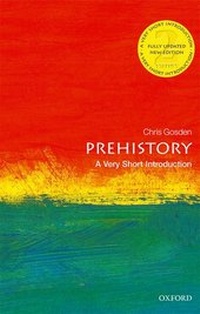
Prehistory
A Very Short Introduction
2nd Edition
Published on 28. June 2018
Book
Paperback/Softback
160 pages
978-0-19-880351-5 (ISBN)
Description
Prehistory covers the period of some 4 million years before the start of written history, when our earliest ancestors, the Australopithecines, existed in Africa. But this is relatively recent compared to whole history of the earth of some 4.5 billion years. A key aspect of prehistory is that it provides a sense of scale, throwing recent ways of life into perspective. Humans and their ancestors lived in many different ways and the cultural variety we see now is just a tiny fraction of that which has existed over millions of years. Humans are part of the broader evolution of landscapes and communities of plants and animals, but Homo sapiens is also the only species to have made a real impact on planetary systems. To understand such an impact, we need a grasp of our longest term development and ways of life.
In this new edition of his Very Short Introduction, Chris Gosden invites us to think seriously about who we are by considering who we have been. As he explains, many new discoveries have been made in archaeology over the last ten years, and a new framework for prehistory is emerging. A greater understanding of Chinese and central Asian prehistory has thrown Eurasian prehistory in quite a different light, with flows of the influence of culture over large areas now evident. This has eaten away at the traditional view of human progress around the invention of agriculture, the development of cities and (much later) the industrial revolution, and given us new geographies to think about. Chris Gosden explores the new landscape of our prehistory, and considers the way the different geographical locations weave together.
ABOUT THE SERIES: The Very Short Introductions series from Oxford University Press contains hundreds of titles in almost every subject area. These pocket-sized books are the perfect way to get ahead in a new subject quickly. Our expert authors combine facts, analysis, perspective, new ideas, and enthusiasm to make interesting and challenging topics highly readable.
In this new edition of his Very Short Introduction, Chris Gosden invites us to think seriously about who we are by considering who we have been. As he explains, many new discoveries have been made in archaeology over the last ten years, and a new framework for prehistory is emerging. A greater understanding of Chinese and central Asian prehistory has thrown Eurasian prehistory in quite a different light, with flows of the influence of culture over large areas now evident. This has eaten away at the traditional view of human progress around the invention of agriculture, the development of cities and (much later) the industrial revolution, and given us new geographies to think about. Chris Gosden explores the new landscape of our prehistory, and considers the way the different geographical locations weave together.
ABOUT THE SERIES: The Very Short Introductions series from Oxford University Press contains hundreds of titles in almost every subject area. These pocket-sized books are the perfect way to get ahead in a new subject quickly. Our expert authors combine facts, analysis, perspective, new ideas, and enthusiasm to make interesting and challenging topics highly readable.
Reviews / Votes
A brilliant exposition of prehistory in all its variety - thoughtful and wide-ranging. * Barry Cunliffe * Challenging, authoritative and with a world vision, Chris Gosdens Prehistory provides the foundations for a twenty first century archaeology. There is no better place to start the journey into deep human history than this concise celebration of the importance of long term history by one of the worlds leading archaeologists. * Professor Clive Gamble, Department of Archaeology, University of Southampton *More details
Series
Edition
2nd Revised edition
Language
English
Place of publication
Oxford
United Kingdom
Edition type
Revised edition
Product notice
Paperback (trade)
Illustrations
10 black and white images
Dimensions
Height: 175 mm
Width: 108 mm
Thickness: 15 mm
Weight
120 gr
ISBN-13
978-0-19-880351-5 (9780198803515)
Copyright in bibliographic data and cover images is held by Nielsen Book Services Limited or by the publishers or by their respective licensors: all rights reserved.
Schweitzer Classification
Other editions
Additional editions
E-Book
06/2018
2nd Edition
OUP eBook
€5.49
Available for download
E-Book
06/2018
2nd Edition
OUP eBook
€5.49
Available for download
Previous edition
Book
06/2003
Oxford University Press
€9.91
Article exhausted; check for reprint
Person
Chris Gosden is Professor of European Archaeology at Oxford. He has written and edited a number of
books on the history of the Pitt Rivers, on Celtic art and reporting on major excavations. He is currently
directing the English Landscape and Identities project looking at the history of the English Landscape
from 1500 BC to AD 1088 (funded by the ERC), and the European Celtic Art in Context project,
exploring Celtic art and its eastern connections (funded by the Leverhulme Trust). He is also finishing a
project on the English Collections of the Pitt Rivers Museum (funded by the ESRC).
books on the history of the Pitt Rivers, on Celtic art and reporting on major excavations. He is currently
directing the English Landscape and Identities project looking at the history of the English Landscape
from 1500 BC to AD 1088 (funded by the ERC), and the European Celtic Art in Context project,
exploring Celtic art and its eastern connections (funded by the Leverhulme Trust). He is also finishing a
project on the English Collections of the Pitt Rivers Museum (funded by the ESRC).
Content
Introduction 1: When does prehistory start and end? 2: What use is prehistory? 3: In the beginning - African origins 4: The end of the beginning - the establishment of human groups in Europe and Asia 5: Continental fusion - the creation of connected communities across Europe and Asia 6: New worlds - the Americas, Australia and the Pacific 7: Final thoughts References Further reading Index