

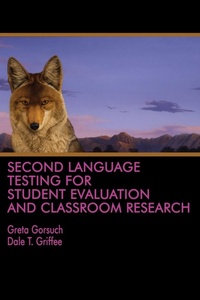
Second Language Testing for Student Evaluation and Classroom Research
Published on 3. October 2017
Book
Paperback/Softback
392 pages
978-1-64113-011-0 (ISBN)
Description
Second Language Testing for Student Evaluation and Classroom Research and its accompanying Student Workbook are introductory-level resources for classroom teachers of all levels of experience, and early-career graduate students in applied linguistics, TESOL, and second/foreign language teaching programs. The book gives a balance between practice and theory for student evaluation, and also aims for readers to use testing to connect to classroom research and to their own teaching. Indeed, Second Language Testing for Student Evaluation and Classroom Research aims at self-discovery and empowerment for readers, even as second language testing as a field undergoes major shifts in scope and areas of concern.
Second Language Testing offer a strong basis for readers who wish to analyze and improve their own classroom tests, and for readers who wish to evaluate standardized tests they are required to use, or are thinking of using. We work with the general idea, "OK, now that I know test X has these strengths and weaknesses, what do I do?" Or, "Alright here are students' scores, now how do I use them in my teaching?" At the same time our book provides more in-depth treatments of key testing topics for those readers who want to know "Why?" and "How?" "Why these terms?" "Why this or that analysis?" "Why does it work?" "How does it work?" "What do these numbers mean?" "How do I use them and how do I explain them to my students, my colleagues, my supervisors?" Second Language Testing for Student Evaluation and Classroom Research includes five Appendices for those readers whose interests continue into more advanced areas. Our information and observations on issues such as rater training (Appendix B) are current and discerning, and our Reference section and Glossary would be valued by any advanced testing practitioner or researcher.
Second Language Testing is useful to readers at varied levels of engagement, at their choice.
Second Language Testing offer a strong basis for readers who wish to analyze and improve their own classroom tests, and for readers who wish to evaluate standardized tests they are required to use, or are thinking of using. We work with the general idea, "OK, now that I know test X has these strengths and weaknesses, what do I do?" Or, "Alright here are students' scores, now how do I use them in my teaching?" At the same time our book provides more in-depth treatments of key testing topics for those readers who want to know "Why?" and "How?" "Why these terms?" "Why this or that analysis?" "Why does it work?" "How does it work?" "What do these numbers mean?" "How do I use them and how do I explain them to my students, my colleagues, my supervisors?" Second Language Testing for Student Evaluation and Classroom Research includes five Appendices for those readers whose interests continue into more advanced areas. Our information and observations on issues such as rater training (Appendix B) are current and discerning, and our Reference section and Glossary would be valued by any advanced testing practitioner or researcher.
Second Language Testing is useful to readers at varied levels of engagement, at their choice.
More details
Language
English
Place of publication
Charlotte
United States
Publishing group
Emerald Publishing Inc
Target group
Professional and scholarly
Dimensions
Height: 234 mm
Width: 156 mm
Thickness: 21 mm
Weight
594 gr
ISBN-13
978-1-64113-011-0 (9781641130110)
Copyright in bibliographic data and cover images is held by Nielsen Book Services Limited or by the publishers or by their respective licensors: all rights reserved.
Schweitzer Classification
Other editions
Additional editions
E-Book
01/2017
1st Edition
Information Age Publishing
from
€62.33
Available for download
Content
Preface.
Acknowledgements.
Introduction: Testing as We Know It.
Chapter 1. Norm-referenced Tests.
Chapter 2. Test Item Formats.
Chapter 3. Teacher-made Tests.
Chapter 4. The Role of Theory in Second Language Testing.
Chapter 5. Performance Tests.
Chapter 6. Scales, Distributions, and Descriptive Statistics.
Chapter 7. Correlation.
Chapter 8. Reliability.
Chapter 9. Test Validity and Validation.
Chapter 10. Standard Setting and Cut Scores.
Chapter 11. Tests and Teaching.
Chapter 12. Tests and Classroom Research.
Appendices.
Glossary.
References.
About the Authors.
Acknowledgements.
Introduction: Testing as We Know It.
Chapter 1. Norm-referenced Tests.
Chapter 2. Test Item Formats.
Chapter 3. Teacher-made Tests.
Chapter 4. The Role of Theory in Second Language Testing.
Chapter 5. Performance Tests.
Chapter 6. Scales, Distributions, and Descriptive Statistics.
Chapter 7. Correlation.
Chapter 8. Reliability.
Chapter 9. Test Validity and Validation.
Chapter 10. Standard Setting and Cut Scores.
Chapter 11. Tests and Teaching.
Chapter 12. Tests and Classroom Research.
Appendices.
Glossary.
References.
About the Authors.