

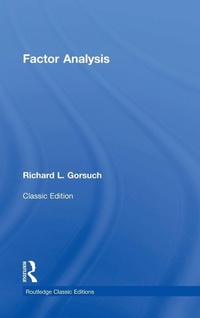
Factor Analysis
Classic Edition
2nd Edition
Published on 16. December 2014
Book
Hardback
464 pages
978-1-138-83198-8 (ISBN)
Description
Comprehensive and comprehensible, this classic text covers the basic and advanced topics essential for using factor analysis as a scientific tool in psychology, education, sociology, and related areas. Emphasizing the usefulness of the techniques, it presents sufficient mathematical background for understanding and applying its use. This includes the theory as well as the empirical evaluations. The overall goal is to show readers how to use factor analysis in their substantive research by highlighting when the differences in mathematical procedures have a major impact on the substantive conclusions, when the differences are not relevant, and when factor analysis might not be the best procedure to use.
Although the original version was written years ago, the book maintains its relevance today by providing readers with a thorough understanding of the basic mathematical models so they can easily apply these models to their own research. Readers are presented with a very complete picture of the "inner workings" of these methods. The new Introduction highlights the remarkably few changes that the author would make if he were writing the book today.
An ideal text for courses on factor analysis or as a supplement for multivariate analysis, structural equation modeling, or advanced quantitative techniques taught in psychology, education, and other social and behavioral sciences, researchers who use these techniques also appreciate this book's thorough review of the basic models. Prerequisites include a graduate level course on statistics and a basic understanding of algebra. Sections with an asterisk can be skipped entirely if preferred.
Although the original version was written years ago, the book maintains its relevance today by providing readers with a thorough understanding of the basic mathematical models so they can easily apply these models to their own research. Readers are presented with a very complete picture of the "inner workings" of these methods. The new Introduction highlights the remarkably few changes that the author would make if he were writing the book today.
An ideal text for courses on factor analysis or as a supplement for multivariate analysis, structural equation modeling, or advanced quantitative techniques taught in psychology, education, and other social and behavioral sciences, researchers who use these techniques also appreciate this book's thorough review of the basic models. Prerequisites include a graduate level course on statistics and a basic understanding of algebra. Sections with an asterisk can be skipped entirely if preferred.
Reviews / Votes
"I have used Gorsuch's book "Factor Analysis" in my courses on exploratory factor analysis for the past ten years. I consider the book to be a classic in the field, and even though it was published in 1983, the book maintains its relevance. The author provides solid practical advice for researchers using factor analytic techniques that is just as important today as it was when the book was written. In addition to his practical advice, Gorsuch provides the mathematical underpinnings of factor analytic techniques so that students and applied researchers can truly understand the "inner workings" of these methods. In my view, his book is the ideal combination of technical rigor and practical advice, which results in a comprehensive text that is accessible to applied researchers." - Deborah L. Bandalos, James Madison University, USA"Factor analysis is a widely used statistical technique across many disciplines. Its use will not decrease any time soon. Yet, the knowledge of its basics, as it was developed in the 60s and 70s can only be found in classic books. A reprint of Gorsuch's book of factor analysis is timely and it will be well received." - Albert Maydeu-Olivares, University of Barcelona, Spain
"Gorsuch is a staple for anyone interested in an informative and accessible presentation of factor analysis (FA).The book presents the mathematics of FA in an applied and comprehensible style that is understandable to most readers. The material presented is still essential for current teaching, learning, and application. Anyone interested in FA will readily find this book an instructive classic by a well-respected expert." - Lisa L. Harlow, University of Rhode Island, USA
More details
Series
Edition
2nd edition
Language
English
Place of publication
London
United Kingdom
Publishing group
Taylor & Francis Ltd
Target group
College/higher education
Dimensions
Height: 235 mm
Width: 157 mm
Thickness: 29 mm
Weight
820 gr
ISBN-13
978-1-138-83198-8 (9781138831988)
Copyright in bibliographic data and cover images is held by Nielsen Book Services Limited or by the publishers or by their respective licensors: all rights reserved.
Schweitzer Classification
Other editions
Additional editions
Book
12/2014
2nd Edition
Routledge
€97.20
Shipment within 10-20 days
E-Book
11/2014
2nd Edition
Routledge
€89.99
Available for download
E-Book
11/2014
2nd Edition
Routledge
€89.99
Available for download
Person
Richard L. Gorsuch is Senior Professor of Psychology at the Fuller Theological Seminary. He is known for his book Factor Analysis (1983), and for the development of the software program UniMult.
Content
1.Introduction to the Classic Second Edition 2. Introduction 3. Basic Factor Models 4. Matrix Algebra and Factor Analysis 5. Geometric Representation of Factor Models. 6. Diagonal and Multiple-Group Analysis. 7. Principle Factor Solutions. 8. Confirmatory Maximum Likelihood Solutions. 9. Determining the Number of Factors. 10. Rotation and Interpretation of Factors. 11. Rotation. 12. Higher-Order Factors. 13. Factor Scores. 14. Relating Factors Across Studies. 15. Data Transformations and Indices of Association. 16. Two- and Three-Mode Factor Analysis. 17. The Replication and Invariance of Factors. 18. Factor Analysis as a Research Technique. 19. Epilogue. Appendices: Data for Examples. Computer Programs for Factor Analysis. Accuracy of Computer Processing.