

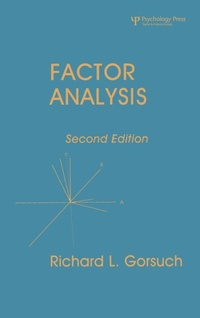
Factor Analysis
2nd Edition
Published on 1. November 1983
Book
Hardback
448 pages
978-0-89859-202-3 (ISBN)
Description
Comprehensive and comprehensible, this classic covers the basic and advanced topics essential for using factor analysis as a scientific tool in psychology, education, sociology, and related areas. Emphasizing the usefulness of the techniques, it presents sufficient mathematical background for understanding and sufficient discussion of applications for effective use. This includes not only theory but also the empirical evaluations of the importance of mathematical distinctions for applied scientific analysis.
Reviews / Votes
"The coverage of the text is extensive. It will give the student a very comprehensive view of factor analysis....should serve as a very useful reference for the student (and researcher) for many years."-Contemporary Psychology
More details
Edition
2nd edition
Language
English
Place of publication
Mahwah
United States
Publishing group
Taylor & Francis Inc
Target group
College/higher education
Professional and scholarly
Dimensions
Height: 235 mm
Width: 157 mm
Thickness: 31 mm
Weight
873 gr
ISBN-13
978-0-89859-202-3 (9780898592023)
Copyright in bibliographic data and cover images is held by Nielsen Book Services Limited or by the publishers or by their respective licensors: all rights reserved.
Schweitzer Classification
Other editions
Additional editions

Richard L. Gorsuch
Factor Analysis
E-Book
05/2013
2nd Edition
Psychology Press Ltd
€73.99
Available for download
Richard L. Gorsuch
Factor Analysis
E-Book
05/2013
2nd Edition
Psychology Press Ltd
€73.99
Available for download
Person
Richard L. Gorsuch
Content
Contents: Preface. Preface to the First Edition. Introduction. Basic Factor Models. Matrix Algebra and Factor Analysis. Geometric Representation of Factor Models. Diagonal and Multiple-Group Analysis. Principle Factor Solutions. Confirmatory Maximum Likelihood Solutions. Determining the Number of Factors. Rotation and Interpretation of Factors. Rotation. Higher-Order Factors. Factor Scores. Relating Factors Across Studies. Data Transformations and Indices of Association. Two- and Three-Mode Factor Analysis. The Replication and Invariance of Factors. Factor Analysis as a Research Technique. Epilogue. Appendices: Data for Examples. Computer Programs for Factor Analysis. Accuracy of Computer Processing.