

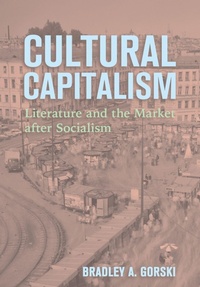
Cultural Capitalism
Literature and the Market After Socialism
Published on 15. March 2025
Book
Hardback
336 pages
978-1-5017-7979-4 (ISBN)
Description
Cultural Capitalism explores Russian literature's eager embrace of capitalism in the post-Soviet era. When the Soviet Union fell, books were suddenly bought and sold as commodities. Russia's first bestseller lists brought attention and prestige. Even literary prizes turned to the market for legitimacy. The rise of capitalism entirely transformed both the economics and the aesthetics of Russian literature. By reconstructing the market's influence on everything from late-Soviet paper shortages to the prose of neoimperialism, Cultural Capitalism reveals Russian literature's exuberant hopes for and deep disappointments in capitalism. Only a free market, it was hoped, could cure endemic book deficits and liberate literature from ideological constraints. But as the market came to dominate literature, it imposed an ideology of its own, one that directed literary development for decades.
Through archival research, original interviews, and provocative readings of literary texts, Bradley A. Gorski immerses the reader in both the economic and aesthetic worlds of post-Soviet Russian literature to reveal a cultural logic dominated by capitalism. The Russian 1990s and early 2000s saw markets introduced, adopted, and debated at an accelerated pace, all against the backdrop of a socialist past, staging the polemics between capitalism and culture in high drama and sharp relief. But the market forces at the center of the post-Soviet transition are fundamental to cultural trends worldwide. By revealing the complexities of Russia's story, Cultural Capitalism mounts a critique that cuts across national borders and provides a new way of seeing culture in the post-1989 era worldwide.
Through archival research, original interviews, and provocative readings of literary texts, Bradley A. Gorski immerses the reader in both the economic and aesthetic worlds of post-Soviet Russian literature to reveal a cultural logic dominated by capitalism. The Russian 1990s and early 2000s saw markets introduced, adopted, and debated at an accelerated pace, all against the backdrop of a socialist past, staging the polemics between capitalism and culture in high drama and sharp relief. But the market forces at the center of the post-Soviet transition are fundamental to cultural trends worldwide. By revealing the complexities of Russia's story, Cultural Capitalism mounts a critique that cuts across national borders and provides a new way of seeing culture in the post-1989 era worldwide.
Reviews / Votes
Gorski, a literary and culture scholar, examines the breakneck commercialization of book publishing, and Russian literature more broadly, following the collapse of the Soviet Union. * Foreign Affairs * Cultural Capitalism is an exciting study and an attractive book object. Dozens of illustrations accompany Gorski's argument, from chapter 1 through the epilogue-not to mention the "Bestseller"- related appendix. It should be read carefully by specialists in post-socialist literature, as well as a broader scholarly audience invested in better understanding the relationship between literature and modern capitalism. * The Russian Review *More details
Series
Language
English
Place of publication
United States
Publishing group
Cornell University Press
Product notice
Paper over boards
Illustrations
17 b&w halftones, 11 charts - 17 Halftones, black and white - 11 Charts
Dimensions
Height: 233 mm
Width: 157 mm
Thickness: 29 mm
Weight
688 gr
ISBN-13
978-1-5017-7979-4 (9781501779794)
Copyright in bibliographic data and cover images is held by Nielsen Book Services Limited or by the publishers or by their respective licensors: all rights reserved.
Schweitzer Classification
Other editions
Additional editions
E-Book
03/2025
Northern Illinois University Press
€39.99
Available for download
Person
Bradley A. Gorski is Assistant Professor of Post-Soviet Literature and Culture at Georgetown University. He is coeditor of Red Migrations. His writing has appeared in World Literature Today, Public Books, the Times Literary Supplement, and elsewhere.
Content
Introduction: The Cultural Logic of Postsocialism
1. Bestseller: Commodification and the Anti-Aesthetic
2. Success: Meritocracy and the Spiritof Capitalism
3. Prizes: Success without Readers
4. Readers: Active Audiences at the Edges of Literature
5. Readers: Active Audiences at the Edges of Literature
Epilogue: Anti-Capitalism and the Fight for Art
1. Bestseller: Commodification and the Anti-Aesthetic
2. Success: Meritocracy and the Spiritof Capitalism
3. Prizes: Success without Readers
4. Readers: Active Audiences at the Edges of Literature
5. Readers: Active Audiences at the Edges of Literature
Epilogue: Anti-Capitalism and the Fight for Art