

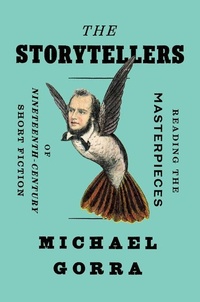
The Storytellers
Reading the Masterpieces of Nineteenth-Century Short Fiction
Will be published approx. on 18. September 2026
Book
Hardback
344 pages
978-0-226-82555-7 (ISBN)
Description
Tracing the origins of the modern short story, Michael Gorra provides the first fully realized picture of a century's worth of great tales.
The Storytellers offers a far-reaching account of the rich tradition of short narratives that flourished in nineteenth-century Europe and America, one that both prepared for and eventually gave way to the modern short story. Tracing unexpected resemblances across languages and decades, Michael Gorra restores a wide-angle view of the form in which works usually treated as stand-alone classics reveal themselves as parts of a single, lively conversation.
What unites these tales, Gorra argues, is their blend of novelty and unity. The book's heart lies in a series of accessible readings of great tales by Herman Melville, Nikolai Gogol, Ivan Turgenev, E. T. A. Hoffmann, Guy de Maupassant, Nathaniel Hawthorne, Arthur Conan Doyle, Sarah Orne Jewett, Charles Chesnutt, and many more. Beyond its consideration of individual works, The Storytellers examines the formal and thematic concerns that bind the century together: the use of frame tales, accounts of social marginality, and an abundance of ghosts and uncanny coincidences. Over time, Gorra shows, these qualities yielded to a cooler realism, with Anton Chekhov as the key transitional figure. His compressed studies of ordinary lives inspired the modern short story and consigned the gothic flourishes of earlier tales to genre fiction.
What do we want from a story? What makes a tale worth telling? The nineteenth-century tale sought not the grand "meaning of life" promised by the novel, Gorra shows, but sudden revelations from singular events. The Storytellers gives readers an incomparable guide to a vast body of tales that still has the power to thrill and entertain.
The Storytellers offers a far-reaching account of the rich tradition of short narratives that flourished in nineteenth-century Europe and America, one that both prepared for and eventually gave way to the modern short story. Tracing unexpected resemblances across languages and decades, Michael Gorra restores a wide-angle view of the form in which works usually treated as stand-alone classics reveal themselves as parts of a single, lively conversation.
What unites these tales, Gorra argues, is their blend of novelty and unity. The book's heart lies in a series of accessible readings of great tales by Herman Melville, Nikolai Gogol, Ivan Turgenev, E. T. A. Hoffmann, Guy de Maupassant, Nathaniel Hawthorne, Arthur Conan Doyle, Sarah Orne Jewett, Charles Chesnutt, and many more. Beyond its consideration of individual works, The Storytellers examines the formal and thematic concerns that bind the century together: the use of frame tales, accounts of social marginality, and an abundance of ghosts and uncanny coincidences. Over time, Gorra shows, these qualities yielded to a cooler realism, with Anton Chekhov as the key transitional figure. His compressed studies of ordinary lives inspired the modern short story and consigned the gothic flourishes of earlier tales to genre fiction.
What do we want from a story? What makes a tale worth telling? The nineteenth-century tale sought not the grand "meaning of life" promised by the novel, Gorra shows, but sudden revelations from singular events. The Storytellers gives readers an incomparable guide to a vast body of tales that still has the power to thrill and entertain.
Reviews / Votes
"We have long known that the short story flourished in the nineteenth century, but it has taken someone with Michael Gorra's literary gifts to map out the terrain for us in such an imaginative and capacious way. Familiar tales are vividly retold and brought into unexpected and illuminating conjunction with tales from distant places and linguistic traditions. Everyone who loves a good story will enjoy reading-and learning from-The Storytellers." -- Ruth Yeazell, Yale University "With its unobtrusive rigor and gentle erudition, The Storytellers breathes new life into the European and North American nineteenth-century short story canon. Gorra confirms here his status--an outstanding scholar who proves to be a gifted storyteller in his own right. Enlightening and an absolute pleasure to read." -- Hernan Diaz * Pulitzer Prize-winning author of "Trust" *More details
Language
English
Place of publication
Chicago
United States
Publishing group
The University of Chicago Press
Dimensions
Height: 229 mm
Width: 152 mm
Weight
454 gr
ISBN-13
978-0-226-82555-7 (9780226825557)
Copyright in bibliographic data and cover images is held by Nielsen Book Services Limited or by the publishers or by their respective licensors: all rights reserved.
Schweitzer Classification
Person
Michael Gorra is the Mary Augusta Jordan Professor Emeritus of English Language and Literature at Smith College. He is the author of Portrait of a Novel: Henry James and the Making of an American Masterpiece, a finalist for the Pulitzer Prize in Biography, and The Saddest Words: William Faulkner's Civil War. Gorra is a member of the American Academy of Arts and Sciences and a regular contributor to the New York Review of Books. He has received a Public Scholar Award from the National Endowment for the Humanities, a Guggenheim Fellowship, and the Nona Balakian Citation of the National Book Critics Circle for his work as a reviewer.
Content
One: An Unprecedented Thing
Two: Novellen
Three: Theories
Four: How Stories Got Short
Five: An English Interlude
Six: The Sportsman at Work
Seven: Local Lives
Eight: A Brief Account of the Long Story
Nine: The Stagecoach from Rouen
Ten: Case Histories
Eleven: Problems, Posed
Twelve: The Storyteller
Acknowledgments
Notes and Sources
Index
Two: Novellen
Three: Theories
Four: How Stories Got Short
Five: An English Interlude
Six: The Sportsman at Work
Seven: Local Lives
Eight: A Brief Account of the Long Story
Nine: The Stagecoach from Rouen
Ten: Case Histories
Eleven: Problems, Posed
Twelve: The Storyteller
Acknowledgments
Notes and Sources
Index