

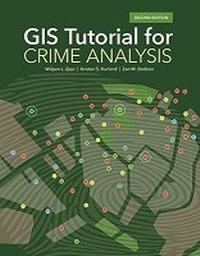
GIS Tutorial for Crime Analysis
2nd Edition
Published on 5. July 2018
Book
Paperback/Softback
364 pages
978-1-58948-516-7 (ISBN)
Description
GIS Tutorial for Crime Analysis, second edition, is a workbook for crime analysts and students of criminology. The book presents state-of-the-art methods that can be incorporated into any police department's standard practices. This second edition builds upon the first edition by updating tutorials, adding a new chapter on building and evaluating models using ModelBuilder and ArcGIS's hot spot analysis tools, and adding a capstone project on hot spot modeling.
In contrast to GIS workbooks that teach skills for one-time projects, this book has users build and use a crime mapping and analysis system to meet all spatial information needs of a police department. The book combines introductions to GIS and crime analysis methods and step-by-step tutorial exercises with independent assignments to teach key GIS skills, including data preparation and updating, map template building, map queries and analysis, automation of map production, and modeling skills. The book also includes a 180-day trial version of ArcGIS Desktop software and tutorial data. Instructor resources are available upon request.
In contrast to GIS workbooks that teach skills for one-time projects, this book has users build and use a crime mapping and analysis system to meet all spatial information needs of a police department. The book combines introductions to GIS and crime analysis methods and step-by-step tutorial exercises with independent assignments to teach key GIS skills, including data preparation and updating, map template building, map queries and analysis, automation of map production, and modeling skills. The book also includes a 180-day trial version of ArcGIS Desktop software and tutorial data. Instructor resources are available upon request.
More details
Series
Edition
Second Edition
Language
English
Place of publication
Redlands
United States
Publishing group
ESRI Press
Edition type
New edition
Product notice
Paperback (trade)
Illustrations
300 Illustrations
Dimensions
Height: 254 mm
Width: 203 mm
ISBN-13
978-1-58948-516-7 (9781589485167)
Copyright in bibliographic data and cover images is held by Nielsen Book Services Limited or by the publishers or by their respective licensors: all rights reserved.
Schweitzer Classification
Other editions
Additional editions
Wilpen L. Gorr | Kristen S. Kurland | Zan M. Dodson
GIS Tutorial for Crime Analysis
E-Book
04/2018
2nd Edition
Esri Press
from
€202.99
Available for download
Previous edition
Wilpen L. Gorr | Kristen S. Kurland
GIS Tutorial for Crime Analysis
Book
11/2011
2nd Edition
ESRI Press
€121.08
Article exhausted; check for reprint
Persons
Wilpen L. Gorr is emeritus professor of public policy and management information systems at the School of Public Policy and Management, H. John Heinz III College, Carnegie Mellon University, where he taught and researched GIS applications. He was also chairman of the school's Master of Science in Public Policy and Management program and editor of the International Journal of Forecasting.
Kristen S. Kurland is a Teaching Professor of Architecture, Information Systems, and Public Policy at the H. John Heinz III College and School of Architecture, Carnegie Mellon University, where she teaches GIS, building information modeling, computer-aided design, 3D visualization, infrastructure management, and enterprise data analytics.
Zan M. Dodson is a postdoctoral associate in the Public Health Dynamics Laboratory at the University of Pittsburgh and adjunct faculty at the H. John Heinz III College, Carnegie Mellon University, where he teaches GIS, spatiotemporal modeling, spatial optimization, and remote sensing.
Kristen S. Kurland is a Teaching Professor of Architecture, Information Systems, and Public Policy at the H. John Heinz III College and School of Architecture, Carnegie Mellon University, where she teaches GIS, building information modeling, computer-aided design, 3D visualization, infrastructure management, and enterprise data analytics.
Zan M. Dodson is a postdoctoral associate in the Public Health Dynamics Laboratory at the University of Pittsburgh and adjunct faculty at the H. John Heinz III College, Carnegie Mellon University, where he teaches GIS, spatiotemporal modeling, spatial optimization, and remote sensing.
Content
Chapter 1 Introducing GIS for police work
Chapter 2 Exploring ArcGIS Desktop
Chapter 3 Using crime maps
Chapter 4 Building crime maps
Chapter5 Querying crime maps
Chapter 6 Assembling jurisdiction feature classes
Chapter 7 Geocoding crime incident data
Chapter 8 Automating crime mapping
Chapter 9 Predictive policing for crime hot spots
Chapter 2 Exploring ArcGIS Desktop
Chapter 3 Using crime maps
Chapter 4 Building crime maps
Chapter5 Querying crime maps
Chapter 6 Assembling jurisdiction feature classes
Chapter 7 Geocoding crime incident data
Chapter 8 Automating crime mapping
Chapter 9 Predictive policing for crime hot spots