

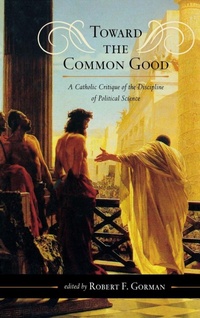
Toward the Common Good
A Catholic Critique of the Discipline of Political Science
Published on 6. October 2011
Book
Hardback
194 pages
978-0-8108-7796-2 (ISBN)
Description
Over the course of two millennia, the Catholic Church has served as one of the key institutional influences on the development of political science. Papal writings on the social teachings of the Church and their application to the modern world reflect the important role the Church has played as a political evaluator and social critic of political ideas and realities and the concepts and methods through which we seek to understand them. Toward the Common Good critiques political science from a distinctly Catholic perspective. Essays in this work engage forthrightly with the origins and destiny of humanity and explore-through a Catholic lens-the natural inclination of human beings to aspire toward the attainment of the common good.
This book examines how the subfields of political theory, comparative politics, American government, international relations, and public administration draw on foundational connections between moral and political philosophy and political science's natural affinities with history, law, anthropology, sociology, and theology. The contributors assess the quality of contemporary political analysis by applying the Catholic principles of the unity of knowledge and pursuit of truth to the traditional principles of justice, the common good, solidarity, and subsidiarity, all in direct contrast to the utilitarian, secularist, materialist, and relativist approaches that dominate political science today. The essays collected here address the question of method in the study of politics-especially the confining effects of regnant behavioralism-and offer in opposition a recovery of political philosophy, the natural law tradition, virtue ethics, and moral realism. Finally, each contributor suggests how the Catholic political scientist can draw upon the truths of the Catholic faith to enter into the study of politics and how that faith influences the kinds of questions and research a Catholic political scientist undertakes.
This book examines how the subfields of political theory, comparative politics, American government, international relations, and public administration draw on foundational connections between moral and political philosophy and political science's natural affinities with history, law, anthropology, sociology, and theology. The contributors assess the quality of contemporary political analysis by applying the Catholic principles of the unity of knowledge and pursuit of truth to the traditional principles of justice, the common good, solidarity, and subsidiarity, all in direct contrast to the utilitarian, secularist, materialist, and relativist approaches that dominate political science today. The essays collected here address the question of method in the study of politics-especially the confining effects of regnant behavioralism-and offer in opposition a recovery of political philosophy, the natural law tradition, virtue ethics, and moral realism. Finally, each contributor suggests how the Catholic political scientist can draw upon the truths of the Catholic faith to enter into the study of politics and how that faith influences the kinds of questions and research a Catholic political scientist undertakes.
Reviews / Votes
Toward the Common Good will be useful to both Catholic and non-Catholic scholars. The former will find in it many useful suggestions for how they might integrate the Catholic intellectual tradition into their own professional studies. The latter will learn that there is nothing to be feared and much to be gained from returning once again to the moral realism of which the Church is still the most persistent and persuasive teacher. And for those teachers who wish not only to survey political science as it is currently practiced but also to invite students to critical reflection on its limitations, the book would make a useful addition to the reading list for an undergraduate introduction to political science course or a graduate scope and methods course. * Catholic Social Science Review *More details
Series
Language
English
Place of publication
Lanham, MD
United States
Dimensions
Height: 235 mm
Width: 157 mm
Thickness: 15 mm
Weight
440 gr
ISBN-13
978-0-8108-7796-2 (9780810877962)
Copyright in bibliographic data and cover images is held by Nielsen Book Services Limited or by the publishers or by their respective licensors: all rights reserved.
Schweitzer Classification
Person
Robert F. Gorman is professor of political science and international studies at Texas State University, where he has served as National Endowment for Humanities Distinguished Teaching Professor and where he teaches international law, organization, and the history of ethics. He is the author, co-author, and editor of numerous books, including Historical Dictionary of Human Rights and Humanitarian Organizations, 2nd Edition (Scarecrow, 2007) and Historical Dictionary of Refugee and Disaster Relief Organizations, 3rd edition (Scarecrow, 2011).
Content
Chapter 1: Toward the Common Good: Introduction
Robert F. Gorman, Professor of Political Science and International Studies, Texas State University
Chapter 2: A Catholic Approach to Political Theory
Steven J. Brust, Associate Director of the Toqueville Forum, Georgetown University
Chapter 3: The Ancient/Modern Distinction and the Catholic Intellectual Tradition
Robert P. Hunt, Professor of Political Science, Kean University
Chapter 4: Political Science and the Study of American Politics
Ryan J. Barilleaux, Professor of Political Science, Miami University, Ohio
Chapter 5: Toward a Subsidiary Public Administration: A Catholic Perspective
John A. Corso, Georgetown University, Center for Continuing Professional Education
Chapter 6: Comparative Politics: Meaning, Purpose and the Common Good
Anthony R. Brunello, Professor of Political Science Eckerd College
Chapter 7: A Catholic Critique of International Relations Theory
Andrew Essig, Associate Professor, DeSales University
Chapter 8: A Catholic Critique of Global Institutional Studies
Robert F. Gorman, Professor of Political Science and International Studies, Texas State University
Bibliography
About the Contributors
Robert F. Gorman, Professor of Political Science and International Studies, Texas State University
Chapter 2: A Catholic Approach to Political Theory
Steven J. Brust, Associate Director of the Toqueville Forum, Georgetown University
Chapter 3: The Ancient/Modern Distinction and the Catholic Intellectual Tradition
Robert P. Hunt, Professor of Political Science, Kean University
Chapter 4: Political Science and the Study of American Politics
Ryan J. Barilleaux, Professor of Political Science, Miami University, Ohio
Chapter 5: Toward a Subsidiary Public Administration: A Catholic Perspective
John A. Corso, Georgetown University, Center for Continuing Professional Education
Chapter 6: Comparative Politics: Meaning, Purpose and the Common Good
Anthony R. Brunello, Professor of Political Science Eckerd College
Chapter 7: A Catholic Critique of International Relations Theory
Andrew Essig, Associate Professor, DeSales University
Chapter 8: A Catholic Critique of Global Institutional Studies
Robert F. Gorman, Professor of Political Science and International Studies, Texas State University
Bibliography
About the Contributors