

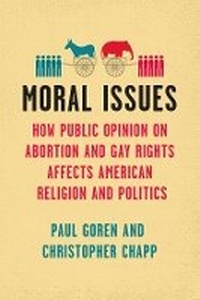
Moral Issues
How Public Opinion on Abortion and Gay Rights Affects American Religion and Politics
Published on 13. December 2024
Book
Hardback
234 pages
978-0-226-83665-2 (ISBN)
Description
A new perspective on how beliefs about abortion and gay rights reshaped American politics.
Many believe that religious and partisan identities undergird American public opinion. However, when it comes to abortion and gay rights, the reverse may be closer to the truth.
Drawing on wide-ranging evidence, Paul Goren and Christopher Chapp show that views on abortion and gay rights are just as durable and politically impactful-and often more so-than political and religious identities. Goren and Chapp locate the lasting strength of stances on abortion and gay rights in the automatic, visceral emotions that the media has primed since the late 1980s. Moral Issues examines how attitudes toward these moralized issues affect, and can sometimes even disrupt, religious and partisan identities. Indeed, over the last thirty years, these attitudes have accelerated the rise of the religious "nones," who have no religious affiliation, and promoted moral sorting into the Democratic and Republican parties.
Many believe that religious and partisan identities undergird American public opinion. However, when it comes to abortion and gay rights, the reverse may be closer to the truth.
Drawing on wide-ranging evidence, Paul Goren and Christopher Chapp show that views on abortion and gay rights are just as durable and politically impactful-and often more so-than political and religious identities. Goren and Chapp locate the lasting strength of stances on abortion and gay rights in the automatic, visceral emotions that the media has primed since the late 1980s. Moral Issues examines how attitudes toward these moralized issues affect, and can sometimes even disrupt, religious and partisan identities. Indeed, over the last thirty years, these attitudes have accelerated the rise of the religious "nones," who have no religious affiliation, and promoted moral sorting into the Democratic and Republican parties.
Reviews / Votes
"Challenging the conventional wisdom that partisan attachment adopted early in life determines choice for most voters, the authors find that partisan attachment may be more fluid than earlier research suggests...this important work forces a deeper reckoning with the drivers of American electoral politics. The arguments in Moral Issues must be considered in any serious evaluation. Academics and political operatives will benefit from a careful reading of this important book." * Choice * "The strength of Moral Issues lies in the authors' linear and logical approach, painstakingly building their case. The book takes readers on a journey that challenges-or even overturns-what many social scientists believed about the relationship between issue positions, partisanship, and religion. Yet, because the authors present their case so clearly, readers are likely to find themselves nodding along, wondering how anyone could have thought otherwise." * Perspectives on Politics * "At times, the thesis of moral emotion relating to abortion and gay rights can seem a too-easy catch-all to explain the rather complex reasons for people's affiliation with churches and political parties, but Goren and Chapp offer a new and persuasive argument, backed up by data, that a person's views on these moral issues are not some distraction from other important issues but are core beliefs that shape the most important public elements of our identities. In essence, they are arguing that partisan and religious leaders, political consultants and advisors, and the media should take abortion and gay rights as seriously as many citizens do." * The Interim * "Moral Issues offers a clear and carefully structured examination of how opinions on abortion and gay rights interact with religious and political identity. By arguing that deeply held moral stances on these issues drive political choices rather than simply reflecting religious or political affiliation, Goren and Chapp make a valuable contribution to the study of public opinion and religion in American politics." * Reading Religion * "Compelling, convincing, and controversial-but for the right reasons. Goren and Chapp demonstrate that attitudes on abortion and LGBTQ rights are stable, and that these beliefs can shape religious and political behavior such as party identification. Through the sheer amount of data collected and the warts-and-all transparency with which it is presented, the authors leave no stone unturned." -- David Campbell | coauthor of "Secular Surge: A New Fault Line in American Politics" "Chapp and Goren's outstanding analyses show that there are still some limitations on the power of partisan messages to change Americans' underlying attitudes. Indeed, Moral Issues makes an important contribution to our understanding of US politics by convincingly demonstrating that opinions about abortion and gay rights have helped reshape voters' deeply held partisan attachments." -- Michael Tesler | University of California, IrvineMore details
Series
Language
English
Place of publication
Chicago
United States
Publishing group
The University of Chicago Press
Target group
College/higher education
Illustrations
26 halftones, 7 line drawings, 20 tables
Dimensions
Height: 229 mm
Width: 152 mm
Thickness: 20 mm
Weight
454 gr
ISBN-13
978-0-226-83665-2 (9780226836652)
Copyright in bibliographic data and cover images is held by Nielsen Book Services Limited or by the publishers or by their respective licensors: all rights reserved.
Schweitzer Classification
Persons
Paul Goren is professor of political science and the director of the Center for the Study of Political Psychology at the University of Minnesota. He is the author of On Voter Competence. Christopher Chapp is professor of political science and the Morrison Family Director of the Institute for Freedom and Community at St. Olaf College. He is the author of Religious Rhetoric and American Politics.
Content
List of Figures
List of Tables
Chapter 1. Moral Hunches
Chapter 2. The Theory of Moral Power
Chapter 3. Moral Messaging
Chapter 4. Moral Emotions and Attitude Stability
Chapter 5. Stand Patters, Switchers, and Collective Opinion
Chapter 6. Moral Issues and Religious Disaffiliation
Chapter 7. Moral Issues and Party Change
Chapter 8. Abortion, Gay Rights, and American Politics
Acknowledgments
Appendixes
Notes
Bibliography
Index
List of Tables
Chapter 1. Moral Hunches
Chapter 2. The Theory of Moral Power
Chapter 3. Moral Messaging
Chapter 4. Moral Emotions and Attitude Stability
Chapter 5. Stand Patters, Switchers, and Collective Opinion
Chapter 6. Moral Issues and Religious Disaffiliation
Chapter 7. Moral Issues and Party Change
Chapter 8. Abortion, Gay Rights, and American Politics
Acknowledgments
Appendixes
Notes
Bibliography
Index