

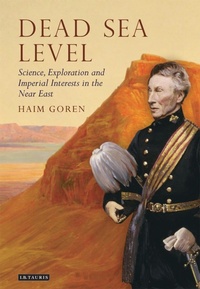
Dead Sea Level
Science, Exploration and Imperial Interests in the Near East
Published on 25. February 2011
Book
Hardback
384 pages
978-1-84885-496-3 (ISBN)
Description
In the nineteenth century The Dead Sea and the Tigris-Euphrates river system had great political significance: the one as a possible gateway for a Russian invasion of Egypt, the other as a potentially faster route to India. This is the traditional explanation for the presence of the international powers in the region. This important new book questions this view. Through a study of two important projects of the time - international efforts to determine the exact level of the Dead Sea, and Chesney's Euphrates Expedition to find a quicker route to India - Professor Goren shows how other forces than the interests of empire, were involved. He reveals the important role played by private individuals and establishes a wealth of new connections between the key players; and he reveals for the first time an important Irish nexus. The resulting work adds an important new dimension to our existing understanding of this period.
Reviews / Votes
'This is a work of exemplary scholarship - learned, reflective, and deeply considered.' - Andrew Lambert, Laughton Professor of Naval History, Kings College, University of LondonMore details
Series
Language
English
Place of publication
United Kingdom
Publishing group
Bloomsbury Publishing PLC
Target group
College/higher education
Product notice
Laminated cover
Illustrations
50 b/w integrated
Dimensions
Height: 234 mm
Width: 156 mm
Thickness: 22 mm
Weight
717 gr
ISBN-13
978-1-84885-496-3 (9781848854963)
Copyright in bibliographic data and cover images is held by Nielsen Book Services Limited or by the publishers or by their respective licensors: all rights reserved.
Schweitzer Classification
Other editions
Additional editions
E-Book
02/2011
1st Edition
I.B. Tauris
€155.99
Available for download
Person
Haim Goren is an historical geographer in the Department of Interdisciplinary Studies, Tel-Hai College, Israel. His main fields of interest are European activity in Ottoman Palestine and the Near East, the history of the scientific study of that region, mainly the Holy Land, and pilgrim and traveller literature.
Content
Introduction
PART I. Britain, Europe, and the Near East, 1830-50
Chapter 1 European military agents in the early 1830s: 'The early spies' Callier, Chesney and Lvov
Chapter 2 The Euphrates Expedition, 1834-7
2.1 British interests and activities in Syria and Palestine
2.2 British military scientific enterprises in Palestine following the 1840 campaign
PART II The Dead Sea and the Jordan Rift Valley, myth and research
Chapter 3 Early explorers
3.1 Costigan, the first victim, and the sailing on the Dead Sea
3.2 'It appears to be considerably lower than the ocean': Moore and Beek
Chapter 4 'The chase after the level', Dead Sea and Jordan depression measurements 1837-1848:
First barometrical measurements
Chapter 5 Who should be crowned as the great discoverer? Publications and discussions following
Moore's and Beek's report
Chapter 6 Further measurements and triangulation
Chapter 7 Conclusive explorations: Molyneux and Lynch
Conclusive remarks
Bibliography
Name Index
Index Locorum
PART I. Britain, Europe, and the Near East, 1830-50
Chapter 1 European military agents in the early 1830s: 'The early spies' Callier, Chesney and Lvov
Chapter 2 The Euphrates Expedition, 1834-7
2.1 British interests and activities in Syria and Palestine
2.2 British military scientific enterprises in Palestine following the 1840 campaign
PART II The Dead Sea and the Jordan Rift Valley, myth and research
Chapter 3 Early explorers
3.1 Costigan, the first victim, and the sailing on the Dead Sea
3.2 'It appears to be considerably lower than the ocean': Moore and Beek
Chapter 4 'The chase after the level', Dead Sea and Jordan depression measurements 1837-1848:
First barometrical measurements
Chapter 5 Who should be crowned as the great discoverer? Publications and discussions following
Moore's and Beek's report
Chapter 6 Further measurements and triangulation
Chapter 7 Conclusive explorations: Molyneux and Lynch
Conclusive remarks
Bibliography
Name Index
Index Locorum