

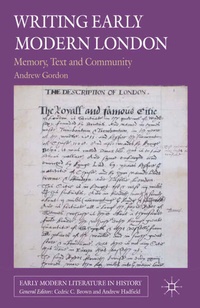
Writing Early Modern London
Memory, Text and Community
Published on 1. January 2013
Book
Paperback/Softback
VIII, 264 pages
978-1-349-45167-8 (ISBN)
Description
Writing Early Modern London explores how urban community in London was experienced, imagined and translated into textual form. Ranging from previously unstudied manuscripts to major works by Middleton, Stow and Whitney, it examines how memory became a key cultural battleground as rites of community were appropriated in creative ways.
Reviews / Votes
"...whereas such volumes often offer little more than a collection of essays on a narrow range of canonical or proto-canonical literary works, this book both promises and delivers a great deal more, and should be read by all historians of early modern London or urban culture between the Reformation and the Civil War... This is truly a model of new historicism in action." Jonathan Barry, Urban History
More details
Series
Edition
1st ed. 2013
Language
English
Place of publication
London
United Kingdom
Target group
Professional and scholarly
Illustrations
VIII, 264 p.
Dimensions
Height: 216 mm
Width: 140 mm
Thickness: 16 mm
Weight
351 gr
ISBN-13
978-1-349-45167-8 (9781349451678)
DOI
10.1057/9781137294920
Schweitzer Classification
Other editions
Additional editions
Book
05/2013
Palgrave Macmillan
€53.49
Shipment within 10-20 days
Person
Andrew Gordon is a Lecturer in Renaissance Literature at the University of Aberdeen, UK. He is the author of numerous articles and chapters on early modern London, manuscript culture and correspondence. He has edited (with Bernhard Klein)
Literature, Mapping and the Politics of Space in Early Modern Britain
(2001), and (with Thomas Rist)
The Arts of Remembrance in Early Modern Britain
(2013).
Content
1. Introduction: Writing the City 2. Henry Machyn's Book of Remembrance 3. Contesting Inheritance: William Smith and Isabella Whitney 4. John Stow and the Textuality of Custom 5. Credit History to Civic History: Thomas Middleton and the Politics of Urban Memory 6. Conclusion