

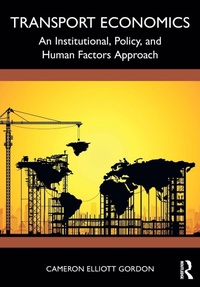
Transport Economics
An Institutional, Policy, and Human Factors Approach
1st Edition
Published on 8. August 2025
Book
Paperback/Softback
430 pages
978-1-032-39680-4 (ISBN)
Description
This book takes an interdisciplinary, institutional, and historically informed approach to the economics of transport, providing a more nuanced and complete understanding of human transport choices, individually and collectively, and the related choice of location, including the formation of cities.
The first principles of standard economic theory - referred to here as the core model - are systematically analysed, with a particular focus on the strengths and weaknesses of the simplifying assumptions used. The economic dynamics of modern transport systems are explored in light of theory and practice, covering such topics as the role of incentives, technological change and economic growth, and the enabling role that transport plays in productivity. Many historical and present-day examples are provided to explore the real-world nuance and subtlety that crops up repeatedly in transport activity, using additional disciplinary lenses such as planning, engineering, psychology, and sociology. Overall, the book examines the implications of the unique particularities of human beings, including the quirks of their psychologies and physical bodies, for transport planning, development, and implementation. A focus is kept on the "real world" policy complications that arise so frequently in the transport arena.
The book, while aimed at university students, will also appeal with its holistic, thoughtful approach to researchers interested in transport, urban planning, and its effective delivery. Policy-makers and practitioners seeking a broad overview of the field beyond their specialisations will also enjoy this book.
The first principles of standard economic theory - referred to here as the core model - are systematically analysed, with a particular focus on the strengths and weaknesses of the simplifying assumptions used. The economic dynamics of modern transport systems are explored in light of theory and practice, covering such topics as the role of incentives, technological change and economic growth, and the enabling role that transport plays in productivity. Many historical and present-day examples are provided to explore the real-world nuance and subtlety that crops up repeatedly in transport activity, using additional disciplinary lenses such as planning, engineering, psychology, and sociology. Overall, the book examines the implications of the unique particularities of human beings, including the quirks of their psychologies and physical bodies, for transport planning, development, and implementation. A focus is kept on the "real world" policy complications that arise so frequently in the transport arena.
The book, while aimed at university students, will also appeal with its holistic, thoughtful approach to researchers interested in transport, urban planning, and its effective delivery. Policy-makers and practitioners seeking a broad overview of the field beyond their specialisations will also enjoy this book.
Reviews / Votes
"A compelling read, that flies through a vast range of ways that urban transport affects society and its space-time dimensions. It traces changes over time in technologies and economies to show how they have shifted roles of urban transport, viewed through an interdisciplinary lens that incorporates foundational economic theory."Glen Weisbrod, founder and former CEO, Economic Development Research Group, US
"A non technical approach to transport economics, enlivened by real life case studies of transport issues. Maybe a text book in name but the topics are so interestingly presented with relevant vignettes in boxes that knowledge is gained without effort."
Corinne Mulley, Professor Emerita, University of Sydney, Australia
More details
Language
English
Place of publication
London
United Kingdom
Publishing group
Taylor & Francis Ltd
Target group
College/higher education
Postgraduate and Undergraduate Advanced
Illustrations
57 s/w Abbildungen, 26 s/w Photographien bzw. Rasterbilder, 31 s/w Zeichnungen, 13 s/w Tabellen
13 Tables, black and white; 31 Line drawings, black and white; 26 Halftones, black and white; 57 Illustrations, black and white
Dimensions
Height: 244 mm
Width: 170 mm
Thickness: 25 mm
Weight
798 gr
ISBN-13
978-1-032-39680-4 (9781032396804)
Copyright in bibliographic data and cover images is held by Nielsen Book Services Limited or by the publishers or by their respective licensors: all rights reserved.
Schweitzer Classification
Other editions
Additional editions
E-Book
08/2025
Routledge
€55.49
Available for download
E-Book
08/2025
Routledge
€55.49
Available for download
Book
08/2025
1st Edition
Routledge
€208.00
Shipment within 10-20 days
Person
Cameron Elliott Gordon is Adjunct Associate Professor (Australian National University) and has been on the faculties of the City University of New York and University of Southern California; served on Transportation Research Board (TRB) programme committees; and worked in the US federal, and New York City governments.
Content
Table of Contents
Acknowledgements
List of Acronyms and Abbreviations
Glossary of Main Transport and Economics Terms
Useful Websites and Further Reading
Section 1: Transport economics basics
1. Introduction
2. Basic elements
3. Markets
4. Geography
Section 2: Transport Demand
5. User travel choices
6. Modes and mode choice
7. Cost
8. Transport and the human body
Section 3: Transport supply
9. Infrastructure and vehicles
10. Finance and funding
11. Planning, management and governance
12. Operational issues
Section 3: "System" policy issues
13. Externalities and other market failures
14. Justice, equity, disadvantage, and social exclusion
15. Economic evaluation of transport
16. Logistics, freight, and supply and value chains
17. Resilience and sustainability
18. Political economy
19. Human factors
20. Micro-mobility versus large networks and Mobility as a Service (MaaS)
21. Some conclusions above the past, present, and future
Index
Acknowledgements
List of Acronyms and Abbreviations
Glossary of Main Transport and Economics Terms
Useful Websites and Further Reading
Section 1: Transport economics basics
1. Introduction
2. Basic elements
3. Markets
4. Geography
Section 2: Transport Demand
5. User travel choices
6. Modes and mode choice
7. Cost
8. Transport and the human body
Section 3: Transport supply
9. Infrastructure and vehicles
10. Finance and funding
11. Planning, management and governance
12. Operational issues
Section 3: "System" policy issues
13. Externalities and other market failures
14. Justice, equity, disadvantage, and social exclusion
15. Economic evaluation of transport
16. Logistics, freight, and supply and value chains
17. Resilience and sustainability
18. Political economy
19. Human factors
20. Micro-mobility versus large networks and Mobility as a Service (MaaS)
21. Some conclusions above the past, present, and future
Index