

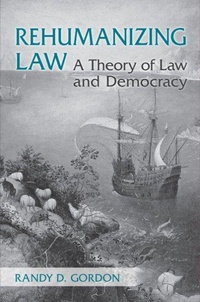
Rehumanizing Law
A Theory of Law and Democracy
Published on 15. April 2011
Book
Hardback
240 pages
978-1-4426-4229-4 (ISBN)
Description
In a popular sense, 'law' connotes the rules of a society, as well as the institutions that make and enforce those rules. Although laws are created and interpreted in legislatures and courtrooms by individuals with very specialized knowledge, the practice and making of law is closely tied to other systems of knowledge. To emphasize this often downplayed connection, Rehumanizing Law examines the law in relation to narrative, a fundamental mode of human expression.
Randy D. Gordon illustrates the bridge between narrative and law by considering whether literature can prompt legislation. Using Upton Sinclair's The Jungle and Rachel Carson's Silent Spring, Gordon shows that literary works can figure in important regulatory measures. Discussing the rule of law in relation to democracy, he reads Melville's Billy Budd and analyzes the O.J. Simpson and Rodney King cases.
This highly original and creative study reconnects the law to its narrative roots by showing how and why stories become laws.
Randy D. Gordon illustrates the bridge between narrative and law by considering whether literature can prompt legislation. Using Upton Sinclair's The Jungle and Rachel Carson's Silent Spring, Gordon shows that literary works can figure in important regulatory measures. Discussing the rule of law in relation to democracy, he reads Melville's Billy Budd and analyzes the O.J. Simpson and Rodney King cases.
This highly original and creative study reconnects the law to its narrative roots by showing how and why stories become laws.
More details
Language
English
Place of publication
Toronto
Canada
Target group
College/higher education
Professional and scholarly
Product notice
sewn/stitched
Cloth over boards
With dust jacket
Dimensions
Height: 234 mm
Width: 160 mm
Thickness: 28 mm
Weight
612 gr
ISBN-13
978-1-4426-4229-4 (9781442642294)
Copyright in bibliographic data and cover images is held by Nielsen Book Services Limited or by the publishers or by their respective licensors: all rights reserved.
Schweitzer Classification
Other editions
Additional editions
E-Book
12/2010
1st Edition
University of Toronto Press
€70.95
Available for download
Person
Randy D. Gordon is an adjunct professor in the Dedman School of Law and a lecturer in English at Southern Methodist University. He is a partner in the Complex Litigation Group of Gardere Wynne Sewell LLP.
Content
Introduction
PART I: Law and Narrative: Reexamining the Relationship
Describing Law in Terms of Autonomy
Narrative as the Basis of Law and the Humanities
Shelley's Case, Part 1: Law of The Jungle
Shelley's Case, Part 2: Silent Spring
Law, Literature, and Narrative
What is Narrative?
How Narratives Interact to Influence Legislation
Text in Context
What's Truth Have to Do with It?
Whose Story to Believe?
PART II: Institutionalizing Narratives
Narrative and the Normative Syllogism
The Narrative Nudge
When Narratives Clash
Changes in Narrative, Changes in Law
Law's Constraints: Genetic or Precedential?
Novelizing Law
Resisting Narratives: Keeping the Outside Out
Absorbing Narratives: Letting the Outside In
What Law Can Learn from Literature (and History)
PART III: Law, Narrative, and Democracy
The Rule of Law and Its Limits
Toward a Democratic Rule of Law
The Jury as a Structural Safeguard of Democracy
The Democratic Role of Interpretive Communities
A Study in Contrasts: The Rodney King and O.J. Simpson Juries
Is Jury Nullification Democratic and Within the Rule of Law?
Some Thoughts on Democratic Interpretation
PART IV: Narrative as Democratic Reasoning
The Narrative Shape of Deliberation
Law-as-Discipline
The Problem with Appellate Practice and Appellate Opinions
(Re)Introducing Narratives in the Classroom
Democratic Education, Private Reason, and the Law
A Conclusion of Sorts
Notes
Bibliography
Index
PART I: Law and Narrative: Reexamining the Relationship
Describing Law in Terms of Autonomy
Narrative as the Basis of Law and the Humanities
Shelley's Case, Part 1: Law of The Jungle
Shelley's Case, Part 2: Silent Spring
Law, Literature, and Narrative
What is Narrative?
How Narratives Interact to Influence Legislation
Text in Context
What's Truth Have to Do with It?
Whose Story to Believe?
PART II: Institutionalizing Narratives
Narrative and the Normative Syllogism
The Narrative Nudge
When Narratives Clash
Changes in Narrative, Changes in Law
Law's Constraints: Genetic or Precedential?
Novelizing Law
Resisting Narratives: Keeping the Outside Out
Absorbing Narratives: Letting the Outside In
What Law Can Learn from Literature (and History)
PART III: Law, Narrative, and Democracy
The Rule of Law and Its Limits
Toward a Democratic Rule of Law
The Jury as a Structural Safeguard of Democracy
The Democratic Role of Interpretive Communities
A Study in Contrasts: The Rodney King and O.J. Simpson Juries
Is Jury Nullification Democratic and Within the Rule of Law?
Some Thoughts on Democratic Interpretation
PART IV: Narrative as Democratic Reasoning
The Narrative Shape of Deliberation
Law-as-Discipline
The Problem with Appellate Practice and Appellate Opinions
(Re)Introducing Narratives in the Classroom
Democratic Education, Private Reason, and the Law
A Conclusion of Sorts
Notes
Bibliography
Index