

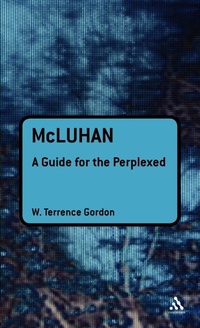
McLuhan: A Guide for the Perplexed
A Guide for the Perplexed
Published on 25. February 2010
Book
Hardback
216 pages
978-1-4411-2629-0 (ISBN)
Description
Marshall McLuhan was dubbed a media guru when he came to prominence in the 1960s. The Woodstock generation found him cool; their parents found him perplexing. Today he is often referred to as a media ecologist, a phrase that would have pleased him for its resonance with James Joyces Echoland. Joyces kaleidoscopic verbal creativity stimulated McLuhans vision for a unified explanation of everything from Woodstock to Wall Street, from woodcuts to weapons, in terms of media and their effects. During his career, he found time to write about high literature (Chesterton, Wyndham Lewis, Pound, Joyce) and popular culture (movies, comics, and advertising), managing even to explore the link between them in reviewing the work of his arch-rival Northrop Frye (Inside Blake and Hollywood). By 1963 McLuhan was Director of the Centre for Culture and Technology at the University of Toronto and would be a public intellectual on the international stage for more than a decade, then linked forever to his two best known coinages: the global village and the medium is the message.Both phrases express a paradox.
We easily interpret the first as an image for our planet dramatically shrunken by the powerful media of instant communication. Broadband buzz and G3 gossip. For this we scarcely need McLuhan. But the medium is the message has an unsettling counter-intuitive quality that provoked critical commentaries many of startling irrelevance to McLuhans thrust and purpose. Legions of bewildered students and intimidated faculty may have kept silent, and McLuhans many interviewers often merely registered irritation, but Jonathan Miller and Umberto Eco were among the luminaries who lodged vigorous protests, stumbling over McLuhans metaphor for how media operate and how they shape and control the speed, scale, and forms of human association and action. This was the key idea at the core of his Understanding Media. Even as Understanding Media was launched, McLuhan was raiding psychology, philosophy, structuralism, and taking second plunder from literary studies. By the end of his career, he had harnessed the complementarities of figure/ground, cause/effect, structure/function, and clich/archetype to his earlier work.
Their full and final expression was achieved in the posthumously published Laws of Media. Taken as a whole, McLuhans writings reveal a profound coherence and illuminate his unifying vision for the study of language, literature, and culture, grounded in the broad understanding of any medium or technology as an extension of the human body. McLuhan: A Guide for the Perplexed is a close reading of all of his work with a focus on tracing the systematic development of his thought. The overriding objective is to clarify all of McLuhans thinking, to consolidate it in a fashion which prevents misreadings, and to open the way to advancing his own program: ensuring that the world does not sleepwalk into the twenty-first century with nineteenth-century perceptions.
We easily interpret the first as an image for our planet dramatically shrunken by the powerful media of instant communication. Broadband buzz and G3 gossip. For this we scarcely need McLuhan. But the medium is the message has an unsettling counter-intuitive quality that provoked critical commentaries many of startling irrelevance to McLuhans thrust and purpose. Legions of bewildered students and intimidated faculty may have kept silent, and McLuhans many interviewers often merely registered irritation, but Jonathan Miller and Umberto Eco were among the luminaries who lodged vigorous protests, stumbling over McLuhans metaphor for how media operate and how they shape and control the speed, scale, and forms of human association and action. This was the key idea at the core of his Understanding Media. Even as Understanding Media was launched, McLuhan was raiding psychology, philosophy, structuralism, and taking second plunder from literary studies. By the end of his career, he had harnessed the complementarities of figure/ground, cause/effect, structure/function, and clich/archetype to his earlier work.
Their full and final expression was achieved in the posthumously published Laws of Media. Taken as a whole, McLuhans writings reveal a profound coherence and illuminate his unifying vision for the study of language, literature, and culture, grounded in the broad understanding of any medium or technology as an extension of the human body. McLuhan: A Guide for the Perplexed is a close reading of all of his work with a focus on tracing the systematic development of his thought. The overriding objective is to clarify all of McLuhans thinking, to consolidate it in a fashion which prevents misreadings, and to open the way to advancing his own program: ensuring that the world does not sleepwalk into the twenty-first century with nineteenth-century perceptions.
Reviews / Votes
For anyone who is serious about understanding the origins of contemporary media theory, one must understand the origins of the original media theorist, Marshall McLuhan. Gordon's new book provides a unique insight into what made McLuhan think, and think in the way that took the world of the 1960s and subsequent by maelstrom. -- Mark Federman, Researcher at OISE, University of Toronto, and Former Chief Strategist, McLuhan Program in Culture and Technology, University of Toronto Marshall McLuhan (1911-80) was a complex and sometimes confusing thinker. He certainly deserves a 'guide for the perplexed', and W. Terrence Gordon attempts to provide one.-Journal of Media and Cultural PoliticsMore details
Series
Language
English
Place of publication
New York
United States
Target group
Professional and scholarly
Dimensions
Height: 222 mm
Width: 145 mm
Thickness: 16 mm
Weight
439 gr
ISBN-13
978-1-4411-2629-0 (9781441126290)
Copyright in bibliographic data and cover images is held by Nielsen Book Services Limited or by the publishers or by their respective licensors: all rights reserved.
Schweitzer Classification
Other editions
Additional editions
W. Terrence Gordon
McLuhan: A Guide for the Perplexed
E-Book
02/2010
1st Edition
Bloomsbury Continuum
€28.49
Available for download
Person
W. Terrence Gordon is Professor Emeritus at Dalhousie University, Halifax, Nova Scotia, Canada and Part-time lecturer in Linguistics at St. Mary's University, Halifax. He is the author of the three titles on McLuhan and the editor of the critical editions of his Understanding Media (2003), McLuhanUnbound (2005), and The Classical Trivium: The Place of Thomas Nashe in the Learning of his Time (2006). His McLuhan for Beginners brought him the invitation from the McLuhan family to write his biography: Marshall McLuhan: Escape into Understanding, critically acclaimed in The New York Times and many other sources. Professor Gordon is also the librettist of a multimedia opera about McLuhan. His Everyman's Joyce is scheduled for release this month.
Content
Preface; 1) Introduction: Background, Context, Definitions, and...Stumbling Blocks; 2) Literary Links: G. K.Chesterton, Ezra Pound & T.S. Eliot, James Joyce, Thomas Nashe; 3) From Madison, Wisconsin to Madison Avenue:The Mechanical Bride and her Electrical Brood; 4) From Media as Political Forms to Understanding Media; 5) McLuhan's Tool Box: From Through the Vanishing Point to Laws of Media; 6) Using Mcluhn's Tools; 7) Further Readings; 8) Notes; 9) References.