

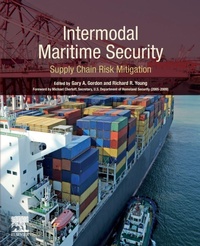
Intermodal Maritime Security
Supply Chain Risk Mitigation
Published on 26. November 2020
Book
Paperback/Softback
400 pages
978-0-12-819945-9 (ISBN)
Description
Intermodal Maritime Security: Supply Chain Risk Mitigation offers every stakeholder involved in international transactions the tools needed to assess the essential risks, threats and vulnerabilities within the global supply chain. The book examines the role intermodal maritime transportation plays in global security, surveying its critical policies, procedures, operations, infrastructure and systems. Linking new technological standards with intermodal operations, this book provides the foundational knowledge readers need, including transportation and maritime trade students, researchers, practitioners and regulatory agencies.
More details
Language
English
Place of publication
United States
Target group
College/higher education
Primary audience:Transportation, Operations Management, Logistics, Supply Chain Management, and Maritime researchers, scholars, and graduate students
Secondary audience: Maritime industry practitioners, consultants, and authorities
Product notice
Paperback (trade)
Dimensions
Height: 239 mm
Width: 192 mm
Thickness: 24 mm
Weight
830 gr
ISBN-13
978-0-12-819945-9 (9780128199459)
Copyright in bibliographic data and cover images is held by Nielsen Book Services Limited or by the publishers or by their respective licensors: all rights reserved.
Schweitzer Classification
Other editions
Additional editions
E-Book
11/2020
Elsevier
€118.00
Available for download
Persons
Gary A. Gordon is a Professor of Professional Practice at the University of Massachusetts Lowell. He holds a Ph.D. and B.S in Civil Engineering, and MBA from the University of Massachusetts Lowell, and M.S. in Civil Engineering from the University of Maryland. Prior to academia, Dr. Gordon had a lengthy career in transportation operations, security and infrastructure design and construction, to include in the U.S. Army Reserve. During his career he held positions as Assistant Federal Security Director-Surface Transportation for DHS/Transportation Security Administration and Assistant Chief Engineer-Design & Construction of a former Class I Northeast Railroad. He is a co-editor of Intermodal Maritime Security: Supply Chain Risk Mitigation, co-author of Railway Security: Protecting Against Manmade and Natural Disasters and Securing Integrated Transportation Networks and is on the editorial board of the Journal of Transportation Security.
Richard R. Young is Distinguished Professor of Supply Chain Management at The Pennsylvania State University. He holds a B.S. in Operations Management from Rider University, M.B.A. from Albany University, and Ph.D. in Business Logistics from The Pennsylvania State University. Dr. Young is a fellow of the Chartered Institute of Logistics and Transport of the United Kingdom and is accepted to practice before the U.S. Federal Maritime Commission. Prior to academia, he held various supply chain management positions in industry. Dr. Young is on the editorial boards of several leading supply chain journals, a Fulbright German Research Scholar, and he received the 2008 Distinguished Educator Award of the National Defense Transportation Association. He is co-author of the book Railway Security: Protecting Against Manmade and Natural Disasters and co-editor of Intermodal Maritime Security: Supply Chain Risk Mitigation.
Richard R. Young is Distinguished Professor of Supply Chain Management at The Pennsylvania State University. He holds a B.S. in Operations Management from Rider University, M.B.A. from Albany University, and Ph.D. in Business Logistics from The Pennsylvania State University. Dr. Young is a fellow of the Chartered Institute of Logistics and Transport of the United Kingdom and is accepted to practice before the U.S. Federal Maritime Commission. Prior to academia, he held various supply chain management positions in industry. Dr. Young is on the editorial boards of several leading supply chain journals, a Fulbright German Research Scholar, and he received the 2008 Distinguished Educator Award of the National Defense Transportation Association. He is co-author of the book Railway Security: Protecting Against Manmade and Natural Disasters and co-editor of Intermodal Maritime Security: Supply Chain Risk Mitigation.
Content
Section I Introduction
1. 9/11, MTSA and how we got to where we are
Section II Overview of Intermodal Maritime Operations
2. Intermodalism History, Advantages, and Disadvantages
3. Water and Landside Components
4. Other Transportation Modes
Section III The Nature of Intermodal Maritime Security Risk
5. Nature of the Intermodal Maritime Security Risk
6. Components of Intermodal Maritime Security Risk
7. Threats from Terrorists and other Violent Non-State Actors
8. Physical and Technological Considerations
9. Vulnerabilities, Gaps and the Future of Physical and Technological Security Measures
10. Information Security and Cyber Threats and Vulnerabilities
Section IV Security Measures and Public Policy
11. Multilateral Trading Partner Policies
12. Intermodal Transport Security: An Israeli Perspective
Section V Risk Mitigation Approach
13. Assessment at Foreign Ports of Loading
14. In-Transit Threats and Risk Management
15. Assessment at U.S. Ports
16. Routing Analysis, Risk and Resiliency
Section VI The Way Forward: Recommendations
17. Application of Systems Theory
18. Public Policy and Security Partnerships
19. Intermodal Maritime Security: Where Do We Go From Here?
1. 9/11, MTSA and how we got to where we are
Section II Overview of Intermodal Maritime Operations
2. Intermodalism History, Advantages, and Disadvantages
3. Water and Landside Components
4. Other Transportation Modes
Section III The Nature of Intermodal Maritime Security Risk
5. Nature of the Intermodal Maritime Security Risk
6. Components of Intermodal Maritime Security Risk
7. Threats from Terrorists and other Violent Non-State Actors
8. Physical and Technological Considerations
9. Vulnerabilities, Gaps and the Future of Physical and Technological Security Measures
10. Information Security and Cyber Threats and Vulnerabilities
Section IV Security Measures and Public Policy
11. Multilateral Trading Partner Policies
12. Intermodal Transport Security: An Israeli Perspective
Section V Risk Mitigation Approach
13. Assessment at Foreign Ports of Loading
14. In-Transit Threats and Risk Management
15. Assessment at U.S. Ports
16. Routing Analysis, Risk and Resiliency
Section VI The Way Forward: Recommendations
17. Application of Systems Theory
18. Public Policy and Security Partnerships
19. Intermodal Maritime Security: Where Do We Go From Here?