

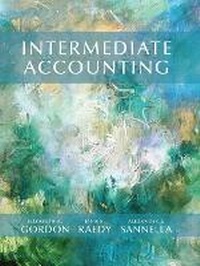
Intermediate Accounting
Published on 9. October 2015
Book
Hardback
1424 pages
978-0-13-216230-2 (ISBN)
Description
This title is intended for students in the intermediate accounting course, but can also be used as a reference for practicing professionals.
Think like an accountant -- from the first day of class, throughout your career.
Thinking like an accountant isn't just rote memorization of accounting rules. Rather, it's developing the judgment and decision-making skills needed to form accounting estimates and evaluate financial statements critically. With its focus on Conceptual Framework fundamentals and critical thinking, Gordon, Raedy, and Sannella's Intermediate Accounting give readers opportunities to develop problem-solving skills, apply their judgment, and work with real company financials-all of the skills necessary to succeed in the course, and beyond. After mastering these essential skills, readers will not only be prepared to pass the CPA exam, they'll be able to think like accountants.
Also Available with MyAccountingLab
This title is also available with MyAccountingLab - an online homework, tutorial, and assessment program designed to work with Intermediate Accounting to engage students and improve results. From the first day of class, the interactive Accounting Cycle Tutorial gives students ample practice to refresh the basics, allowing instructors to spend valuable class time focusing on intermediate-level concepts and applications. Throughout the course, students test their understanding, receive helpful feedback on their errors, and practice solving accounting problems the way they will in their careers.
NOTE: You are purchasing a standalone product; MyAccountingLab does not come packaged with this content. If you would like to purchase both the physical text and MyAccountingLab search for ISBN: 0134053710 / 9780134053714. That package includes ISBN: 013216230X / 9780132162302 and ISBN: 0134041216 / 9780134041216.
MyAccountingLab should only be purchased when required by an instructor.
Think like an accountant -- from the first day of class, throughout your career.
Thinking like an accountant isn't just rote memorization of accounting rules. Rather, it's developing the judgment and decision-making skills needed to form accounting estimates and evaluate financial statements critically. With its focus on Conceptual Framework fundamentals and critical thinking, Gordon, Raedy, and Sannella's Intermediate Accounting give readers opportunities to develop problem-solving skills, apply their judgment, and work with real company financials-all of the skills necessary to succeed in the course, and beyond. After mastering these essential skills, readers will not only be prepared to pass the CPA exam, they'll be able to think like accountants.
Also Available with MyAccountingLab
This title is also available with MyAccountingLab - an online homework, tutorial, and assessment program designed to work with Intermediate Accounting to engage students and improve results. From the first day of class, the interactive Accounting Cycle Tutorial gives students ample practice to refresh the basics, allowing instructors to spend valuable class time focusing on intermediate-level concepts and applications. Throughout the course, students test their understanding, receive helpful feedback on their errors, and practice solving accounting problems the way they will in their careers.
NOTE: You are purchasing a standalone product; MyAccountingLab does not come packaged with this content. If you would like to purchase both the physical text and MyAccountingLab search for ISBN: 0134053710 / 9780134053714. That package includes ISBN: 013216230X / 9780132162302 and ISBN: 0134041216 / 9780134041216.
MyAccountingLab should only be purchased when required by an instructor.
More details
Other editions
New editions
Elizabeth Gordon | Jana Raedy | Alexander Sannella
Intermediate Accounting
Book
01/2018
2nd Edition
Pearson
€334.24
Article exhausted; check for reprint
Persons
Elizabeth A. Gordon, Ph.D., MBA
Elizabeth A. Gordon is an associate professor of accounting at the Fox Business School at Temple University, and Merves Research Fellow. She received her Doctorate from Columbia University, Master's in Business Administration from Yale University, and Bachelor's of Science in Accounting with highest distinction from Indiana University.
Dr. Gordon specializes in the areas of international financial reporting and corporate governance. Her research is published in top journals including the Journal of Accounting Research, the Journal of Accounting, Auditing and Finance, and The Accounting Review. She serves on the editorial review boards of the Journal of International Accounting Research, The International Journal of Accounting, and the Accounting Research Journal. She is an ex officio member of the Executive Committee of the International Association of Accounting Education and Research.
Dr. Gordon has taught courses in financial accounting and international accounting at the graduate and undergraduate levels, receiving a number of teaching awards. She has co-authored accounting readings for the CFA Institute, integrating IFRS and U.S. GAAP. She was an auditor with PricewaterhouseCoopers, LLP and interned at the Office of Management and Budget before entering academia. Dr. Gordon was licensed as a CPA in Maryland. She has been on the faculty of the Graduate School of Business at the University of Chicago, the Rutgers Business School, and a visiting professor at the University of Pennsylvania.
Jana S. Raedy, Ph.D., CPA
Jana Raedy is an associate professor of accounting, associate dean of the Master of Accounting Program, and the Ernst & Young Scholar in Accounting at the Kenan-Flager Business School at the University of North Carolina at Chapel Hill. She received her B.S. and M.S. from the University of Kentucky and her Ph.D. from the Pennsylvania State University.
Dr. Raedy's research is primarily focused on issues in international financial reporting as well as areas where financial reporting and taxation intersect. Her research is published in top journals such as Journal of Accounting Research, Journal of Accounting and Economics, The Accounting Review, Contemporary Accounting Research and Journal of the American Taxation Association.
Dr. Raedy has taught a number of courses in financial reporting at the graduate level, including core financial reporting (both introductory and intermediate accounting), international financial reporting, and forensic accounting. For over fifteen years she has been teaching a self-developed course in applied financial accounting research with a heavy emphasis on judgment and decision making. During her academic career, she has received a number of different teaching awards. She currently is a team member on the Ernst & Young Academic Resource Center, which provides faculty nationwide with comprehensive teaching materials for the integration of IFRS into the accounting curriculum.
Alexander J. Sannella, Ph.D., CPA
Alexander J. Sannella is currently an associate professor of accounting at the Rutgers Business School, the director of the MBA in Professional Accounting Program, and the director of the Rutgers Business School Teaching Excellence Center. He received his Ph.D. in Accounting and Finance from New York University, and is a New York State Certified Public A
Elizabeth A. Gordon is an associate professor of accounting at the Fox Business School at Temple University, and Merves Research Fellow. She received her Doctorate from Columbia University, Master's in Business Administration from Yale University, and Bachelor's of Science in Accounting with highest distinction from Indiana University.
Dr. Gordon specializes in the areas of international financial reporting and corporate governance. Her research is published in top journals including the Journal of Accounting Research, the Journal of Accounting, Auditing and Finance, and The Accounting Review. She serves on the editorial review boards of the Journal of International Accounting Research, The International Journal of Accounting, and the Accounting Research Journal. She is an ex officio member of the Executive Committee of the International Association of Accounting Education and Research.
Dr. Gordon has taught courses in financial accounting and international accounting at the graduate and undergraduate levels, receiving a number of teaching awards. She has co-authored accounting readings for the CFA Institute, integrating IFRS and U.S. GAAP. She was an auditor with PricewaterhouseCoopers, LLP and interned at the Office of Management and Budget before entering academia. Dr. Gordon was licensed as a CPA in Maryland. She has been on the faculty of the Graduate School of Business at the University of Chicago, the Rutgers Business School, and a visiting professor at the University of Pennsylvania.
Jana S. Raedy, Ph.D., CPA
Jana Raedy is an associate professor of accounting, associate dean of the Master of Accounting Program, and the Ernst & Young Scholar in Accounting at the Kenan-Flager Business School at the University of North Carolina at Chapel Hill. She received her B.S. and M.S. from the University of Kentucky and her Ph.D. from the Pennsylvania State University.
Dr. Raedy's research is primarily focused on issues in international financial reporting as well as areas where financial reporting and taxation intersect. Her research is published in top journals such as Journal of Accounting Research, Journal of Accounting and Economics, The Accounting Review, Contemporary Accounting Research and Journal of the American Taxation Association.
Dr. Raedy has taught a number of courses in financial reporting at the graduate level, including core financial reporting (both introductory and intermediate accounting), international financial reporting, and forensic accounting. For over fifteen years she has been teaching a self-developed course in applied financial accounting research with a heavy emphasis on judgment and decision making. During her academic career, she has received a number of different teaching awards. She currently is a team member on the Ernst & Young Academic Resource Center, which provides faculty nationwide with comprehensive teaching materials for the integration of IFRS into the accounting curriculum.
Alexander J. Sannella, Ph.D., CPA
Alexander J. Sannella is currently an associate professor of accounting at the Rutgers Business School, the director of the MBA in Professional Accounting Program, and the director of the Rutgers Business School Teaching Excellence Center. He received his Ph.D. in Accounting and Finance from New York University, and is a New York State Certified Public A
Content
1. The Financial Reporting Environment
2. The Theory Underlying Financial Reporting
3. Judgment and Applied Financial Accounting Research
4. Review of the Accounting Cycle
5. Statements of Net Income and Comprehensive Income
6. Statements of Financial Position and Cash Flows and the Annual Report
7. Accounting and the Time Value of Money
8. Revenue Recognition
9. Cash and Receivables
10. Inventory
11. Acquisition, Cost Allocation, and Derecognition of Long-Term Operating Assets
12. Departures from Historical Cost of Long-Term Operating Assets
13. Operating Liabilities and Contingencies
14. Financing Liabilities
15. Accounting for Stockholders' Equity
16. Investing Assets
17. Accounting for Income Taxes
18. Accounting for Leases
19. Accounting for Employee Compensation and Benefits
20. Earnings Per Share
21. Accounting Changes and Errors
22. The Statement of Cash Flows Revisited
2. The Theory Underlying Financial Reporting
3. Judgment and Applied Financial Accounting Research
4. Review of the Accounting Cycle
5. Statements of Net Income and Comprehensive Income
6. Statements of Financial Position and Cash Flows and the Annual Report
7. Accounting and the Time Value of Money
8. Revenue Recognition
9. Cash and Receivables
10. Inventory
11. Acquisition, Cost Allocation, and Derecognition of Long-Term Operating Assets
12. Departures from Historical Cost of Long-Term Operating Assets
13. Operating Liabilities and Contingencies
14. Financing Liabilities
15. Accounting for Stockholders' Equity
16. Investing Assets
17. Accounting for Income Taxes
18. Accounting for Leases
19. Accounting for Employee Compensation and Benefits
20. Earnings Per Share
21. Accounting Changes and Errors
22. The Statement of Cash Flows Revisited