

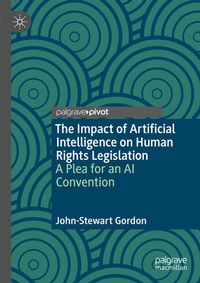
The Impact of Artificial Intelligence on Human Rights Legislation
A Plea for an AI Convention
Published on 1. June 2024
Book
Paperback/Softback
XIII, 88 pages
978-3-031-31390-5 (ISBN)
Description
The unmatched technological achievements in artificial intelligence (AI), robotics, computer science, and related fields over the last few decades can be considered a success story. The technological sophistication has been so groundbreaking in various types of applications that many experts believe that we will see, at some point or another, the emergence of general AI (AGI) and, eventually, superintelligence. This book examines the impact of AI on human rights by focusing on potential risks and human rights legislation and proposes creating a Universal Convention for the Rights of AI Systems (AI Convention).
Reviews / Votes
"In this easy read on artificial intelligence (AI), human rights, and robot rights, the author states different arguments from many different points of view. He refers to this futuristic topic in a very objective way. . I enjoyed reading this book. It will be a good reference for lawmakers, human rights legislators, and anyone who has an interest in the area." (Gulustan Dogan, Computing Reviews, December 13, 2023)More details
Edition
2023 ed.
Language
English
Place of publication
Cham
Switzerland
Publishing group
Springer International Publishing
Target group
Professional and scholarly
Illustrations
XIII, 88 p.
Dimensions
Height: 210 mm
Width: 148 mm
Thickness: 7 mm
Weight
147 gr
ISBN-13
978-3-031-31390-5 (9783031313905)
DOI
10.1007/978-3-031-31388-2
Schweitzer Classification
Other editions
Additional editions
John-Stewart Gordon
The Impact of Artificial Intelligence on Human Rights Legislation
A Plea for an AI Convention
Book
05/2023
Palgrave Macmillan
€53.49
Shipment within 15-20 days
Person
John-Stewart Gordon
, PhD in Philosophy, serves as an adjunct full professor at LSMU and has held various academic roles. He's an associate editor at AI & Society, serves on multiple editorial boards, and is the general editor of Brill's Philosophy and Human Rights series. With over 90 publications, John is a prolific contributor to practical philosophy.
Content
1 General Introduction.- 1.1 General Line of Argumentation.- 1.2 The Caveat.- 1.3 Extreme Scepticism and Robot Rights.- 1.3.1 A Plea for Human Exceptionalism.- 1.3.2 The Mindless Morality View.- 1.3.3 Open-mindedness.- References.- 2 What Is Artificial Intelligence?.- 2.1 Introduction.- 2.2 Defining Artificial Intelligence.- 2.3 Artificial Intelligence and Ethics.- 2.3.1 Three Developmental Periods.- 2.3.2 The Ethics of Artificial Intelligence.- 2.4 Weak and Strong Artificial Intelligence.- 2.5 Superintelligence.- 2.6 Conclusions.- References.- 3 What Are Human Rights?.- 3.1 Introduction.- 3.2 What Are Human Rights?.- 3.2.1 The Concept of Human Rights.- 3.2.2 The Main Features of Human Rights.- 3.2.3 Different Types of Human Rights-A Classification.- 3.3 Moral and Legal Human Rights.- 3.4 Human Rights and Personhood.- 3.4.1 The Human DNA Argument.- 3.4.2 The Human Dignity Argument.- 3.5 Conclusions.- References.- 4 The Impact of Artificial Intelligence on Human Rights.- 4.1 Introduction.- 4.2 Artificial Intelligence and Human Rights-An Overview.- 4.3 Universal Declaration of Human Rights-Abridged Version.- 4.4 Zones of Conflict I-Machines Violate Human Rights.- 4.4.1 Table.- 4.4.2 Comments.- 4.4.3 Table.- 4.4.4 Comments.- 4.4.5 Table.- 4.4.6 Comments.- 4.5 Zones of Conflict II-Humans Violate "Machine Rights".- 4.5.1 Table.- 4.5.2 Comments.- 4.6 Conclusions.- References.- 5 Moving Towards a "Universal Convention for the Rights of AI Systems".- 5.1 Introduction.- 5.2 The Significance of Moral Status.- 5.3 Machine Rights as Fundamental Rights.- 5.4 The Idea of an AI Convention.- 5.5 The Problem of Design.- 5.6 Conclusions.- References.- 6 Objections.- 6.1 Introduction.- 6.2 The Dark Side of Superintelligence.- 6.3 Human Rights Are for Humans and Not Machines.- 6.4 The Argument from Artificial Servitude.- 6.5 Conclusions.- References.- 7 General Conclusions.