

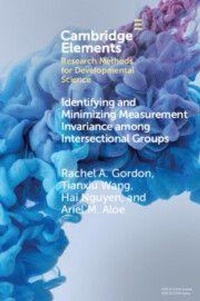
Identifying and Minimizing Measurement Invariance among Intersectional Groups
The Alignment Method Applied to Multi-category Items
Published on 6. July 2023
Book
Paperback/Softback
76 pages
978-1-009-35774-6 (ISBN)
Description
This Element demonstrates how and why the alignment method can advance measurement fairness in developmental science. It explains its application to multi-category items in an accessible way, offering sample code and demonstrating an R package that facilitates interpretation of such items' multiple thresholds. It features the implications for group mean differences when differences in the thresholds between categories are ignored because items are treated as continuous, using an example of intersectional groups defined by assigned sex and race/ethnicity. It demonstrates the interpretation of item-level partial non-invariance results and their implications for group-level differences and encourages substantive theorizing regarding measurement fairness.
More details
Series
Language
English
Place of publication
Cambridge
United Kingdom
Target group
College/higher education
Product notice
Paperback (trade)
Illustrations
Worked examples or Exercises
Dimensions
Height: 229 mm
Width: 152 mm
Thickness: 4 mm
Weight
113 gr
ISBN-13
978-1-009-35774-6 (9781009357746)
Copyright in bibliographic data and cover images is held by Nielsen Book Services Limited or by the publishers or by their respective licensors: all rights reserved.
Schweitzer Classification
Other editions
Additional editions
Rachel A. Gordon | Tianxiu Wang | Hai Nguyen
Identifying and Minimizing Measurement Invariance among Intersectional Groups
The Alignment Method Applied to Multi-category Items
E-Book
07/2023
Cambridge University Press
€20.99
Available for download
Persons
Content
1. Introduction; 2. Formal Presentation of Psychometric Models; 3. Empirical Example; 4. Discussion.