

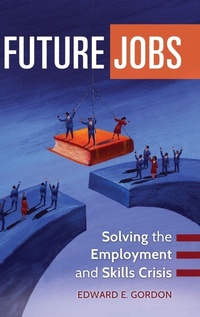
Future Jobs
Solving the Employment and Skills Crisis
Published on 26. August 2013
Book
Hardback
228 pages
978-1-4408-2933-8 (ISBN)
Description
A pervasive disconnect exists between the job/career culture and the present economic reality in America. This book offers powerful strategies for stemming the employment crisis and proposes comprehensive solutions for businesses, government, and job seekers alike.
More than 30 million Americans are unemployed, underemployed, or have given up on looking for a job. Undoubtedly, the massive economic downturn after the financial crisis of 2007-2008 is a key factor in this situation. But the U.S. job market has stalled because our nation is failing to produce workers with the right skills, not because we cannot create enough jobs for the workers.
Future Jobs: Solving the Employment and Skills Crisis offers an economic and historical perspective on the evolution of jobs and careers, explains how technology has permanently altered the U.S. job/labor market, and provides practical information for businesses seeking qualified workers, educators preparing students for careers, unemployed or underemployed individuals, and those interested in changing careers.
The book examines the problem of the mismatch between individuals' skills and employers' job needs from the perspectives of both employers and employees or prospective employees, offering comprehensive regional solutions to the issues each group faces. The author reveals the most promising jobs and careers of the next decade for early-career job seekers and workers with established careers looking to change their path, and provides potential solutions to the jobs and skills disconnect in America, including education reform, business and government policy changes, and regional public-private partnerships.
More than 30 million Americans are unemployed, underemployed, or have given up on looking for a job. Undoubtedly, the massive economic downturn after the financial crisis of 2007-2008 is a key factor in this situation. But the U.S. job market has stalled because our nation is failing to produce workers with the right skills, not because we cannot create enough jobs for the workers.
Future Jobs: Solving the Employment and Skills Crisis offers an economic and historical perspective on the evolution of jobs and careers, explains how technology has permanently altered the U.S. job/labor market, and provides practical information for businesses seeking qualified workers, educators preparing students for careers, unemployed or underemployed individuals, and those interested in changing careers.
The book examines the problem of the mismatch between individuals' skills and employers' job needs from the perspectives of both employers and employees or prospective employees, offering comprehensive regional solutions to the issues each group faces. The author reveals the most promising jobs and careers of the next decade for early-career job seekers and workers with established careers looking to change their path, and provides potential solutions to the jobs and skills disconnect in America, including education reform, business and government policy changes, and regional public-private partnerships.
Reviews / Votes
Edward Gordon brings a good deal of data, insight, and clarity to a hotly debated topic: the skills required by the workers of the Postindustrial Age. . . Future Jobs maps out the dimensions of an underappreciated crisis confronting not only the United States but also many of the world's developed and emerging economies: the rapidly growing shortage of adults who possess the basic skills to qualify for high growth, information-intensive jobs of what the author calls the age of 'cyber-mental work.' . . . Future Jobs makes a convincing case that there is an urgent need to provide tens of millions of U.S. workers-both the unemplyed and employed-with advanced cognitive skills. . . He concludes that the only effective means by which America can timely address its workplace skills crisis is through local initiatives: employers collaborating with educators, government, and civic leadership to provide millions of individuals with the specific skills required to perform the jobs of our Cyber-Mental Age. * The Futurist * Gordon, a business consultant, examines how the United States can reduce workforce skills shortages by offering comprehensive regional solutions. . . . Recommended. * Choice * With wisdom, integrity, compassion, and determination, Dr. Gordon identifies and analyzes the issues, and proposes with demonstrably workable solutions. Gordon concludes, 'As an optimist, I believe that American society's greater flexibility and dynamism will prevail as in past eras. My hope is that Future Jobs will inspire people in many walks of life to take a proactive role in shaping that new jobs and talent era.' * The National Career Development Association *More details
Language
English
Place of publication
United States
Publishing group
Bloomsbury Publishing Plc
Target group
College/higher education
Dimensions
Height: 240 mm
Width: 161 mm
Thickness: 17 mm
Weight
511 gr
ISBN-13
978-1-4408-2933-8 (9781440829338)
Copyright in bibliographic data and cover images is held by Nielsen Book Services Limited or by the publishers or by their respective licensors: all rights reserved.
Schweitzer Classification
Other editions
Additional editions
E-Book
03/2018
1st Edition
Praeger Publishers Inc
€29.49
Available for download
E-Book
08/2013
1st Edition
Praeger Publishers Inc
from
€43.69
Available for download
Persons
Edward E. Gordon, PhD, is president of Imperial Consulting Corporation in Chicago, IL.
Content
Foreword by Kevin Hollenbeck
Acknowledgments
Introduction: The Jobs Revolution
Part I: Jobs and Careers
1 The "Good Jobs"
2 Career versus Jobs: What Are the Issues?
Part II: The Roadblocks
3 The Widening Job-Skills Gap
4 Career Culture-Business Culture Fantasies
5 The "Big Lie"
Part III: The Breakthroughs
6 Regional Talent Innovation Networks (RETAINs)
7 Future Jobs at the Grassroots
Part IV: The Future
8 A New Business Agenda
9 Government Realignment
10 Falling Off the Talent Cliff
Appendix I: Career Analysis Scorecard
Appendix II: Training Return-on-Investment: Human Capital ROI Worksheet Example
Appendix III: Comprehensive Career Academies
Notes
Index
Acknowledgments
Introduction: The Jobs Revolution
Part I: Jobs and Careers
1 The "Good Jobs"
2 Career versus Jobs: What Are the Issues?
Part II: The Roadblocks
3 The Widening Job-Skills Gap
4 Career Culture-Business Culture Fantasies
5 The "Big Lie"
Part III: The Breakthroughs
6 Regional Talent Innovation Networks (RETAINs)
7 Future Jobs at the Grassroots
Part IV: The Future
8 A New Business Agenda
9 Government Realignment
10 Falling Off the Talent Cliff
Appendix I: Career Analysis Scorecard
Appendix II: Training Return-on-Investment: Human Capital ROI Worksheet Example
Appendix III: Comprehensive Career Academies
Notes
Index