

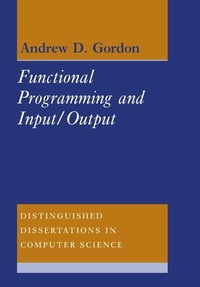
Functional Programming and Input/Output
Published on 31. July 2008
Book
Paperback/Softback
172 pages
978-0-521-07007-2 (ISBN)
Description
A common attraction to functional programming is the ease with which proofs can be given of program properties. A common disappointment with functional programming is the difficulty of expressing input/output (I/O), while at the same time being able to verify programs. Here, the author shows how a theory of functional programming can be smoothly extended to admit both an operational semantics for functional I/O and verification of programs engaged in I/O. He obtains operational semantics for the three most widely implemented I/O mechanisms for lazy languages, and proves that the three are equivalent in expressive power. He develops semantics for a form of monadic I/O and verifies a simple programming example. These theories of functional I/O are based on an entirely operational theory of functional programming, developed using Abramsky's 'applicative bisimulation'.
More details
Series
Language
English
Place of publication
Cambridge
United Kingdom
Target group
Professional and scholarly
Product notice
Paperback (trade)
Illustrations
15 Tables, unspecified
Dimensions
Height: 244 mm
Width: 170 mm
Thickness: 10 mm
Weight
309 gr
ISBN-13
978-0-521-07007-2 (9780521070072)
Copyright in bibliographic data and cover images is held by Nielsen Book Services Limited or by the publishers or by their respective licensors: all rights reserved.
Schweitzer Classification
Other editions
Additional editions
Andrew D. Gordon
Functional Programming and Input/Output
Book
10/1994
Cambridge University Press
€85.42
Article exhausted; check for reprint
Previous edition
Andrew D. Gordon
Functional Programming and Input/Output
Book
10/1994
Cambridge University Press
€85.42
Article exhausted; check for reprint
Person
Content
Preface; 1. Introduction; 2. A calculus of recursive types; 3. A metalanguage for semantics; 4. Operational precongruence; 5. Theory of the metalanguage; 6. An operational theory of functional programming; 7. Four mechanisms for teletype I/O; 8. Monadic I/O; 9. Conclusion; Bibliography; Notation; Index.