

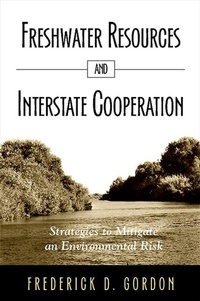
Freshwater Resources and Interstate Cooperation
Strategies to Mitigate an Environmental Risk
Published on 13. November 2008
Book
Hardback
184 pages
978-0-7914-7635-2 (ISBN)
Description
Examines state cooperation over increasingly scarce water resources.
Reports from the United Nations suggest that as much as forty percent of the global population could be without adequate freshwater supplies by 2015, leading some experts to predict that future wars will be fought over water rather than oil. Yet to date, most nation-states have been able to develop viable freshwater agreements to share this precious resource. Frederick D. Gordon examines how effective these accords are in sharing and redistributing water and whether they are sufficient to meet the increasing threat of water scarcity. Using an innovative ranking system, he assesses the significance of cooperation within both bilateral and multilateral accords, including the Israeli-Palestinian Interim Accords of 1993-1995, the Lesotho Highlands Water Treaty of 1986, and the 1994 Convention on Cooperation for the Protection and Sustainable Use of the River Danube. Gordon identifies central factors and stakeholders that are necessary for mitigating the risk of conflict and presents a template for understanding how state behavior can manage and sustain regional water resources.
Reports from the United Nations suggest that as much as forty percent of the global population could be without adequate freshwater supplies by 2015, leading some experts to predict that future wars will be fought over water rather than oil. Yet to date, most nation-states have been able to develop viable freshwater agreements to share this precious resource. Frederick D. Gordon examines how effective these accords are in sharing and redistributing water and whether they are sufficient to meet the increasing threat of water scarcity. Using an innovative ranking system, he assesses the significance of cooperation within both bilateral and multilateral accords, including the Israeli-Palestinian Interim Accords of 1993-1995, the Lesotho Highlands Water Treaty of 1986, and the 1994 Convention on Cooperation for the Protection and Sustainable Use of the River Danube. Gordon identifies central factors and stakeholders that are necessary for mitigating the risk of conflict and presents a template for understanding how state behavior can manage and sustain regional water resources.
Reviews / Votes
"Fresh water, long taken for granted, is rapidly becoming one of the world's most pressing environmental problems ... Freshwater Resources and Interstate Cooperation is a welcome addition to the literature." - H-Net Reviews"This book addresses a compelling problem for humanity in the twenty-first century and will be valuable for graduate classes and the international water policy community like World Bank analysts." - John M. Whiteley, University of California at Irvine
More details
Language
English
Place of publication
Albany, NY
United States
Target group
College/higher education
Professional and scholarly
US School Grade: College Graduate Student and over
Product notice
sewn/stitched
Cloth over boards
With dust jacket
Illustrations
2 Figures; 5 Maps; 8 Tables, black and white
Dimensions
Height: 249 mm
Width: 159 mm
Thickness: 17 mm
Weight
390 gr
ISBN-13
978-0-7914-7635-2 (9780791476352)
Copyright in bibliographic data and cover images is held by Nielsen Book Services Limited or by the publishers or by their respective licensors: all rights reserved.
Schweitzer Classification
Other editions
Additional editions
Frederick D. Gordon
Freshwater Resources and Interstate Cooperation
Strategies to Mitigate an Environmental Risk
E-Book
11/2008
1st Edition
State University of New York Press
€34.99
Available for download
Person
Frederick D. Gordon teaches Environmental Law and Policy at California Lutheran University.
Content
Preface
Acknowledgments
Abbreviations
1. Introduction
2. Overview of Explanatory Theories for Interpreting Interstate Water Accords
3. A Quantitative Assessment of Interstate Water Accords, 1950-1999
4. Comparative Case Study Introduction and Case Study Number One (Low Level of Cooperation)
5. Case Study Number Two: Lesotho Highlands Water Accords (Medium Level of Cooperation)
6. The 1994 Convention on Cooperation for the Protection and Sustainable Use of the River Danube (High Level of Cooperation)
7. Conclusion
Notes
References
Appendix A. Tables
Appendix B. Figures
Appendix C. Maps
Index
Acknowledgments
Abbreviations
1. Introduction
2. Overview of Explanatory Theories for Interpreting Interstate Water Accords
3. A Quantitative Assessment of Interstate Water Accords, 1950-1999
4. Comparative Case Study Introduction and Case Study Number One (Low Level of Cooperation)
5. Case Study Number Two: Lesotho Highlands Water Accords (Medium Level of Cooperation)
6. The 1994 Convention on Cooperation for the Protection and Sustainable Use of the River Danube (High Level of Cooperation)
7. Conclusion
Notes
References
Appendix A. Tables
Appendix B. Figures
Appendix C. Maps
Index