

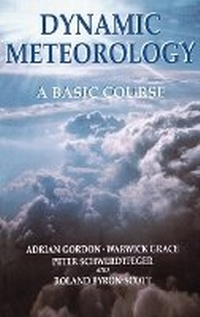
Dynamic Meteorology
Published on 30. January 1998
Book
Hardback
344 pages
978-0-340-70592-6 (ISBN)
Description
A step-by-step introduction to the physics of the atmosphere. Starting from the basics, it provides students with an awareness of simple mathematics and proceeds to provide a grounding in the fundamentals of meteorology. The authors aim to lead students to a scientifically rigorous understanding of the behaviour of weather systems such as highs, lows, fronts, jet streams, and tropical cyclones. This text explains the laws of Avogrado, Boyle and Charles, the omega equation and beyond. Why does the wind blow along the lines of isobars rather than across them? Why are low-pressure systems on the weather map more intense than high-pressure systems? These, and other fundamental questions are answered with simple mathematical equations. The book covers both northern and southern hemispheres.
More details
Language
English
Place of publication
London
United Kingdom
Publishing group
Taylor & Francis Ltd
Target group
College/higher education
Illustrations
references
Weight
597 gr
ISBN-13
978-0-340-70592-6 (9780340705926)
Copyright in bibliographic data and cover images is held by Nielsen Book Services Limited or by the publishers or by their respective licensors: all rights reserved.
Schweitzer Classification
Other editions
Additional editions
E-Book
05/2016
1st Edition
Routledge
€55.49
Available for download
E-Book
05/2016
1st Edition
Routledge
€55.49
Available for download
Book
12/1997
1st Edition
Hodder Education
€64.00
Shipment within 10-20 days
Content
Introduction - units and dimensions; the thermodynamics of dry clan air; the aerological diagram; the thermodynamics of moist air; hydrostatic equilibrium; the equations of motion (1) - the Coriolos force; the equations of motion (2) - derivation in various co-ordinates; balanced flow; unbalanced flow; Euler and Lagrange; vorticity; the long wave equations; the upper air synoptic chart; friction in the boundary layer of the atmosphere; some more advanced equations; synoptic observations and analysis; simple synoptic models; the tropical cyclone; radiant energy transfer; the radiation balance of the Earth; climate change.