

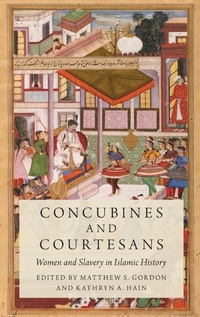
Concubines and Courtesans
Women and Slavery in Islamic History
Published on 9. November 2017
Book
Hardback
368 pages
978-0-19-062218-3 (ISBN)
Description
Concubines and Courtesans contains sixteen essays that consider, from a variety of viewpoints, enslaved and freed women across medieval and pre-modern Islamic social history. The essays bring together arguments regarding slavery, gender, social networking, cultural production (songs, poetry and instrumental music), sexuality, Islamic family law, and religion in the shaping of Near Eastern and Islamic society over time. They range over nearly 1000 years of Islamic history - from the early, formative period (seventh to tenth century C.E.) to the late Ottoman, Safavid and Mughal eras (sixteenth to eighteenth century C.E.) - and regions from al-Andalus (Islamic Spain) to Central Asia (Timurid Iran).
The close, common thread joining the essays is an effort to account for the lives, careers and representations of female slaves and freed women participating in, and contributing to, elite urban society of the Islamic realm. Interest in a gendered approach to Islamic history, society and religion has by now deep roots in Middle Eastern and Islamic studies. The shared aim of the essays collected here is to get at the wealth of these topics, and to underscore their centrality to a firm grasp on Islamic and Middle Eastern history.
The close, common thread joining the essays is an effort to account for the lives, careers and representations of female slaves and freed women participating in, and contributing to, elite urban society of the Islamic realm. Interest in a gendered approach to Islamic history, society and religion has by now deep roots in Middle Eastern and Islamic studies. The shared aim of the essays collected here is to get at the wealth of these topics, and to underscore their centrality to a firm grasp on Islamic and Middle Eastern history.
Reviews / Votes
We can only admire the high quality of this work, of which each chapter provides a cornerstone to the study of female slavery and contributes admirably to research in this area. * Monica Balda-Tillier, The Arabica *More details
Language
English
Place of publication
New York
United States
Target group
College/higher education
Dimensions
Height: 240 mm
Width: 161 mm
Thickness: 24 mm
Weight
716 gr
ISBN-13
978-0-19-062218-3 (9780190622183)
Copyright in bibliographic data and cover images is held by Nielsen Book Services Limited or by the publishers or by their respective licensors: all rights reserved.
Schweitzer Classification
Other editions
Additional editions
E-Book
09/2017
OUP eBook
€79.49
Available for download
E-Book
09/2017
1st Edition
OUP eBook
€79.49
Available for download
Persons
Matthew S. Gordon is Professor of History at Miami University. He has written widely on Islamic and Middle East history. He is the author of Civilizations: Past and Present and co-author of The Rise of Islam and Understanding Islam.
Kathryn A. Hain is a PhD candidate in Middle Eastern History at the University of Utah. She came to academia after seventeen years serving the church in Jerusalem and Amman.
Kathryn A. Hain is a PhD candidate in Middle Eastern History at the University of Utah. She came to academia after seventeen years serving the church in Jerusalem and Amman.
Content
Introduction: Producing Songs and Sons
Matthew S. Gordon
Chapter 1: Statistical Approaches to the Rise of Concubinage in Islam
Majied Robinson
Chapter 2: Abbasid Courtesans and the Question of Social Mobility
Matthew S. Gordon
Chapter 3: A jariya's prospects in Abbasid Baghdad
Pernilla Myrne
Chapter 4: Visibility and Performance: Courtesans in the Early Islamicate
Courts (661-950 CE)
Lisa Nielson
Chapter 5: The Qiyan of al-Andalus
Dwight F. Reynolds
Chapter 6: The Ethnic Origins of Female Slaves in al-Andalus
Cristina de la Puente
Chapter 7: The Mothers of the Caliph's Sons: Women as Spoils of War in the
Early Almohad Period
Heather J. Empey
Chapter 8: Concubines on the Road - Ibn Battuta's Slave Women
Marina A. Tolmacheva
Chapter 9: Slaves Only in Name: Free Women as Royal Concubinesin Late
Timurid Iran and Central Asia
Usman Hamid
Chapter 10: A Queen Mother and the Ottoman Imperial Harem: Rabia Guelnu?
Emetullah Valide Sultan (1640-1715)
Betul Ipsirli Argit
Chapter 11: Hagar and Mariya: Early Islamic Models of Slave Motherhood
Elizabeth Urban
Chapter 12: Between History and Hagiography: The Mothers of the Imams in
Imami Historical Memory
Michael Dann
Chapter 13: Are Houris Heavenly Concubines?
Nerina Rustomji
Chapter 14: Educated Slave Women and Gift Exchange in Abbasid Culture
Jocelyn Sharlet
Chapter 15: Remembering the Umm al-Walad: Ibn Kathir's Treatise on the Sale
of the Concubine
Younus Y. Mirza
Epilogue: Avenues to Social Mobility for Courtesans and Concubines
Kathryn Hain
Contributors
Index
Matthew S. Gordon
Chapter 1: Statistical Approaches to the Rise of Concubinage in Islam
Majied Robinson
Chapter 2: Abbasid Courtesans and the Question of Social Mobility
Matthew S. Gordon
Chapter 3: A jariya's prospects in Abbasid Baghdad
Pernilla Myrne
Chapter 4: Visibility and Performance: Courtesans in the Early Islamicate
Courts (661-950 CE)
Lisa Nielson
Chapter 5: The Qiyan of al-Andalus
Dwight F. Reynolds
Chapter 6: The Ethnic Origins of Female Slaves in al-Andalus
Cristina de la Puente
Chapter 7: The Mothers of the Caliph's Sons: Women as Spoils of War in the
Early Almohad Period
Heather J. Empey
Chapter 8: Concubines on the Road - Ibn Battuta's Slave Women
Marina A. Tolmacheva
Chapter 9: Slaves Only in Name: Free Women as Royal Concubinesin Late
Timurid Iran and Central Asia
Usman Hamid
Chapter 10: A Queen Mother and the Ottoman Imperial Harem: Rabia Guelnu?
Emetullah Valide Sultan (1640-1715)
Betul Ipsirli Argit
Chapter 11: Hagar and Mariya: Early Islamic Models of Slave Motherhood
Elizabeth Urban
Chapter 12: Between History and Hagiography: The Mothers of the Imams in
Imami Historical Memory
Michael Dann
Chapter 13: Are Houris Heavenly Concubines?
Nerina Rustomji
Chapter 14: Educated Slave Women and Gift Exchange in Abbasid Culture
Jocelyn Sharlet
Chapter 15: Remembering the Umm al-Walad: Ibn Kathir's Treatise on the Sale
of the Concubine
Younus Y. Mirza
Epilogue: Avenues to Social Mobility for Courtesans and Concubines
Kathryn Hain
Contributors
Index