

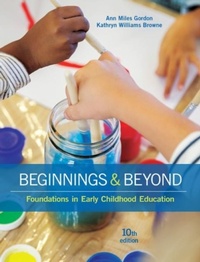
Beginnings & Beyond
Foundations in Early Childhood Education
10th Edition
Published on 1. January 2016
Book
Hardback
560 pages
978-1-305-50096-9 (ISBN)
Description
In a clear and easy-to-understand style, BEGINNINGS AND BEYOND: FOUNDATIONS IN EARLY CHILDHOOD EDUCATION, 10th Edition lays out basic questions any student of early childhood education -- including you -- would want answered. It also presents key concepts, the latest research, and practical examples so that questions are thoroughly answered. Coverage of the current Developmentally Appropriate Practices (DAP) is woven throughout the text, as is material on diversity and development, which enables you to understand that issues of age, gender, race/ethnicity, ability, and family are part of every aspect of teaching and learning. Every chapter has a feature focused on how brain-based research is connected to development, and another that highlights intentional teaching. Through its tone, visuals, and pedagogy, the book is accessible to and respectful of readers with a range of abilities and learning styles.
More details
Edition
10th edition
Language
English
Place of publication
Belmont, CA
United States
Publishing group
Cengage Learning, Inc
Target group
College/higher education
Dimensions
Height: 225 mm
Width: 445 mm
Thickness: 25 mm
Weight
1440 gr
ISBN-13
978-1-305-50096-9 (9781305500969)
Copyright in bibliographic data and cover images is held by Nielsen Book Services Limited or by the publishers or by their respective licensors: all rights reserved.
Schweitzer Classification
Other editions
New editions
Ann Gordon | Kathryn Williams Browne
Beginnings and Beyond: Foundations in Early Childhood Education
Book
05/2023
11th Edition
Wadsworth Publishing Co Inc
€101.50
Shipment within 15-20 days
Persons
Ann Miles Gordon has been in the early childhood field for over 60 years -- as a teacher of young children, parents and college students. She has taught in lab schools, church-related centers, and private and public preschool and kindergarten programs. While at Stanford University, she taught at the Bing Nursery School where she was a head teacher and lecturer in the psychology department. Gordon spent a decade as an adjunct faculty member in four colleges, teaching the full gamut of early childhood courses. For 14 years, she served as executive director of the National Association of Episcopal Schools, where more than 1,100 early childhood programs were part of her network. She is now semi-retired and lives in the San Francisco area. Gordon earned a Bachelor of Arts in child development from the University of Washington and a Master of Arts in early childhood education from Stanford University. Kathryn Williams Browne teaches in the California Community College system, leads both the College EDU/CD department and Early Childhood Mentor program, and serves as commissioner of the State Commission for Teacher Credentialing, all of which offer the richness of diverse faculty and students coupled with the challenges of access and privilege that parallel those in the early education field itself. She has been teaching children, families, teachers and students for more than 45 years. First a teacher of young children -- in nursery school, parent cooperatives, full-day child care, prekindergarten, bilingual preschool, kindergarten and first grade -- Browne moved to Stanford University's lab school, where she served as head teacher and psychology lecturer. For her co-author role, she also brings perspective as a parent, while her consultant and school board experience offer insights on public policy and reform.
Content
Part I: WHAT IS THE FIELD OF EARLY CHILDHOOD EDUCATION?
1. History of Early Childhood Education.
2. Types of Programs.
Part II: WHO IS THE YOUNG CHILD?
3. Defining the Young Child.
4. Developmental and Learning Theories.
Part III: WHO ARE THE TEACHERS?
5. Teaching: A Professional Commitment.
6. Observation and Assessment of Children.
7. Guiding Children's Behavior.
8. Families and Teachers: Partners in Education.
9. Creating Environments.
Part IV: WHAT IS BEING TAUGHT?
10: Curriculum: Creating a Context for Learning.
11: Planning for the Body: Physical/Motor Development in Action.
12: Planning for the Mind: Cognitive Development in Action.
13: Planning for the Mind: Language and Literacy Development in Action.
14: Planning for the Heart and Soul: Psychosocial Development in Action.
Part V: HOW DO WE TEACH FOR TOMORROW?
15: Issues and Trends in Early Childhood Education: Four Themes.
1. History of Early Childhood Education.
2. Types of Programs.
Part II: WHO IS THE YOUNG CHILD?
3. Defining the Young Child.
4. Developmental and Learning Theories.
Part III: WHO ARE THE TEACHERS?
5. Teaching: A Professional Commitment.
6. Observation and Assessment of Children.
7. Guiding Children's Behavior.
8. Families and Teachers: Partners in Education.
9. Creating Environments.
Part IV: WHAT IS BEING TAUGHT?
10: Curriculum: Creating a Context for Learning.
11: Planning for the Body: Physical/Motor Development in Action.
12: Planning for the Mind: Cognitive Development in Action.
13: Planning for the Mind: Language and Literacy Development in Action.
14: Planning for the Heart and Soul: Psychosocial Development in Action.
Part V: HOW DO WE TEACH FOR TOMORROW?
15: Issues and Trends in Early Childhood Education: Four Themes.