

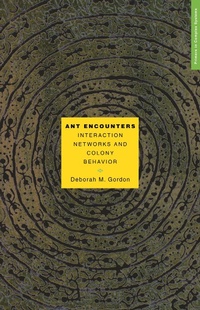
Ant Encounters
Interaction Networks and Colony Behavior
Published on 11. April 2010
Book
Paperback/Softback
184 pages
978-0-691-13879-4 (ISBN)
Description
How do ant colonies get anything done, when no one is in charge? An ant colony operates without a central control or hierarchy, and no ant directs another. Instead, ants decide what to do based on the rate, rhythm, and pattern of individual encounters and interactions--resulting in a dynamic network that coordinates the functions of the colony. Ant Encounters provides a revealing and accessible look into ant behavior from this complex systems perspective. Focusing on the moment-to-moment behavior of ant colonies, Deborah Gordon investigates the role of interaction networks in regulating colony behavior and relations among ant colonies. She shows how ant behavior within and between colonies arises from local interactions of individuals, and how interaction networks develop as a colony grows older and larger. The more rapidly ants react to their encounters, the more sensitively the entire colony responds to changing conditions. Gordon explores whether such reactive networks help a colony to survive and reproduce, how natural selection shapes colony networks, and how these structures compare to other analogous complex systems.
Ant Encounters sheds light on the organizational behavior, ecology, and evolution of these diverse and ubiquitous social insects.
Ant Encounters sheds light on the organizational behavior, ecology, and evolution of these diverse and ubiquitous social insects.
Reviews / Votes
One of Choice's Outstanding Academic Titles for 2010 "In her new book, written in a lively style and accessible to a general audience, Gordon describes the sophisticated experiments that led her to intriguing insights about how an ant colony can solve vital problems, such as finding the shortest path to the best food source, allocating workers to different tasks or defending a territory from rivals."--Times Higher Education "This volume provides a well-focused review of how complex biological systems develop and function, with applications well beyond understanding ant colonies. It may compel behavioral and community ecologists, as well as other non-biologists, to consider new perspectives in understanding interacting systems."--Choice "This concise, well-written book will be of interest to biologists and complexity scientists, but is written to also be accessible to non-scientists... Ant Encounters is an enjoyable read, full of neat experiments and lively anecdotes illustrating the scientific points."--Elva J. H. Washington, Trends in Ecology and Evolution "[T]he good and easy to understand introduction to the role of interaction networks in colony behavior--or ants as a natural complex system based on interactions networks--as well as the style of writing makes the book an entertaining read."--Heike Feldhaar, Basic and Applied EcologyMore details
Series
Language
English
Place of publication
New Jersey
United States
Target group
College/higher education
Professional and scholarly
Product notice
Paperback (trade)
Illustrations
3 Abbildungen
2 halftones. 1 line illus.
Dimensions
Height: 213 mm
Width: 140 mm
Thickness: 18 mm
Weight
249 gr
ISBN-13
978-0-691-13879-4 (9780691138794)
Copyright in bibliographic data and cover images is held by Nielsen Book Services Limited or by the publishers or by their respective licensors: all rights reserved.
Schweitzer Classification
Other editions
Additional editions
E-Book
03/2010
1st Edition
Princeton University Press
€30.49
Available for download
Person
Deborah M. Gordon is professor of biology at Stanford University. She is the author of" Ants at Work" (Norton).
Content
List of Illustrations ix Preface xi Chapter 1: The Ant Colony as a Complex System 1 Chapter 2: Colony Organization 14 The Diversity of Ant Behavior 14 From Individual to Collective Behavior 19 Division of Labor 25 Ants Switch Tasks 30 Age Polyethism 33 What Ants Respond To 37 Task Allocation 41 Chapter 3: Interaction Networks 45 What Happens at Network Nodes 47 The Pattern of Interaction Is the Message 49 Rate and Memory 57 Individual Variation 83 Species Differences 67 Chapter 4: Colony Size 75 Colony Growth 75 Task Allocation and Colony Size 83 Ecology, Behavior, and Mature Colony Size 90 Chapter 5: Relations with Neighbors 96 Relations with Neighbors of the Same Species 97 Interactions between Species 107 Invasive Species 112 From Ecology to Behavior 117 Chapter 6: Ant Evolution 121 Coevolution of Ants and Plants 121 Evolution of Colony Organization 125 Natural Selection in Action 131 Chapter 7: Modeling Ant Behavior 141 Notes 147 Index 165