

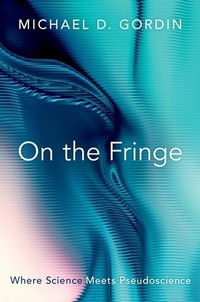
On the Fringe
Where Science Meets Pseudoscience
Published on 23. September 2021
Book
Hardback
136 pages
978-0-19-755576-7 (ISBN)
Description
Everyone has heard of the term "pseudoscience", typically used to describe something that looks like science, but is somehow false, misleading, or unproven. Many would be able to agree on a list of things that fall under its umbrella-- astrology, phrenology, UFOlogy, creationism, and eugenics might come to mind. But defining what makes these fields "pseudo" is a far more complex issue. It has proved impossible to come up with a simple criterion that enables us to differentiate pseudoscience from genuine science. Given the virulence of contemporary disputes over the denial of climate change and anti-vaccination movements--both of which display allegations of "pseudoscience" on all sides-- there is a clear need to better understand issues of scientific demarcation.
On the Fringe explores the philosophical and historical attempts to address this problem of demarcation. This book argues that by understanding doctrines that are often seen as antithetical to science, we can learn a great deal about how science operated in the past and does today. This exploration raises several questions: How does a doctrine become demonized as pseudoscientific? Who has the authority to make these pronouncements? How is the status of science shaped by political or cultural contexts? How does pseudoscience differ from scientific fraud?
Michael D. Gordin both answers these questions and guides readers along a bewildering array of marginalized doctrines, looking at parapsychology (ESP), Lysenkoism, scientific racism, and alchemy, among others, to better understand the struggle to define what science is and is not, and how the controversies have shifted over the centuries. On the Fringe provides a historical tour through many of these fringe fields in order to provide tools to think deeply about scientific controversies both in the past and in our present.
On the Fringe explores the philosophical and historical attempts to address this problem of demarcation. This book argues that by understanding doctrines that are often seen as antithetical to science, we can learn a great deal about how science operated in the past and does today. This exploration raises several questions: How does a doctrine become demonized as pseudoscientific? Who has the authority to make these pronouncements? How is the status of science shaped by political or cultural contexts? How does pseudoscience differ from scientific fraud?
Michael D. Gordin both answers these questions and guides readers along a bewildering array of marginalized doctrines, looking at parapsychology (ESP), Lysenkoism, scientific racism, and alchemy, among others, to better understand the struggle to define what science is and is not, and how the controversies have shifted over the centuries. On the Fringe provides a historical tour through many of these fringe fields in order to provide tools to think deeply about scientific controversies both in the past and in our present.
Reviews / Votes
Gordin's book should be mandatory reading for all those interested in the nature of science and pseudoscience. On the Fringe provides an excellent exposition of a wide diversity of pseudoscientifc doctrines, something which certainly can help to devise more useful demarcation criteria. * Juan Gefaell, Metascience * Michael Gordin's book adds at least two important aspects to the literature. First, as a historian, he puts some of the pseudosciences in a historical perspective that is seldom presented. Secondly, he contributes to the systematic treatment of pseudosciences by introducing four groups of such teachings. * SVEN OVE HANSSON, Society for US Intellectual History * Gordin's discussion offers critical tools for students confronting a cultural context in which claims of scientific expertise carry significant-even unprecedented-consequence. * J. D. Martin, Durham University * A fascinating exploration of the line between science and pseudoscience. * PD Smith, The Guardian * Fascinating... a very effective and readable analysis. * Brian Clegg, Popular Science blog * This will be helpful to anyone curious about how to separate the wheat of science from the chaff of pseudoscience. * Publishers Weekly Review * Illuminating * Ross McFarlane, Fortean Times * Gordin's book can best be approached as a first sketch of a very useful and promising way of studying pseudoscience rather than as a definitive account of it. * Juan Gefaell, Metascience *More details
Language
English
Place of publication
New York
United States
Target group
Professional and scholarly
Product notice
sewn/stitched
Cloth over boards
Illustrations
10
Dimensions
Height: 218 mm
Width: 150 mm
Thickness: 20 mm
Weight
262 gr
ISBN-13
978-0-19-755576-7 (9780197555767)
Copyright in bibliographic data and cover images is held by Nielsen Book Services Limited or by the publishers or by their respective licensors: all rights reserved.
Schweitzer Classification
Other editions
Additional editions
E-Book
03/2021
OUP eBook
€16.99
Available for download
E-Book
03/2021
OUP eBook
€16.99
Available for download
Person
Michael D. Gordin is Rosengarten Professor of Modern and Contemporary History and the director of the Society of Fellows in the Liberal Arts at Princeton University. He specializes in the history of modern science in Russia, Europe, and North America, in particular on issues related to the history of fringe science, the early years of the nuclear arms race, Russian and Soviet science, language and science, and Albert Einstein. He is the author of The Pseudoscience Wars: Immanuel Velikovsky and the Birth of the Modern Fringe, Scientific Babel: How Science Was Done Before and After Global English, and Red Cloud at Dawn: Truman, Stalin, and the End of the Atomic Monopoly.
Content
Chapter 1: The Demarcation Problem
Chapter 2: Vestigial Sciences
Chapter 3: Hyperpoliticized Sciences
Chapter 4: Fighting "Establishment" Science
Chapter 5: Mind over Matter
Chapter 6: Controversy Is Inevitable
Chapter 7: The Russian Questions
Notes
Further Reading
Chapter 2: Vestigial Sciences
Chapter 3: Hyperpoliticized Sciences
Chapter 4: Fighting "Establishment" Science
Chapter 5: Mind over Matter
Chapter 6: Controversy Is Inevitable
Chapter 7: The Russian Questions
Notes
Further Reading