

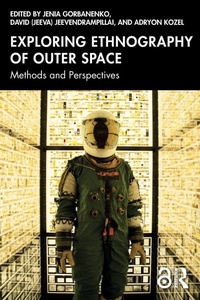
Exploring Ethnography of Outer Space
Methods and Perspectives
1st Edition
Published on 31. January 2025
Book
Paperback/Softback
240 pages
978-1-032-57128-7 (ISBN)
Description
This book explores new methods and perspectives in the anthropology of outer space. For the past ten years, scholarship of outer space has grown significantly in the social sciences. Now, an international community of anthropologists is starting to produce significant contributions to this work. This is pushing the conversations around the future of humanity, technology, and outer space beyond the realm of speculative theory into concrete challenges to established norms within anthropology. Each chapter in this volume introduces a unique take on what constitutes an ethnographic field in anthropology. They signal a re-imagination of the central concept for the discipline and offer a timely meditation on the shift in anthropology's understanding of fieldwork from its inception until now. The volume consists of eleven ethnographic chapters, plus an introduction by the editors, and two invited responses. Each of the main body chapters presents a distinct approach to situating outer space empirically on Earth. By bringing together emerging and established scholars, this book ultimately posits that an anthropological approach to outer space requires creative approaches to ethnography that are no longer exclusively premised on a co-presence with the people under study. A primer of innovative ethnographies and an ideal companion to courses on methods, this volume will provide students with a body of accessible, contemporary work on futurisms and outer space. In addition, this book will serve as a snapshot of a moment in ethnographically innovative anthropology that will be relevant to a wider academic audience through its exegesis of new methods for the study of distributed communities.
The Open Access version of this book, available at http://www.taylorfrancis.com, has been made available under a Creative Commons Attribution-Non Commercial-No
Derivatives-ShareAlike (CC-BY-NC-SA) 4.0 license.
The Open Access version of this book, available at http://www.taylorfrancis.com, has been made available under a Creative Commons Attribution-Non Commercial-No
Derivatives-ShareAlike (CC-BY-NC-SA) 4.0 license.
Reviews / Votes
"This book is stellar in every sense of the word and should be required reading for anyone interested in the whys and hows of extra-terrestrial social science research. Its richly textured and imaginative chapters provide vital contributions that will undoubtedly shape outer space ethnography for years to come." - Assistant Professor William Lempert, Bowdoin College, USA"This excellent volume is a testament to why and how anthropological engagements with outer space have reached cosmic heights. Each contribution overflows with theoretical and methodological innovations. Anthropologists, particularly those who have imagined the cosmos beyond their purview, will find in this volume inspiration for stretching terrestrial and extraterrestrial inquiries." - Associate Professor Lisa Messeri, Yale University, USA
"Interest in social dimensions of outer space has recently proliferated across the fields of science and technology studies, critical infrastructures research and human geography. However, an essential role in these endeavours is taken by anthropology, which provides both key methodological tools for our enquiries as well as the (self-)critical reflection upon our results.
Having myself developed a "Peripatetic Approach" to studying socio-technical systems within the Space Sector - spanning a variety of places, communities, temporalities - I welcome this book's comprehensive analysis of ethnographic methods and fieldwork experiences. The authors systematically contextualise both the urgent relevance as well as radical nature of these approaches, noting in particular the various strategies and heuristics to untangle the multi-layered realities and arrange them in accessible interconnected narratives.
This book is essential reading to scholars from social sciences and humanities looking to (further) engage with social studies of outer space, as well as natural scientists and engineers, who are curious about the cultural aspects of their work. Combining reflections from a number of earlier careers scholars with epistemological grounding of their research projects, this work also established a baseline pedagogy concerning ethnographic methods for multi-sited, longitudinal studies, which is accessible to students at all levels." - Dr Matjaz Vidmar, Co-founder of Social Studies of Outer Space Network; Author of "Innovation Intermediaries and (Final) Frontiers of High-tech"; Institute for the Study of Science, Technology and Innovation, School of Engineering, The University of Edinburgh, UK
"Exploring Ethnography of Outer Space: Methods and Perspectives is a key text for understanding a burgeoning field: the anthropology of outer space. As well as contributing to the empirical and theoretical delimitation of this field of research, the editors stimulate much-needed methodological reflection on ways of developing ethnographical investigations to study human activities related with outer space." - Professor Perig Pitrou, CNRS, Maison Francaise d'Oxford, Team "Anthropology of Life", College de France, PSL University, France
More details
Series
Language
English
Place of publication
London
United Kingdom
Publishing group
Taylor & Francis Ltd
Target group
College/higher education
Professional and scholarly
Academic, Postgraduate, and Undergraduate Advanced
Illustrations
22 s/w Abbildungen, 22 s/w Photographien bzw. Rasterbilder, 2 s/w Tabellen
2 Tables, black and white; 22 Halftones, black and white; 22 Illustrations, black and white
Dimensions
Height: 229 mm
Width: 152 mm
Thickness: 14 mm
Weight
376 gr
ISBN-13
978-1-032-57128-7 (9781032571287)
Copyright in bibliographic data and cover images is held by Nielsen Book Services Limited or by the publishers or by their respective licensors: all rights reserved.
Schweitzer Classification
Other editions
Additional editions
Jenia Gorbanenko | David (Jeeva) Jeevendrampillai | Adryon Kozel
Exploring Ethnography of Outer Space
Methods and Perspectives
E-Book
01/2025
1st Edition
Routledge
€0.00
Available for download
Jenia Gorbanenko | David (Jeeva) Jeevendrampillai | Adryon Kozel
Exploring Ethnography of Outer Space
Methods and Perspectives
E-Book
01/2025
1st Edition
Routledge
€0.00
Available for download
Jenia Gorbanenko | David (Jeeva) Jeevendrampillai | Adryon Kozel
Exploring Ethnography of Outer Space
Methods and Perspectives
Book
01/2025
1st Edition
Routledge
€207.80
Shipment within 10-20 days
Persons
Jenia Gorbanenko is a PhD candidate in Anthropology at University College London specialising in the anthropology of religion in outer space.
David (Jeeva) Jeevendrampillai is a Lecturer at The University of Manchester. He researches planetary belonging and community building in outer space.
Adryon Kozel is a PhD candidate in Anthropology at University College London. They research how space enthusiasts construct potential futures in space, and narratives of what it means for humans to go to space.
All three editors are members of the ERC Advanced Grant ETHNO-ISS, an anthropological study of the International Space Station based at University College London.
David (Jeeva) Jeevendrampillai is a Lecturer at The University of Manchester. He researches planetary belonging and community building in outer space.
Adryon Kozel is a PhD candidate in Anthropology at University College London. They research how space enthusiasts construct potential futures in space, and narratives of what it means for humans to go to space.
All three editors are members of the ERC Advanced Grant ETHNO-ISS, an anthropological study of the International Space Station based at University College London.
Content
1. Introduction, 2. Transcendence, bodies, and estranged labour in outer space: The astronaut's contribution to a general theory of hierarchy, 3. Anthropologists in outer space: Science fiction, infrastructure, comparison, 4. Imaginaries of Outer Space from Africa. Astronomy Infrastructure in South Africa and Madagascar, 5. Museums, Meteorites, and Portals: tracing the imperial logics of trans-planetary resource extractivism, 6. Of Stars and Wheat: Making Sense of the Cosmos in a Regional Museum of Cosmonautics, 7. From Mexico to the Moon: (Outer)Spatializing Ethnography, 8. Are we still anthropologists if we go to space using only our imaginations?, 9. Terraforming a field site: Reflections on crafting knowledge on Mars, 10. Composing the cosmos: Tuning into multiplicities with Thai Buddhist concepts, 11. Divining South Korea's Space Age through Korean Shamanism and Astrology (Myongni), 12. Space intentionally left blank, 13. Methodological Sensibilities in Outer Spaces, 14. ...a response