


How to Make Sense of Statistics
1st Edition
Published on 24. February 2021
Book
Hardback
320 pages
978-1-5264-1381-9 (ISBN)
Description
In a new textbook designed for students new to statistics and social data, Stephen Gorard focuses on non-inferential statistics as a basis to ensure students have basic statistical literacy.
Understanding why we have to learn statistics and seeing the links between the numbers and real life is a crucial starting point. Using engaging, friendly, approachable language this book will demystify numbers from the outset, explaining exactly how they can be used as tools to understand the relationships between variables.
This text assumes no previous mathematical or statistical knowledge, taking the reader through each basic technique with step-by-step advice, worked examples, and exercises. Using non-inferential techniques, students learn the foundations that underpin all statistical analysis and will learn from the ground up how to produce theoretically and empirically informed statistical results.
Understanding why we have to learn statistics and seeing the links between the numbers and real life is a crucial starting point. Using engaging, friendly, approachable language this book will demystify numbers from the outset, explaining exactly how they can be used as tools to understand the relationships between variables.
This text assumes no previous mathematical or statistical knowledge, taking the reader through each basic technique with step-by-step advice, worked examples, and exercises. Using non-inferential techniques, students learn the foundations that underpin all statistical analysis and will learn from the ground up how to produce theoretically and empirically informed statistical results.
Reviews / Votes
This book takes beginner students hand-in-hand through a journey in the world of statistics without dumbing down the concepts, just making them very accessible. It teaches the basics (and beyond) by stimulating critical thinking. -- Luana RussoMore details
Language
English
Place of publication
London
United Kingdom
Target group
College/higher education
Dimensions
Height: 250 mm
Width: 175 mm
Thickness: 22 mm
Weight
734 gr
ISBN-13
978-1-5264-1381-9 (9781526413819)
Copyright in bibliographic data and cover images is held by Nielsen Book Services Limited or by the publishers or by their respective licensors: all rights reserved.
Schweitzer Classification
Other editions
Additional editions
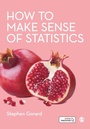
Stephen Gorard
How to Make Sense of Statistics
Book
02/2021
1st Edition
SAGE Publications Ltd
€80.50
Shipment within 15-20 days
Stephen Gorard
How to Make Sense of Statistics
E-Book
02/2021
1st Edition
SAGE Publications Ltd
€71.49
Available for download
Stephen Gorard
How to Make Sense of Statistics
E-Book
02/2021
1st Edition
SAGE Publications Ltd
€71.49
Available for download
Stephen Gorard
How to Make Sense of Statistics
E-Book
02/2021
1st Edition
SAGE Publications Ltd
€71.49
Available for download
Person
Stephen Gorard is Professor of Education and Public Policy, and Director of the Evidence Centre for Education, at Durham University (https://www.dur.ac.uk/). He is a Fellow of the Academy of Social Sciences, member of the ESRC Commissioning Panel for the Research Methods Programme, the British Academy grants panel, and Lead Editor for BERA's Review of Education. He is a member of the Cabinet Office Trials Advice Panel as part of the Prime Minister's Implementation Unit.
His work concerns the robust evaluation of education as a lifelong process, focused on issues of equity, especially regarding school intakes. He is author of around 30 books and over 1,000 other publications. He is currently funded by Nesta to evaluate their EdTech Testbed, and by the British Academy to look at the impact of schooling in India and Pakistan.
His work concerns the robust evaluation of education as a lifelong process, focused on issues of equity, especially regarding school intakes. He is author of around 30 books and over 1,000 other publications. He is currently funded by Nesta to evaluate their EdTech Testbed, and by the British Academy to look at the impact of schooling in India and Pakistan.
Content
Part I: Introduction
Chapter 1: Why we use numbers in research
Chapter 2: What is a number?: Issues of measurement
Part II: Basic analyses
Chapter 3: Working with one variable
Chapter 4: Working with tables of categorical variables
Chapter 5: Examining differences between real numbers
Chapter 6: Significance tests: how to conduct them and what they do not mean
Chapter 7: Significance tests: why we should not report them
Part III: Advanced issues for analysis
Chapter 8: The role of judgement in analysis
Chapter 9: Research designs
Chapter 10: Sampling and populations
Chapter 11: What is randomness?
Chapter 12: Handling missing data: The importance of what we don't know
Chapter 13: Handling missing data: more complex issues
Part IV: Modelling with data
Chapter 14: Errors in measurements
Chapter 15: Correlating two real numbers
Chapter 16: Predicting measurements using simple linear regression
Chapter 17: Predicting measurements using multiple linear regression
Chapter 18: Assumptions and limitations in regression
Chapter 19: Predicting outcomes using logistic regression
Chapter 20: Data reduction techniques
Part V: Conclusion
Chapter 21: Presenting data for your audience
Chapter 1: Why we use numbers in research
Chapter 2: What is a number?: Issues of measurement
Part II: Basic analyses
Chapter 3: Working with one variable
Chapter 4: Working with tables of categorical variables
Chapter 5: Examining differences between real numbers
Chapter 6: Significance tests: how to conduct them and what they do not mean
Chapter 7: Significance tests: why we should not report them
Part III: Advanced issues for analysis
Chapter 8: The role of judgement in analysis
Chapter 9: Research designs
Chapter 10: Sampling and populations
Chapter 11: What is randomness?
Chapter 12: Handling missing data: The importance of what we don't know
Chapter 13: Handling missing data: more complex issues
Part IV: Modelling with data
Chapter 14: Errors in measurements
Chapter 15: Correlating two real numbers
Chapter 16: Predicting measurements using simple linear regression
Chapter 17: Predicting measurements using multiple linear regression
Chapter 18: Assumptions and limitations in regression
Chapter 19: Predicting outcomes using logistic regression
Chapter 20: Data reduction techniques
Part V: Conclusion
Chapter 21: Presenting data for your audience