

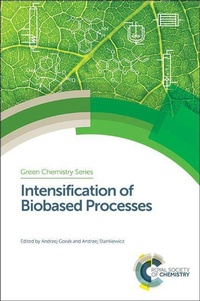
Intensification of Biobased Processes
Published on 19. June 2018
Book
Hardback
544 pages
978-1-78262-855-2 (ISBN)
Description
In recent years bioprocessing has increased in popularity and importance, however, bioprocessing still poses various important techno-economic and environmental challenges, such as product yields, excessive energy consumption for separations in highly watery systems, batch operation or the downstream processing bottlenecks in the production of biopharmaceutical products. Many of those challenges can be addressed by application of different process intensification technologies discussed in the present book.
The first book dedicated entirely to this area, Intensification of Biobased Processes provides a comprehensive overview of modern process intensification technologies used in bioprocessing. The book focusses on four different categories of biobased products: bio-fuels and platform chemicals; cosmeceuticals; food products; and polymers and advanced materials. It will cover various intensification aspects of the processes concerned, including (bio)reactor intensification; intensification of separation, recovery and formulation operations; and process integration. This is an invaluable source of information for researchers and industrialists working in chemical engineering, biotechnology and process engineering.
The first book dedicated entirely to this area, Intensification of Biobased Processes provides a comprehensive overview of modern process intensification technologies used in bioprocessing. The book focusses on four different categories of biobased products: bio-fuels and platform chemicals; cosmeceuticals; food products; and polymers and advanced materials. It will cover various intensification aspects of the processes concerned, including (bio)reactor intensification; intensification of separation, recovery and formulation operations; and process integration. This is an invaluable source of information for researchers and industrialists working in chemical engineering, biotechnology and process engineering.
More details
Series
Language
English
Place of publication
Cambridge
United Kingdom
Target group
Professional and scholarly
Product notice
Unsewn / adhesive bound
Dimensions
Height: 241 mm
Width: 163 mm
Thickness: 35 mm
Weight
959 gr
ISBN-13
978-1-78262-855-2 (9781782628552)
Copyright in bibliographic data and cover images is held by Nielsen Book Services Limited or by the publishers or by their respective licensors: all rights reserved.
Schweitzer Classification
Other editions
Additional editions
Andrzej Gorak | Andrzej Stankiewicz
Intensification of Biobased Processes
E-Book
06/2018
1st Edition
Royal Society of Chemistry
€245.99
Available for download
Andrzej Gorak | Andrzej Stankiewicz
Intensification of Biobased Processes
E-Book
06/2018
1st Edition
Royal Society of Chemistry
€245.99
Available for download
Persons
Prof. Andrzej Gorak is a Professor at Lodz University of Technology, Poland and an Emeritus Professor of TU Dortmund University. He is an Editor of Chemical Engineering and Processing: Process Intensification and a Board Member of the European Process Intensification Centre (EUROPIC).
His scientific interests are reactive and bioreactive separation processes, process intensification, computer aided process engineering. His research is also focused on experimental investigations of reactive and hybrid separation processes such as reactive distillation and membrane separations.
Andrzej Stankiewicz is Full Professor at Delft University of Technology (Chair of Intensified Reaction and Separation Systems) and Director of TU Delft Process Technology Institute. He is author of numerous publications on chemical reaction engineering, industrial catalysis and process intensification, including the world's first book on Process Intensification: Re-Engineering the Chemical Processing Plant.
Prof. Stankiewicz is an Editor of Chemical Engineering and Processing: Process Intensification and a Series Editor of the Green Chemistry Books Series. He was the founder and first Chairman of the Working Party on Process Intensification at the European Federation of Chemical Engineering, and currently chairs the Board of the European Process Intensification Centre (EUROPIC).
His current research interests are control of molecular interactions and intensification of chemical processes using electric and electromagnetic fields. And he has been awarded the prestigious Advanced Investigator Grant by the European Research Council (with co-workers) and a grant by the Bill and Melinda Gates Foundation.
His scientific interests are reactive and bioreactive separation processes, process intensification, computer aided process engineering. His research is also focused on experimental investigations of reactive and hybrid separation processes such as reactive distillation and membrane separations.
Andrzej Stankiewicz is Full Professor at Delft University of Technology (Chair of Intensified Reaction and Separation Systems) and Director of TU Delft Process Technology Institute. He is author of numerous publications on chemical reaction engineering, industrial catalysis and process intensification, including the world's first book on Process Intensification: Re-Engineering the Chemical Processing Plant.
Prof. Stankiewicz is an Editor of Chemical Engineering and Processing: Process Intensification and a Series Editor of the Green Chemistry Books Series. He was the founder and first Chairman of the Working Party on Process Intensification at the European Federation of Chemical Engineering, and currently chairs the Board of the European Process Intensification Centre (EUROPIC).
His current research interests are control of molecular interactions and intensification of chemical processes using electric and electromagnetic fields. And he has been awarded the prestigious Advanced Investigator Grant by the European Research Council (with co-workers) and a grant by the Bill and Melinda Gates Foundation.
Content
Intensified Fermentation Processes and Equipment;
Rotating Bioreactors: Concept, Designs and Applications;
Intensified downstream processing in biofuels production;
Improving fermentation by product removal;
Liquid-Liquid extraction in processing of bioproducts;
Organic Solvent Nanofiltration for an Intensified Processing of Renewable Raw Materials;
Green Fuels and Fuel Additives Production in Simulated Moving Bed Reactors;
Intensification of Enzymatic Hydrolysis of Cellulose Using High-Frequency Ultrasound;
Process Intensification for Hydroprocessing of Vegetable Oil;
Enzymatic reactive absorption (ERA) and distillation (ERD);
Process Intensification of Immobilised Enzyme Reactors;
Process Intensification of Enzymatic Biotransformation Processes;
Microalgae: From biobased curiosity towards a bulk feedstock;
Process Intensification in Glutamic Acid Production;
Intensified production of recombinant proteins;
Intensification of Aqueous Two-Phase Extraction for Protein Purification;
Intensification of Functional Foods Production;
Microwave-enhanced extraction;
Intensified food processing through membrane operations;
Intensified brewing systems;
Novel processing concepts for making fibrous food products;
The usefulness of direct digital manufacturing for biomedical applications;
Alternative energy forms in manufacturing, processing and applications of biopolymers and biomaterials
Rotating Bioreactors: Concept, Designs and Applications;
Intensified downstream processing in biofuels production;
Improving fermentation by product removal;
Liquid-Liquid extraction in processing of bioproducts;
Organic Solvent Nanofiltration for an Intensified Processing of Renewable Raw Materials;
Green Fuels and Fuel Additives Production in Simulated Moving Bed Reactors;
Intensification of Enzymatic Hydrolysis of Cellulose Using High-Frequency Ultrasound;
Process Intensification for Hydroprocessing of Vegetable Oil;
Enzymatic reactive absorption (ERA) and distillation (ERD);
Process Intensification of Immobilised Enzyme Reactors;
Process Intensification of Enzymatic Biotransformation Processes;
Microalgae: From biobased curiosity towards a bulk feedstock;
Process Intensification in Glutamic Acid Production;
Intensified production of recombinant proteins;
Intensification of Aqueous Two-Phase Extraction for Protein Purification;
Intensification of Functional Foods Production;
Microwave-enhanced extraction;
Intensified food processing through membrane operations;
Intensified brewing systems;
Novel processing concepts for making fibrous food products;
The usefulness of direct digital manufacturing for biomedical applications;
Alternative energy forms in manufacturing, processing and applications of biopolymers and biomaterials