

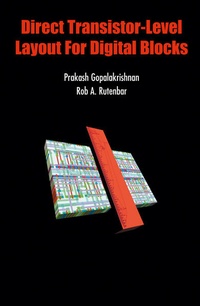
Direct Transistor-Level Layout for Digital Blocks
Published on 17. June 2004
Book
Hardback
IX, 125 pages
978-1-4020-7665-7 (ISBN)
Description
Cell-based design methodologies have dominated layout generation of digital circuits. Unfortunately, the growing demands for transparent process portability, increased performance, and low-level device sizing for timing/power are poorly handled in a fixed cell library.
Direct Transistor-Level Layout For Digital Blocks proposes a direct transistor-level layout approach for small blocks of custom digital logic as an alternative that better accommodates demands for device-level flexibility. This approach captures essential shape-level optimizations, yet scales easily to netlists with thousands of devices, and incorporates timing optimization during layout. The key idea is early identification of essential diffusion-merged MOS device groups, and their preservation in an uncommitted geometric form until the very end of detailed placement. Roughly speaking, essential groups are extracted early from the transistor-level netlist, placed globally, optimized locally, and then finally committed each to a specific shape-level form while concurrently optimizing for both density and routability.
The essential flaw in prior efforts is an over-reliance on geometric assumptions from large-scale cell-based layout algorithms. Individual transistors may seem simple, but they do not pack as gates do. Algorithms that ignore these shape-level issues suffer the consequences when thousands of devices are poorly packed. The approach described in this book can pack devices much more densely than a typical cell-based layout.
Direct Transistor-Level Layout For Digital Blocks is a comprehensive reference work on device-level layout optimization, which will be valuable to CAD tool and circuit designers.
Direct Transistor-Level Layout For Digital Blocks proposes a direct transistor-level layout approach for small blocks of custom digital logic as an alternative that better accommodates demands for device-level flexibility. This approach captures essential shape-level optimizations, yet scales easily to netlists with thousands of devices, and incorporates timing optimization during layout. The key idea is early identification of essential diffusion-merged MOS device groups, and their preservation in an uncommitted geometric form until the very end of detailed placement. Roughly speaking, essential groups are extracted early from the transistor-level netlist, placed globally, optimized locally, and then finally committed each to a specific shape-level form while concurrently optimizing for both density and routability.
The essential flaw in prior efforts is an over-reliance on geometric assumptions from large-scale cell-based layout algorithms. Individual transistors may seem simple, but they do not pack as gates do. Algorithms that ignore these shape-level issues suffer the consequences when thousands of devices are poorly packed. The approach described in this book can pack devices much more densely than a typical cell-based layout.
Direct Transistor-Level Layout For Digital Blocks is a comprehensive reference work on device-level layout optimization, which will be valuable to CAD tool and circuit designers.
More details
Edition
2004 ed.
Language
English
Place of publication
New York
United States
Target group
Professional and scholarly
College/higher education
Research
Illustrations
IX, 125 p.
Dimensions
Height: 241 mm
Width: 160 mm
Thickness: 13 mm
Weight
383 gr
ISBN-13
978-1-4020-7665-7 (9781402076657)
DOI
10.1007/b117054
Schweitzer Classification
Other editions
Additional editions
Prakash Gopalakrishnan | Rob A. Rutenbar
Direct Transistor-Level Layout for Digital Blocks
Book
03/2013
Springer
€106.99
Shipment within 15-20 days
Prakash Gopalakrishnan | Rob A. Rutenbar
Direct Transistor-Level Layout for Digital Blocks
E-Book
01/2006
Springer
€96.29
Available for download
Content
Circuit Structure and Clustering.- Global Placement.- Detailed Placement and Layout Results.- Timing-Driven Placement.- Conclusion.