

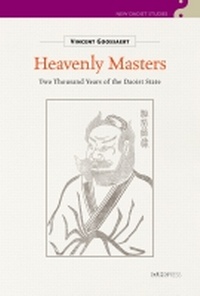
Heavenly Masters
Two Thousand Years of the Daoist State
Published on 30. April 2022
Book
Hardback
432 pages
978-988-237-202-3 (ISBN)
Description
The origins of modern Daoism can be traced to the Church of the Heavenly Master (Tianshidao), reputedly established by the formidable Zhang Daoling. In 142 CE, according to Daoist tradition, Zhang was visited by the Lord on High, who named him his vicar on Earth with the title Heavenly Master. The dispensation articulated an eschatological vision of saving initiates-the pure, those destined to become immortals- by enforcing a strict moral code. Under evolving forms, Tianshidao has remained central to Chinese society, and Daoist priests have upheld their spiritual allegiance to Zhang, their now divinized founder. This book tells the story of the longue duree evolution of the Heavenly Master leadership and institution.
Later hagiography credits Zhang Daoling's great?grandson, putatively the fourth Heavenly Master, with settling the family at Longhushan (Dragon and Tiger Mountain); in time his descendants-down to the present contested sixty?fifth Heavenly Master living in Taiwan- made the extraordinary claim of being able to transmit hereditarily the function of the Heavenly Master and the power to grant salvation. Over the next twelve centuries, the Zhangs turned Longhushan into a major holy site and a household name in the Chinese world, and constructed a large administrative center for the bureaucratic management of Chinese society. They gradually built the Heavenly Master institution, which included a sacred site; a patriarchal line of successive Heavenly Masters wielding vast monopolistic powers to ordain humans and gods; a Zhang lineage that nurtured talent and accumulated wealth; and a bureaucratic apparatus comprised of temples, training centers, and a clerical hierarchy. So well?designed was this institution that it remained stable for more than a millennium, far outlasting the longest dynasties, and had ramifications for every city and village in imperial China.
In this ambitious work, Vincent Goossaert traces the Heavenly Master bureaucracy from medieval times to the modern Chinese nation?state as well as its expansion. His in?depth portraits of influential Heavenly Masters are skillfully embedded in a large?scale analysis of the institution and its rules, ideology, and vision of society.
Later hagiography credits Zhang Daoling's great?grandson, putatively the fourth Heavenly Master, with settling the family at Longhushan (Dragon and Tiger Mountain); in time his descendants-down to the present contested sixty?fifth Heavenly Master living in Taiwan- made the extraordinary claim of being able to transmit hereditarily the function of the Heavenly Master and the power to grant salvation. Over the next twelve centuries, the Zhangs turned Longhushan into a major holy site and a household name in the Chinese world, and constructed a large administrative center for the bureaucratic management of Chinese society. They gradually built the Heavenly Master institution, which included a sacred site; a patriarchal line of successive Heavenly Masters wielding vast monopolistic powers to ordain humans and gods; a Zhang lineage that nurtured talent and accumulated wealth; and a bureaucratic apparatus comprised of temples, training centers, and a clerical hierarchy. So well?designed was this institution that it remained stable for more than a millennium, far outlasting the longest dynasties, and had ramifications for every city and village in imperial China.
In this ambitious work, Vincent Goossaert traces the Heavenly Master bureaucracy from medieval times to the modern Chinese nation?state as well as its expansion. His in?depth portraits of influential Heavenly Masters are skillfully embedded in a large?scale analysis of the institution and its rules, ideology, and vision of society.
Reviews / Votes
Although the Heavenly Masters' claim to represent an unbroken tradition almost as old as the papacy is open to question, the Zhangs of Longhushan certainly are heirs to a family legacy comparable to that of the best noble lineages of Europe, and they have exercised a distinctive religious office for more than a millennium. Fragments of their remarkable story have been told before, but now Vincent Goossaert has pieced together the entire narrative, adding another extraordinary first to his many achievements. He has already done much to illuminate change in the history of Chinese religion; in this volume he spectacularly demonstrates its simultaneous capacity for continuity." -T. H. Barrett, SOAS, University of London"This book is a tour de force, providing the first synthesis in any Western language of the rise of the institution of the Heavenly Master, its many interactions with the Chinese state, its role in the performance of ordination and the distribution of registers, and its economic basis. It makes use of a wide range of primary sources, including manuscripts, gazetteers, notebooks, and archival material. It also carefully includes the best and most recent secondary research in Chinese, Japanese, and Western languages. By reasserting the primacy of the Heavenly Master tradition, this path?breaking work will set a new standard for the study of Daoism in Late Imperial China." -Terry Kleeman, University of Colorado, Boulder
More details
Series
Language
English
Place of publication
Hong Kong
Hong Kong
Target group
Professional and scholarly
Dimensions
Height: 229 mm
Width: 152 mm
Weight
333 gr
ISBN-13
978-988-237-202-3 (9789882372023)
Copyright in bibliographic data and cover images is held by Nielsen Book Services Limited or by the publishers or by their respective licensors: all rights reserved.
Schweitzer Classification
Person
Vincent Goossaert is professor of Daoism and Chinese religions at Ecole Pratique des Hautes Etudes?PSL.
Content
Series Editors' Preface ix
Acknowledgments xi
Abbreviations xiii
Introduction 1
Chapter One Inventing the Founding Ancestor: The Lives of Zhang Daoling 13
Chapter Two The Rise of Longhushan 33
Chapter Three The Heavenly Masters in the History of Daoist Ordinations 53
Chapter Four New Rituals and the Longhushan Synthesis of Modern Daoism 91
Chapter Five The Mature Institution: Longhushan during the Song?Yuan Period 129
Chapter Six The Most Powerful Heavenly Master Ever? The Lives of Zhang Yuchu 157
Chapter Seven The Institution under the Ming and the Qing 185
Chapter Eight The Heavenly Masters and Late Imperial Chinese Society 219
Chapter Nine The Predicaments of Modernity: The Heavenly Masters since the 1850s 265
Conclusion 289
Appendix 1: List of the Heavenly Masters 299
Appendix 2: The Different Versions of the Tiantan yuge 303
Notes 305
Bibliography 375
Index 409
Acknowledgments xi
Abbreviations xiii
Introduction 1
Chapter One Inventing the Founding Ancestor: The Lives of Zhang Daoling 13
Chapter Two The Rise of Longhushan 33
Chapter Three The Heavenly Masters in the History of Daoist Ordinations 53
Chapter Four New Rituals and the Longhushan Synthesis of Modern Daoism 91
Chapter Five The Mature Institution: Longhushan during the Song?Yuan Period 129
Chapter Six The Most Powerful Heavenly Master Ever? The Lives of Zhang Yuchu 157
Chapter Seven The Institution under the Ming and the Qing 185
Chapter Eight The Heavenly Masters and Late Imperial Chinese Society 219
Chapter Nine The Predicaments of Modernity: The Heavenly Masters since the 1850s 265
Conclusion 289
Appendix 1: List of the Heavenly Masters 299
Appendix 2: The Different Versions of the Tiantan yuge 303
Notes 305
Bibliography 375
Index 409