

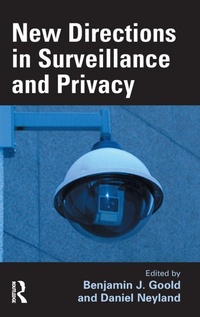
New Directions in Surveillance and Privacy
1st Edition
Published on 1. April 2009
Book
Hardback
240 pages
978-1-84392-363-3 (ISBN)
Description
The field of surveillance studies is growing at a rapid rate, fuelled by a growing interest in the questions that lie at its heart and a deep unease about the future of individual privacy. What information is held about us, to what extent that information is secure, how new technologies ought to be regulated, and how developments in surveillance will affect our ordinary and everyday lives?
Deliberately multi-disciplinary in character, this book examines these questions from the perspective of a broad range of fields, including sociology, management research, law, literary analysis and internet studies. As privacy comes under increasing threat and surveillance activities grow in quantity and diversity, so too the academic field needs to develop in new directions, form new perspectives, and gain new insights. In keeping with this aim, the chapters of this book consider how individuals, organisations, and states are engaged in the compilation, mobilization, scrutiny and use of ever increasing amounts of information.
Divided into three sections focusing in turn on legal regulation, technologies of surveillance, and the future of privacy and surveillance, this collection provides a unique and eclectic insight into the question of how the spread of surveillance is changing our lives and the societies in which we live.
Deliberately multi-disciplinary in character, this book examines these questions from the perspective of a broad range of fields, including sociology, management research, law, literary analysis and internet studies. As privacy comes under increasing threat and surveillance activities grow in quantity and diversity, so too the academic field needs to develop in new directions, form new perspectives, and gain new insights. In keeping with this aim, the chapters of this book consider how individuals, organisations, and states are engaged in the compilation, mobilization, scrutiny and use of ever increasing amounts of information.
Divided into three sections focusing in turn on legal regulation, technologies of surveillance, and the future of privacy and surveillance, this collection provides a unique and eclectic insight into the question of how the spread of surveillance is changing our lives and the societies in which we live.
Reviews / Votes
'[T[he book is a timely intervention. ... The chapters of the book are very contemporary, capturing a picture of issues in surveillance and privacy as they currently stand.The book moves beyond critique and several chapters contain proposald for regulatory or technological measures to counter the diminution of privacy and control over personal information.' - David Barnard-Wills, Cranfield University in Information, Community and Society
More details
Language
English
Place of publication
Cullompton
United Kingdom
Publishing group
Taylor & Francis Ltd
Target group
College/higher education
Dimensions
Height: 240 mm
Width: 161 mm
Thickness: 18 mm
Weight
531 gr
ISBN-13
978-1-84392-363-3 (9781843923633)
Copyright in bibliographic data and cover images is held by Nielsen Book Services Limited or by the publishers or by their respective licensors: all rights reserved.
Schweitzer Classification
Other editions
Additional editions
Benjamin J. Goold | Daniel Neyland
New Directions in Surveillance and Privacy
Book
05/2015
1st Edition
CRC Press
€51.10
Shipment within 10-20 days
Benjamin J. Goold | Daniel Neyland
New Directions in Surveillance and Privacy
E-Book
05/2013
Willan Publishing
€44.99
Available for download
Benjamin J. Goold | Daniel Neyland
New Directions in Surveillance and Privacy
E-Book
05/2013
Willan Publishing
€44.99
Available for download
Persons
Benjamin Goold is an Associate Professor at the University of British Columbia Faculty of Law, and a Research Associate at the Oxford University Centre for Criminology. His major research interests are in the use of surveillance technology by the police and the relationship between individual privacy rights and the criminal law.
Daniel Neyland is a Senior Lecturer in the Department of Organisation, Work and Technology at Lancaster University. His research interests incorporate issues of privacy, surveillance, trust, identity, governance and accountability.
Daniel Neyland is a Senior Lecturer in the Department of Organisation, Work and Technology at Lancaster University. His research interests incorporate issues of privacy, surveillance, trust, identity, governance and accountability.
Content
Introduction: Where next for surveillance studies? Exploring new directions in privacy and surveillance Part One: Regulation 1. The limits of privacy protection 2. Building it in: the role of privacy enhancing technologies (PETs) in the regulation of surveillance and data collection 3. Regulation of converged communications surveillance 4. From targeted to mass surveillance: is the EU Data Retention Directive a necessary measure or an unjustified threat to privacy? Part Two: Technologies and Techniques of Surveillance 5. Surveillance, accountability and organisational failure: the story of Jean Charles de Menezes 6. Perceptions of government technology, surveillance and privacy: the UK Identity Cards Scheme Part Three: Surveillance Futures 7. 'Ten Thousand Times Larger...': anticipating the expansion of surveillance 8. Since 'Nineteen Eighty Four': representations of surveillance in literary fiction