

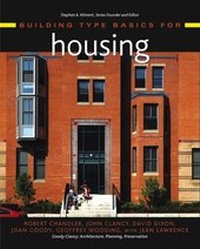
Building Type Basics for Housing
1st Edition
Published on 29. November 2004
Book
Hardback
224 pages
978-0-471-31930-6 (ISBN)
Description
The fastest wayto straighten out the learning curve on specialized design projects
"The series is welcome. By providing recent buildings as examples, supported with technical information and charts of design criteria, these books attempt to bridge the gap between theory and practice."
-Oculus
Building Type Basics books provide architects, planners, and developers with the essentials they need to jump-start the design of a variety of specialized building types. In each volume, leading national figures in the field address the key questions that shape the early phases of a project commission. The answers to these questions provide instant information in a convenient, easy-to-follow format. The result is an excellent, hands-on reference that puts critical information at professionals' fingertips.
Building Type Basics for Housing is a nuts-and-bolts guide to all the design considerations for a variety of housing-from planning and site layout to building design. Complete with descriptive illustrations, this useful resource offers essential information, guidelines, and planning concepts for building projects for single-family detached units; townhouses; multi-family; mid-rise and high-rise buildings; and housing in mixed-use buildings.
"The series is welcome. By providing recent buildings as examples, supported with technical information and charts of design criteria, these books attempt to bridge the gap between theory and practice."
-Oculus
Building Type Basics books provide architects, planners, and developers with the essentials they need to jump-start the design of a variety of specialized building types. In each volume, leading national figures in the field address the key questions that shape the early phases of a project commission. The answers to these questions provide instant information in a convenient, easy-to-follow format. The result is an excellent, hands-on reference that puts critical information at professionals' fingertips.
Building Type Basics for Housing is a nuts-and-bolts guide to all the design considerations for a variety of housing-from planning and site layout to building design. Complete with descriptive illustrations, this useful resource offers essential information, guidelines, and planning concepts for building projects for single-family detached units; townhouses; multi-family; mid-rise and high-rise buildings; and housing in mixed-use buildings.
More details
Series
Edition
1., Auflage
Language
English
Place of publication
New York
United States
Publishing group
John Wiley and Sons Ltd
Target group
Professional and scholarly
Edition type
New edition
Illustrations
Illustrations (some col.), plans
Dimensions
Height: 24.1 cm
Width: 19.7 cm
Weight
676 gr
ISBN-13
978-0-471-31930-6 (9780471319306)
Schweitzer Classification
Other editions
New editions
Joan Goody | Robert Chandler | John Clancy
Building Type Basics for Housing
Book
03/2010
2nd Edition
Wiley
Unfortunately, price unknown
Article is exhausted; no reprint
Persons
ROBERT CHANDLER, AIA, DAVID DIXON, FAIA, JOAN GOODY, FAIA, and GEOFFREY WOODING, AIA, are all principals of Goody Clancy. The late JOHN CLANCY, FAIA, was also a firm principal.
JEAN LAWRENCE, AIA, is a former associate of the firm and a frequent consultant.
STEPHEN A. KLIMENT, FAIA (Series Founder and Editor), is an architectural journalist and Adjunct Professor of Architecture at the City College of New York. He was chief editor of Architectural Record from 1990 to 1996.
JEAN LAWRENCE, AIA, is a former associate of the firm and a frequent consultant.
STEPHEN A. KLIMENT, FAIA (Series Founder and Editor), is an architectural journalist and Adjunct Professor of Architecture at the City College of New York. He was chief editor of Architectural Record from 1990 to 1996.
Content
Preface by Stephen A. Kliment.
Acknowledgments.
Introduction.
Chapter 1. Housing and Community.
Chapter 2. The Detached House.
Chapter 3. The Row House and Other Low-Rise Housing.
Chapter 4. The Mid-Rise.
Chapter 5. The High-Rise.
Chapter 6. Adaptive Reuse.
Chapter 7. Systems.
Chapter 8. Financing and Feasibility Issues.
Acknowledgments.
Introduction.
Chapter 1. Housing and Community.
Chapter 2. The Detached House.
Chapter 3. The Row House and Other Low-Rise Housing.
Chapter 4. The Mid-Rise.
Chapter 5. The High-Rise.
Chapter 6. Adaptive Reuse.
Chapter 7. Systems.
Chapter 8. Financing and Feasibility Issues.