

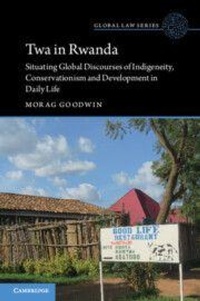
Twa in Rwanda
Situating Global Discourses of Indigeneity, Conservationism and Development in Daily Life
Will be published approx. on 31. July 2026
Book
Paperback/Softback
234 pages
978-1-009-76853-5 (ISBN)
Description
This book is a contribution to the growing field of global legal ethnography. Through engagement with the global discourses of indigeneity, conservation and development, this empirical study shows how power and legal normativity are enacted and experienced in the everyday life of the Batwa in Rwanda. By exploring how Twa negotiate their position within society, the regulatory power of these global jurisdictional encounters to construct (subjects, communities, normative frameworks), to reframe and to discipline comes into sharper focus. Focusing on agency instead of resistance, on a desire for inclusion rather than difference, this book provides a critical contribution to the scholarship on counter-hegemonic narratives of globalisation. Rwandan Twa are positioning themselves within national and global narratives to demand progress and belonging - not as part of a political movement based on their ethnic distinctness or indigeneity but as Rwandans.
More details
Series
Language
English
Place of publication
Cambridge
United Kingdom
Target group
College/higher education
Professional and scholarly
Product notice
Paperback (trade)
Illustrations
Worked examples or Exercises
Weight
25 gr
ISBN-13
978-1-009-76853-5 (9781009768535)
Copyright in bibliographic data and cover images is held by Nielsen Book Services Limited or by the publishers or by their respective licensors: all rights reserved.
Schweitzer Classification
Other editions
Additional editions
Morag Goodwin
Twa in Rwanda
Situating Global Discourses of Indigeneity, Conservationism and Development in Daily Life
Book
approx. 07/2026
Cambridge University Press
€129.50
Not yet published
Person
Morag Goodwin is a professor at Tilburg University, the Netherlands, and holds the chair in Global Law and Development. She was PI of a Dutch Research Council (NWO)-funded project researching barriers to inclusion in Rwanda.
Content
1. Setting the scene; 2. Tales of Rwanda's Twa: indigenous, (self-)marginalised and poor; 3. A different kind of dirt; 4. Progress, mind-set and agaciro: the Twa as development subjects; 5. Becoming Rwandan; 6. Acted upon, acting on; Glossary; Bibliography; Index.