

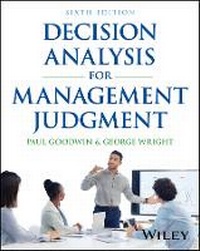
Decision Analysis for Management Judgment
6th Edition
Published on 19. March 2026
Book
Paperback/Softback
496 pages
978-1-394-36255-4 (ISBN)
Description
APPLYING DECISION ANALYSIS FOR EFFECTIVE MANAGEMENT JUDGMENT ACROSS DIVERSE FIELDS
Sound decision-making is essential for success in today's complex organizational environments. Now in its sixth edition, Decision Analysis for Management Judgment provides students and professionals with the tools and insights needed to make informed, rational choices in the face of uncertainty.
Written for managers and students without advanced mathematical training, this leading textbook clearly explains a wide range of decision analysis techniques while addressing the psychological biases and pitfalls that often undermine judgment. Throughout the text, authors Paul Goodwin and George Wright combine behavioral insights with practical analytical tools, bridging the gap between foundational theory and real-world practice.
Presenting complex concepts in a clear, accessible style suitable for both students and professionals, Decision Analysis for Management Judgment is an invaluable resource for anyone tasked with evaluating alternatives, anticipating future scenarios, and balancing multiple objectives in professional contexts. It is ideal for upper-level undergraduate, MBA, and executive education courses in decision analysis, management judgment, strategic planning, and environmental planning.
NEW TO THIS EDITION:
Introduces the role of artificial intelligence in decision-making, highlighting benefits, limitations, and future potential
Provides a step-by-step guide to applying the Intuitive Logics method of scenario planning
Demonstrates a streamlined approach for integrating scenario planning with multi-attribute decision analysis
New practical examples illustrating successful applications of decision analysis and scenario planning
Includes the latest psychological research on multi-attribute decision-making and behavioral "nudges"
Incorporates the SPIES method for estimating probability distributions and expands coverage of the Delphi method with recommendations for robust implementation
Adds Cooke's Classical Method for aggregating expert probability judgments and discusses the success of superforecasters
WILEY ADVANTAGE:
Provides a reader-friendly introduction to decision analysis without requiring advanced mathematical knowledge
Integrates behavioral insights to address psychological biases that can undermine managerial judgment
Covers a wide range of qualitative and quantitative decision analysis techniques applicable to real-world problems
Applies concepts to diverse contexts, including business, public administration, and environmental planning
Encourages active learning through end-of-chapter exercises that reinforce understanding and critical thinking
Supports flexible teaching approaches with a companion website containing additional exercises, case studies, quizzes, and simulations
Sound decision-making is essential for success in today's complex organizational environments. Now in its sixth edition, Decision Analysis for Management Judgment provides students and professionals with the tools and insights needed to make informed, rational choices in the face of uncertainty.
Written for managers and students without advanced mathematical training, this leading textbook clearly explains a wide range of decision analysis techniques while addressing the psychological biases and pitfalls that often undermine judgment. Throughout the text, authors Paul Goodwin and George Wright combine behavioral insights with practical analytical tools, bridging the gap between foundational theory and real-world practice.
Presenting complex concepts in a clear, accessible style suitable for both students and professionals, Decision Analysis for Management Judgment is an invaluable resource for anyone tasked with evaluating alternatives, anticipating future scenarios, and balancing multiple objectives in professional contexts. It is ideal for upper-level undergraduate, MBA, and executive education courses in decision analysis, management judgment, strategic planning, and environmental planning.
NEW TO THIS EDITION:
Introduces the role of artificial intelligence in decision-making, highlighting benefits, limitations, and future potential
Provides a step-by-step guide to applying the Intuitive Logics method of scenario planning
Demonstrates a streamlined approach for integrating scenario planning with multi-attribute decision analysis
New practical examples illustrating successful applications of decision analysis and scenario planning
Includes the latest psychological research on multi-attribute decision-making and behavioral "nudges"
Incorporates the SPIES method for estimating probability distributions and expands coverage of the Delphi method with recommendations for robust implementation
Adds Cooke's Classical Method for aggregating expert probability judgments and discusses the success of superforecasters
WILEY ADVANTAGE:
Provides a reader-friendly introduction to decision analysis without requiring advanced mathematical knowledge
Integrates behavioral insights to address psychological biases that can undermine managerial judgment
Covers a wide range of qualitative and quantitative decision analysis techniques applicable to real-world problems
Applies concepts to diverse contexts, including business, public administration, and environmental planning
Encourages active learning through end-of-chapter exercises that reinforce understanding and critical thinking
Supports flexible teaching approaches with a companion website containing additional exercises, case studies, quizzes, and simulations
More details
Edition
6th edition
Language
English
Place of publication
New York
United States
Target group
College/higher education
Dimensions
Height: 231 mm
Width: 185 mm
Thickness: 31 mm
Weight
680 gr
ISBN-13
978-1-394-36255-4 (9781394362554)
Copyright in bibliographic data and cover images is held by Nielsen Book Services Limited or by the publishers or by their respective licensors: all rights reserved.
Schweitzer Classification
Other editions
Previous edition
Paul Goodwin | George Wright
Decision Analysis for Management Judgment
Book
04/2014
Wiley
€63.50
Shipment within 15-20 days
Persons
PAUL GOODWIN is Emeritus Professor at the University of Bath, UK. His research focuses on the role of judgment in forecasting and decision-making. A Fellow of the International Institute of Forecasters, he has consulted for numerous organizations and served as editor of the International Journal of Forecasting and the "Hot New Research" column in Foresight: The International Journal of Applied Forecasting for twenty years.
GEORGE WRIGHT is Professor at the University of Strathclyde, UK, and Director of Scenario Associates Ltd. His research examines the role and quality of judgment in anticipating the future. He is editor of both the Journal of Behavioral Decision Making and Futures & Foresight Science. He has delivered workshops and consultancy in scenario planning for organizations worldwide.
GEORGE WRIGHT is Professor at the University of Strathclyde, UK, and Director of Scenario Associates Ltd. His research examines the role and quality of judgment in anticipating the future. He is editor of both the Journal of Behavioral Decision Making and Futures & Foresight Science. He has delivered workshops and consultancy in scenario planning for organizations worldwide.
Content
Foreword to First Edition ix
Preface xi
Chapter 1 Introduction 1
Chapter 2 How people make decisions involving multiple objectives 15
Chapter 3 Decisions involving multiple objectives: SMART 37
Chapter 4 Decisions involving multiple objectives: alternatives to SMART 71
Chapter 5 Introduction to probability 101
Chapter 6 Decision-making under risk 123
Chapter 7 Decision trees and influence diagrams 165
Chapter 8 Applying simulation to decision problems 193
Chapter 9 Revising judgments in light of new information 227
Chapter 10 Heuristics and biases in probability assessment 251
Chapter 11 Methods for eliciting probabilities 281
Chapter 12 Structured risk management 303
Chapter 13 Decisions involving groups of individuals 315
Chapter 14 Resource allocation and negotiation problems 347
Chapter 15 Decision framing and cognitive inertia 369
Chapter 16 Scenario planning: a way of dealing with uncertainty 395
Chapter 17 Combining scenario planning with decision analysis 431
Chapter 18 Alternative decision-support systems and the role of AI 445
Suggested answers to selected questions 469
Index 475
Preface xi
Chapter 1 Introduction 1
Chapter 2 How people make decisions involving multiple objectives 15
Chapter 3 Decisions involving multiple objectives: SMART 37
Chapter 4 Decisions involving multiple objectives: alternatives to SMART 71
Chapter 5 Introduction to probability 101
Chapter 6 Decision-making under risk 123
Chapter 7 Decision trees and influence diagrams 165
Chapter 8 Applying simulation to decision problems 193
Chapter 9 Revising judgments in light of new information 227
Chapter 10 Heuristics and biases in probability assessment 251
Chapter 11 Methods for eliciting probabilities 281
Chapter 12 Structured risk management 303
Chapter 13 Decisions involving groups of individuals 315
Chapter 14 Resource allocation and negotiation problems 347
Chapter 15 Decision framing and cognitive inertia 369
Chapter 16 Scenario planning: a way of dealing with uncertainty 395
Chapter 17 Combining scenario planning with decision analysis 431
Chapter 18 Alternative decision-support systems and the role of AI 445
Suggested answers to selected questions 469
Index 475