

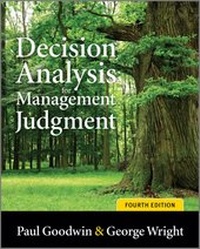
Decision Analysis for Management Judgment
4th Edition
Published on 11. September 2009
Book
Paperback/Softback
468 pages
978-0-470-71439-3 (ISBN)
Description
In an increasingly complex world, decision analysis has a major role to play in helping decision-makers to gain insights into the problems they face. Decision Analysis for Management Judgment is unique in its breadth of coverage of decision analysis methods. It covers both the psychological problems that are associated with unaided managerial decision making and the decision analysis methods designed to overcome them. It is presented and explained in a clear, straightforward manner without using mathematical notation.
The fourth edition has been fully revised and updated and includes a number of changes to reflect the latest developments in the field.
The fourth edition has been fully revised and updated and includes a number of changes to reflect the latest developments in the field.
More details
Edition
4. Auflage
Language
English
Place of publication
Chichester
United Kingdom
Publishing group
John Wiley and Sons Ltd
Target group
Professional and scholarly
Edition type
Revised edition
Illustrations
Illustrations
Dimensions
Height: 23.4 cm
Width: 19.2 cm
Thickness: 2.5 cm
Weight
828 gr
ISBN-13
978-0-470-71439-3 (9780470714393)
Schweitzer Classification
Other editions
New editions
Paul Goodwin | George Wright
Decision Analysis for Management Judgment
Book
04/2014
Wiley
€63.50
Shipment within 15-20 days
Previous edition
Paul Goodwin | George Wright
Decision Analysis for Management Judgment
Book
12/2003
3rd Edition
Wiley
€44.90
Article exhausted; check for reprint
Persons
Paul Goodwin is Professor of Management Science at the School of Management, University of Bath. His research interests focus on the role of management judgment in forecasting and decision-making and he has published in key journals in the field. He is an Associate Editor of the International Journal of Forecasting and a member of the editorial board of the Journal of Behavioural Decision Making.
George Wright is Professor of Management at the Business School, Durham University. He is the founding Editor of the Journal of Behavioral Decision Making and an Associate Editor of two forecasting journals: International Journal of Forecasting and the Journal of Forecasting. He is also an Associate Editor of Decision Support Systems and a member of the editorial board of Journal of Multi-Criteria Decision Analysis.
George Wright is Professor of Management at the Business School, Durham University. He is the founding Editor of the Journal of Behavioral Decision Making and an Associate Editor of two forecasting journals: International Journal of Forecasting and the Journal of Forecasting. He is also an Associate Editor of Decision Support Systems and a member of the editorial board of Journal of Multi-Criteria Decision Analysis.
Content
Foreword by Lawrence D. Phillips
Preface
Chapter 1 Introduction
Chapter 2 How people make decisions involving multiple objectives
Chapter 3 Decisions involving multiple objectives: SMART
Chapter 4 Decisions involving multiple objectives: Alternatives to SMART
Chapter 5 Introduction to probability
Chapter 6 Decision making under uncertainty
Chapter 7 Decision trees and influence diagrams
Chapter 8 Applying simulation to decision problems
Chapter 9 Revising judgments in the light of new information
Chapter 10 Heuristics and biases in probability assessment
Chapter 11 Methods for eliciting probabilities
Chapter 12 Risk and uncertainty management
Chapter 13 Decisions involving groups of individuals
Chapter 14 Resource allocation and negotiation problems
Chapter 15 Decision framing and cognitive inertia
Chapter 16 Scenario planning: an alternative way of dealing with uncertainty
Chapter 17 Alternative decision-support systems and conclusions
Suggested answers to selected questions
Index
Preface
Chapter 1 Introduction
Chapter 2 How people make decisions involving multiple objectives
Chapter 3 Decisions involving multiple objectives: SMART
Chapter 4 Decisions involving multiple objectives: Alternatives to SMART
Chapter 5 Introduction to probability
Chapter 6 Decision making under uncertainty
Chapter 7 Decision trees and influence diagrams
Chapter 8 Applying simulation to decision problems
Chapter 9 Revising judgments in the light of new information
Chapter 10 Heuristics and biases in probability assessment
Chapter 11 Methods for eliciting probabilities
Chapter 12 Risk and uncertainty management
Chapter 13 Decisions involving groups of individuals
Chapter 14 Resource allocation and negotiation problems
Chapter 15 Decision framing and cognitive inertia
Chapter 16 Scenario planning: an alternative way of dealing with uncertainty
Chapter 17 Alternative decision-support systems and conclusions
Suggested answers to selected questions
Index