

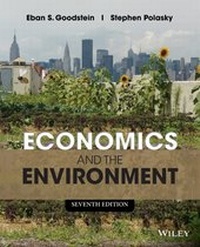
Economics and the Environment
7th Edition
Published on 4. April 2014
Book
Paperback/Softback
544 pages
978-1-118-53972-9 (ISBN)
Unfortunately, price unknown
Article is exhausted; no reprint
Description
Climate change and other critical environmental challenges are reshaping economic policy and practice. In the 7th edition of Economics and the Environment, Dr. Eban Goodstein and new co-author, Dr. Stephen Polasky, provide students with a clear, concise, and comprehensive presentation of environmental and resource economics.
The text also offers a compelling look at broader topics including the ethical foundations of environmental economics, the promotion of ''clean technology", and the challenges of sustainable development. With a unique framework and compelling narrative style, Goodstein & Polasky provide a timely synthesis of the economic tools available for understanding and solving environmental problems that are crucial for today's students to consider for tomorrow's world.
The text also offers a compelling look at broader topics including the ethical foundations of environmental economics, the promotion of ''clean technology", and the challenges of sustainable development. With a unique framework and compelling narrative style, Goodstein & Polasky provide a timely synthesis of the economic tools available for understanding and solving environmental problems that are crucial for today's students to consider for tomorrow's world.
More details
Other editions
Previous edition

Eban S. Goodstein
Economics and the Environment
Book
10/2010
6th Edition
Wiley
€239.32
Article exhausted; check for reprint
Persons
Eban Goodstein is Director of the Bard Center for Environmental Policy and Director at The National Teach-In. He received his B.A. from Williams College and Ph.D. from University of Michigan. Prior to Directing the Bard Center for Environmental Policy, Goodstein had a 20-year career as a Professor of Economics at Lewis & Clark and Skidmore Colleges. Goodstein also led the National teach-In on Global Warming Solutions, coordinating educational events at over 2500 colleges, universities, high schools and other institutions across the country. He is the author of a college textbook, Economics and the Environment, (John Wiley and Sons: 2010) now in its sixth edition; Fighting for Love in the Century of Extinction: How Passion and Politics Can Stop Global Warming (University Press of New England: 2007); and The Trade-off Myth: Fact and Fiction about Jobs and the Environment (Island Press: 1999). Articles by Goodstein have appeared in among other outlets, The Journal of Environmental Economics and Management, Land Economics, Ecological Economics, and Environmental Management. His research has been featured in The New York Times, Scientific American, Time, Chemical and Engineering News, The Economist, USA Today, and The Chronicle of Higher Education. He serves on the editorial board of Sustainability: The Journal of Record, and Environment, Workplace and Employment, is on the Steering Committee of Economics for Equity & the Environment, and is a Member Scholar at the Center for Progressive Reform.
Content
Preface
Chapter 1: Four Economic Questions about Global Warming
Chapter 2: Ethics and Economics
Chapter 3: Pollution and Resource Degradation as Externalities
Chapter 4: The Efficiency Standard
Chapter 5: Measuring the Benefits of Environmental Protection
Chapter 6: Measuring the Costs of Environmental Protection
Chapter 7: The Safety Standard
Chapter 8: The Sustainability Standard
Chapter 9: Measuring Sustainability
Chapter 10: Natural Resources and Ecosystem Services
Chapter 11: Is More Really Better? Consumption and Welfare
Chapter 12: The Political Economy of Environmental Regulation
Chapter 13: An Overview of Environmental Legislation
Chapter 14: The Regulatory Record: Achievements and Obstacles
Chapter 15: Incentive-Based Regulation: Theory
Chapter 16: Incentive Based Regulation: Practice
Chapter 17: Promoting Clean Technology: Theory
Chapter 18: Energy and the Future
Chapter 19: Poverty, Population, and the Environment
Chapter 20: Environmental Policy in Poor Countries
Chapter 21: The Economics of Global Agreements
Chapter 1: Four Economic Questions about Global Warming
Chapter 2: Ethics and Economics
Chapter 3: Pollution and Resource Degradation as Externalities
Chapter 4: The Efficiency Standard
Chapter 5: Measuring the Benefits of Environmental Protection
Chapter 6: Measuring the Costs of Environmental Protection
Chapter 7: The Safety Standard
Chapter 8: The Sustainability Standard
Chapter 9: Measuring Sustainability
Chapter 10: Natural Resources and Ecosystem Services
Chapter 11: Is More Really Better? Consumption and Welfare
Chapter 12: The Political Economy of Environmental Regulation
Chapter 13: An Overview of Environmental Legislation
Chapter 14: The Regulatory Record: Achievements and Obstacles
Chapter 15: Incentive-Based Regulation: Theory
Chapter 16: Incentive Based Regulation: Practice
Chapter 17: Promoting Clean Technology: Theory
Chapter 18: Energy and the Future
Chapter 19: Poverty, Population, and the Environment
Chapter 20: Environmental Policy in Poor Countries
Chapter 21: The Economics of Global Agreements